
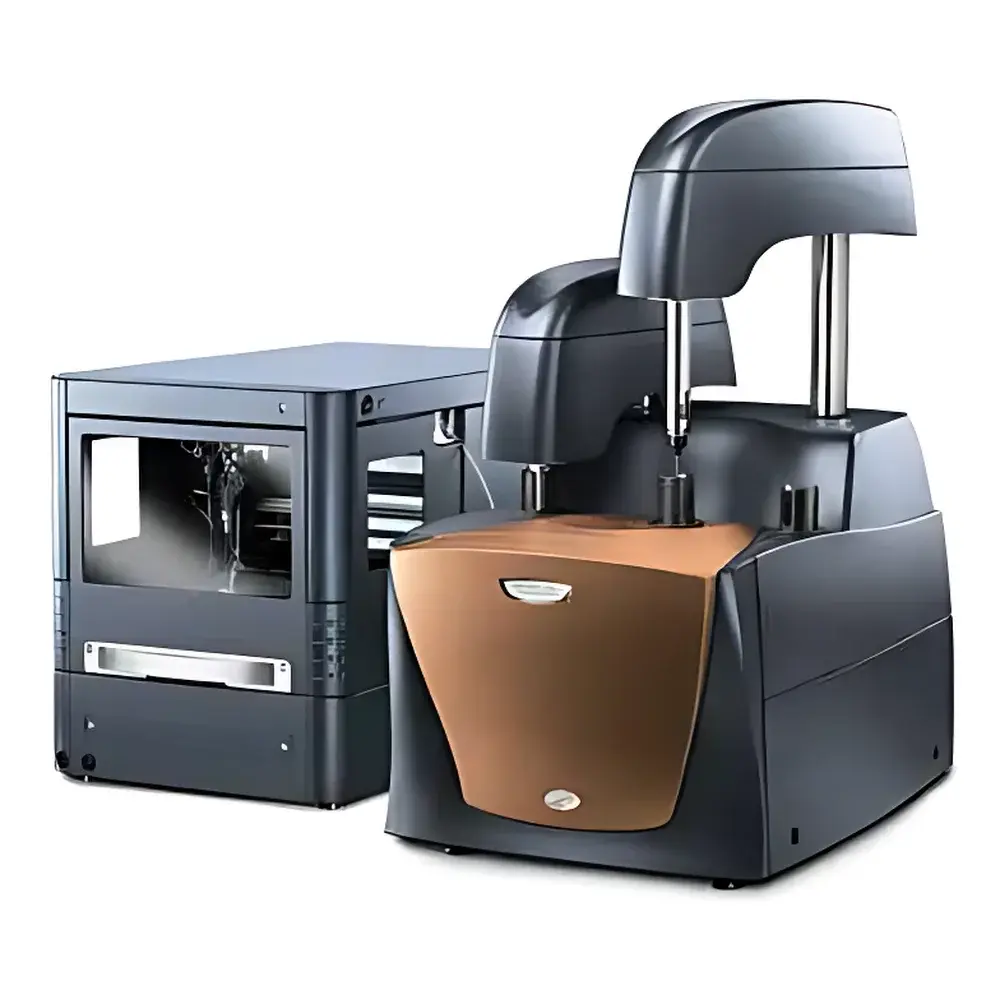
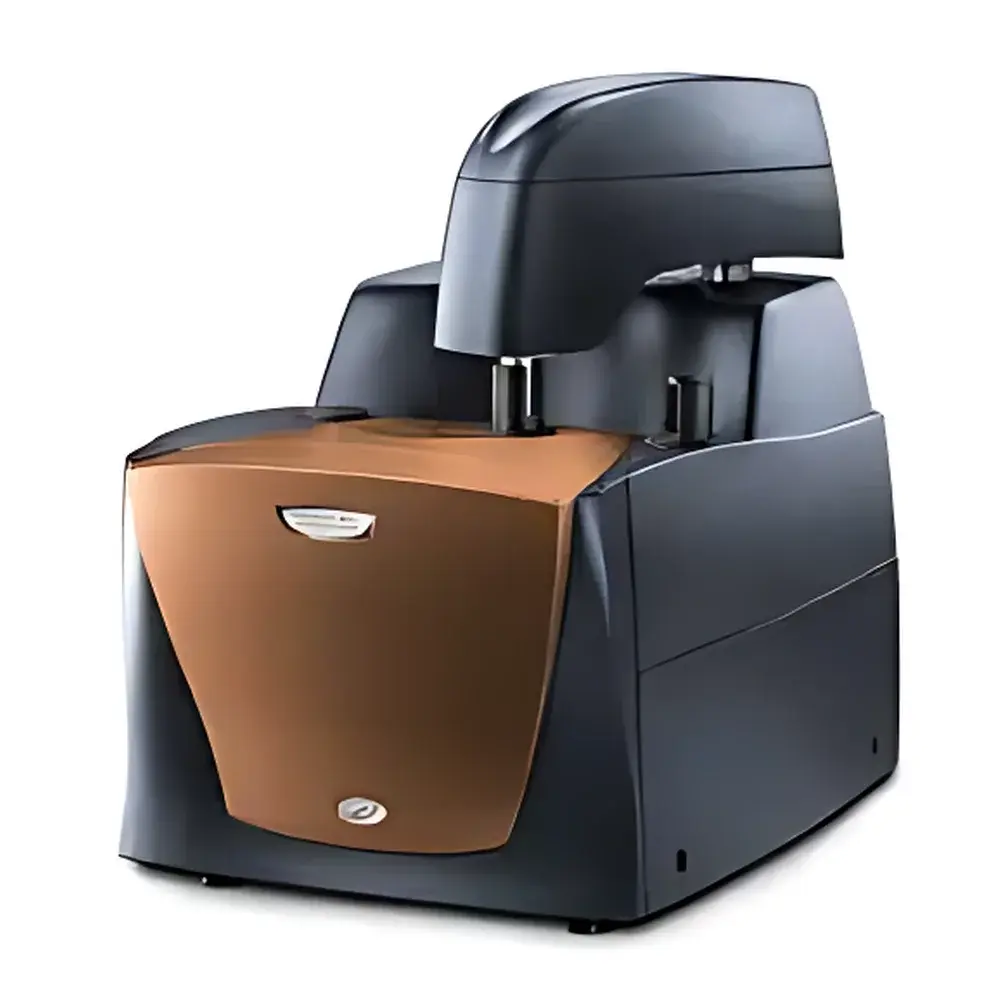
TA Instruments Affinity ITC Isothermal Titration Calorimeter
| Brand | TA Instruments |
|---|---|
| Origin | USA |
| Model | Affinity ITC / ITC Auto |
| Temperature Range | 2–80 °C |
| Cell Volume Options | 1.0 mL (standard) or 190 µL (low-volume) |
| Sample Throughput | Multi-sample via integrated 96-well autosampler |
| Temperature Control | Active solid-state heating/cooling with ±0.01 °C stability |
| Automation Level | Fully automated titration, injection, cleaning, and cell positioning |
| Compliance | Designed for GLP/GMP environments |
Overview
The TA Instruments Affinity ITC is a high-precision isothermal titration calorimeter engineered for quantitative thermodynamic characterization of biomolecular interactions in solution. Operating on the principle of direct heat measurement during controlled ligand titration into a macromolecule-containing sample cell, the Affinity ITC delivers label-free, solution-phase binding data—including binding affinity (Ka), enthalpy change (ΔH), stoichiometry (n), and entropy (ΔS)—without assumptions about molecular size or conformation. Its core architecture integrates microcalorimetric detection with active solid-state thermal control, enabling stable baseline performance across the full 2–80 °C operating range. Unlike conventional DSC systems, the Affinity ITC is not a differential scanning calorimeter; it is a dedicated ITC platform optimized for low-heat-capacity, high-sensitivity interaction studies—particularly where weak affinities (µM to mM Kd), small enthalpic signals (<1 kcal/mol), or limited sample availability present analytical challenges.
Key Features
- AccuShot Injection System: Precision-engineered syringe drive and needle positioning ensure reproducible delivery of titrant directly into the center of the sample cell, minimizing injection artifacts and improving signal-to-noise ratio.
- FlexSpin Mixing Technology: Patented low-speed magnetic stirring enables efficient homogenization at sub-300 rpm rotation speeds—reducing shear-induced denaturation while maintaining thermal equilibrium and enhancing sensitivity for fragile proteins and nucleic acids.
- Active Solid-State Thermal Control: Dual-mode Peltier elements provide rapid, drift-free temperature regulation with ±0.01 °C stability—critical for long-duration experiments and comparative thermodynamic profiling across temperature gradients.
- Modular Cell Options: Interchangeable 1.0 mL and 190 µL calorimetric cells support both high-sensitivity screening (low-volume mode) and traditional macro-scale assays—enabling optimal signal scaling based on sample concentration and heat capacity.
- Integrated 96-Well Autosampler: Industry-standard liquid handler compatible with SBS-format plates; supports unattended multi-experiment workflows, cross-contamination mitigation via programmable wash cycles, and traceable sample tracking.
- Smart Cell Positioning & Automated Cleaning: Motorized cell carriage ensures repeatable alignment; user-defined cleaning protocols—including solvent flushes and air-drying steps—are executed between runs to maintain integrity across sequential experiments.
Sample Compatibility & Compliance
The Affinity ITC accommodates a broad spectrum of biologically relevant analytes: proteins (including membrane-associated and intrinsically disordered variants), peptides, oligonucleotides, carbohydrates, small-molecule inhibitors, and synthetic ligands. It operates under ambient atmospheric pressure and requires no specialized consumables beyond standard syringes and cells. All hardware and firmware are designed to meet ISO/IEC 17025 calibration traceability requirements. When deployed with NanoAnalyze software in validated configurations, the system supports audit trail generation, electronic signatures, and role-based access control—aligning with FDA 21 CFR Part 11, EU Annex 11, and GLP/GMP documentation standards for regulated laboratories.
Software & Data Management
ITCRun serves as the instrument control interface, offering real-time monitoring, method scripting, and adaptive titration scheduling. NanoAnalyze provides comprehensive post-acquisition analysis: global fitting across multiple datasets, statistical error propagation, thermodynamic parameter comparison, and publication-ready visualization. Batch processing capabilities enable consistent reanalysis of legacy datasets using updated models or constraints. Export formats include CSV, Excel, PDF, and SVG—ensuring compatibility with institutional LIMS and third-party modeling tools such as PyTC or SEDPHAT. Data integrity is reinforced through embedded metadata logging (e.g., cell history, injection volume corrections, thermal baseline residuals).
Applications
- Quantitative determination of protein–ligand, protein–protein, and nucleic acid–small molecule binding thermodynamics
- Enthalpy–entropy compensation analysis in drug lead optimization
- Validation of structural predictions from X-ray crystallography or cryo-EM
- Characterization of allosteric modulation and cooperative binding mechanisms
- Thermodynamic profiling of antibody–antigen interactions under varying pH or ionic strength conditions
- Supporting regulatory submissions requiring orthogonal, label-free binding data per ICH M3(R2) and FDA guidance on biophysical characterization
FAQ
Is the Affinity ITC compatible with viscous or aggregated samples?
Yes—its low-shear FlexSpin mixing and robust thermal feedback loop accommodate samples with viscosities up to 10 cP and moderate turbidity, though clarification by centrifugation or filtration is recommended prior to loading.
Can binding constants be determined for very tight interactions (Kd < 1 nM)?
Tight-binding analysis is supported via the “tight binding” model in NanoAnalyze, provided stoichiometry is known and excess ligand depletion is accounted for during curve fitting.
Does the system require external chillers or compressors?
No—the integrated solid-state thermal module eliminates reliance on external cooling units, reducing footprint and operational complexity.
How is carryover addressed between high-concentration runs?
The autosampler’s configurable multi-step cleaning protocol—including sequential washes with water, buffer, and organic solvents—achieves <0.01% carryover, verified by blank titrations.
Is remote operation supported?
Yes—ITCRun and NanoAnalyze support secure remote desktop access and scheduled unattended operation via Windows Remote Desktop or institutional VPN infrastructure.



