
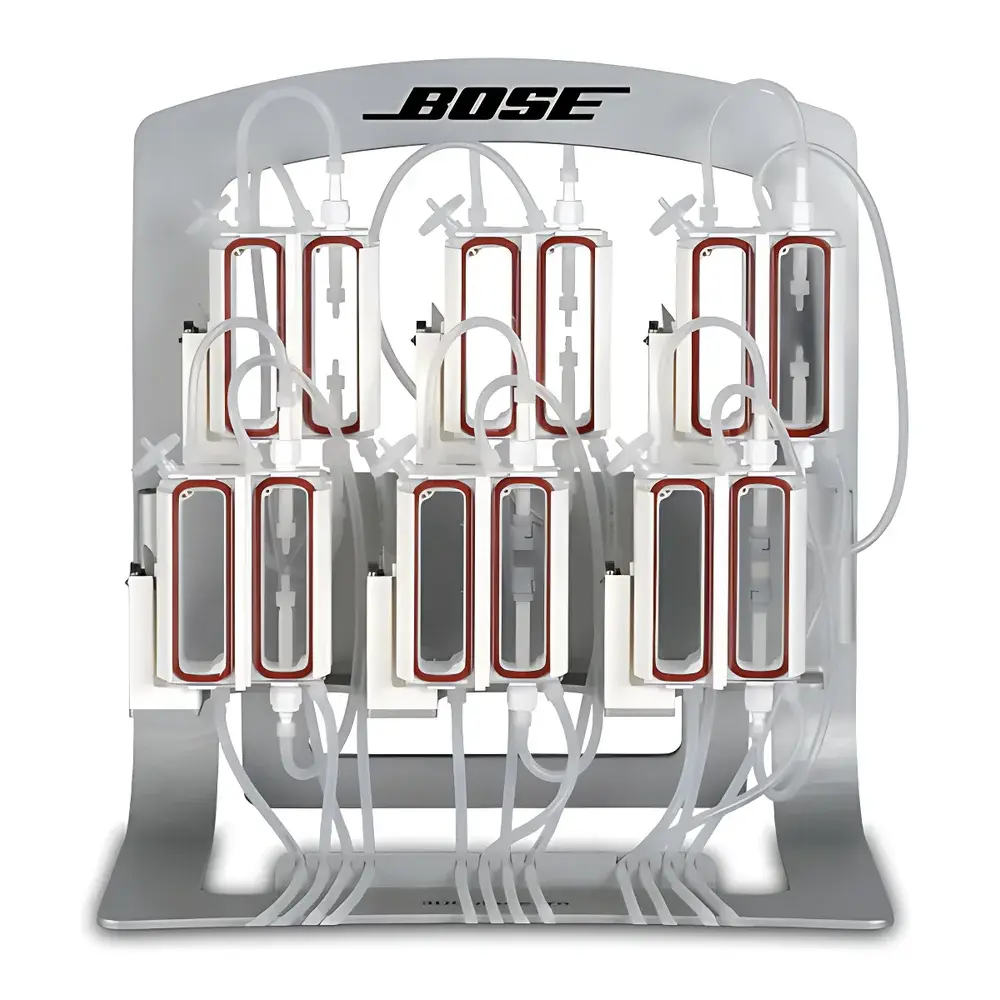
TA Instruments ElectroForce Multi-Sample Fatigue Testing System
| Brand | TA Instruments |
|---|---|
| Origin | USA |
| Manufacturer Type | Authorized Distributor |
| Origin Category | Imported |
| Model | ElectroForce |
| Instrument Type | Dynamic Mechanical Analyzer (DMA/DMTA) |
| Temperature Control | Physiological Saline Bath |
| Loading Mode | Displacement-Controlled Tension-Tension or Compression-Compression |
| Sample Capacity | Multiple Independent Test Stations |
| Cycle Resolution | High-Resolution Linear Encoder-Based Displacement Measurement |
| Compliance | Designed for ISO 14242-1, ASTM F2129, and FDA Guidance for Cardiovascular Implant Fatigue Testing |
Overview
The TA Instruments ElectroForce Multi-Sample Fatigue Testing System is an electromechanical test platform engineered for high-fidelity, displacement-controlled cyclic mechanical evaluation of small-scale soft-tissue implants and minimally invasive medical devices. Unlike conventional single-station servo-hydraulic or electromagnetic fatigue testers, this system employs a precision linear motor architecture coupled with independent, synchronized actuation channels to simultaneously subject multiple specimens to physiologically relevant tension–tension or compression–compression waveforms. Its core measurement principle relies on closed-loop displacement control validated by sub-micrometer-resolution linear encoders, ensuring traceable, repeatable strain application without reliance on load cell feedback alone. The system operates within a temperature-regulated physiological saline bath environment—maintained at 37 °C ± 0.5 °C—to replicate in vivo fluidic and thermal conditions critical for assessing time-dependent viscoelastic degradation, crack initiation, and structural integrity loss in polymer-based stents, nitinol filters, PTFE patches, and other cardiovascular or orthopedic implant architectures.
Key Features
- Multi-sample parallel testing capability: Up to eight independent test stations mounted on a rigid granite base, each with dedicated linear motor actuator, high-resolution encoder (≤0.1 µm resolution), and integrated force transducer (optional calibration traceable to NIST standards).
- Physiological saline immersion bath: Stainless-steel chamber with PID-controlled heating and circulation, supporting long-duration tests (up to 10⁸ cycles) under ISO-compliant 0.9% NaCl solution at 37 °C.
- Displacement-controlled waveform generation: Programmable sinusoidal, triangular, or custom waveforms with frequency range from 0.1 Hz to 50 Hz; maximum stroke ±5 mm per station (configurable).
- Real-time data acquisition: Synchronized sampling at up to 10 kHz per channel for displacement, force, and bath temperature; timestamped binary output compatible with post-processing in MATLAB, Python (NumPy/Pandas), or TA Instruments’ TRIOS software.
- Modular mechanical interface: Standardized clamping fixtures for wire-based stents, woven mesh filters, and planar patch structures; optional custom fixture design support per ASTM F2516 Annex A2 guidelines.
Sample Compatibility & Compliance
The system accommodates specimens ranging from 2 mm diameter nitinol coil stents to 25 mm × 25 mm polyurethane septal occluders. All test protocols align with internationally recognized regulatory frameworks: ISO 14242-1:2018 (fatigue testing of orthopedic implants), ASTM F2129-22 (electrochemical corrosion fatigue of cardiovascular devices), and FDA’s “Guidance for Industry and FDA Staff: Nonclinical Engineering Tests and Analyses for Cardiovascular Implants” (2021). Data audit trails comply with 21 CFR Part 11 requirements when used with TRIOS software configured for electronic signatures and user-access controls. Environmental monitoring logs (temperature, cycle count, displacement amplitude) are automatically embedded in raw data files for GLP/GMP-aligned reporting.
Software & Data Management
Control and analysis are performed via TA Instruments’ TRIOS Fatigue Module—a validated, Windows-based application offering method-driven test sequencing, real-time waveform visualization, and automated pass/fail logic based on displacement drift, cycle count thresholds, or sudden force drop (>5% nominal). Raw data exports as .tdf (Trios Data Format) or ASCII CSV with metadata headers including calibration coefficients, environmental timestamps, and operator ID. Batch analysis tools enable statistical comparison across multiple specimens using Weibull distribution fitting for fatigue life estimation (B₁₀, B₅₀ lifetimes). Audit logs record all parameter changes, user logins, and file exports—retained for ≥36 months per internal QA policy.
Applications
- Comparative fatigue life assessment of next-generation bioresorbable stents under pulsatile arterial loading profiles.
- ISO 14242-compliant cyclic bending tests of spinal fusion cages subjected to axial compression.
- Accelerated durability screening of transcatheter heart valve frames during preclinical development.
- Material-level validation of thermoplastic polyurethane (TPU) suture anchors under repeated tensile loading.
- Regulatory submission support for 510(k) and PMA dossiers requiring mechanical reliability evidence per FDA Q5D and ISO 10993-12.
FAQ
What types of medical devices are most commonly tested on this system?
Stents (peripheral, coronary, biliary), vena cava filters, septal occluders, embolic coils, suture anchors, and soft-tissue reinforcement meshes.
Is the saline bath temperature uniform across all eight stations?
Yes—the recirculating bath maintains ±0.3 °C spatial uniformity verified by calibrated PT100 probes at each station location.
Can the system perform force-controlled testing?
No—this configuration is strictly displacement-controlled to ensure consistent strain history across specimens; force is measured but not regulated as the primary control variable.
Does TA Instruments provide installation qualification (IQ) and operational qualification (OQ) documentation?
Yes—standard IQ/OQ protocols aligned with ISO/IEC 17025 and ASTM E2500 are included with system delivery and supported by certified field service engineers.
How is data integrity ensured during multi-day fatigue runs?
Continuous checksum verification of acquired data blocks, redundant storage to internal SSD + network-attached storage (NAS), and automatic recovery upon power interruption without cycle count loss.



