
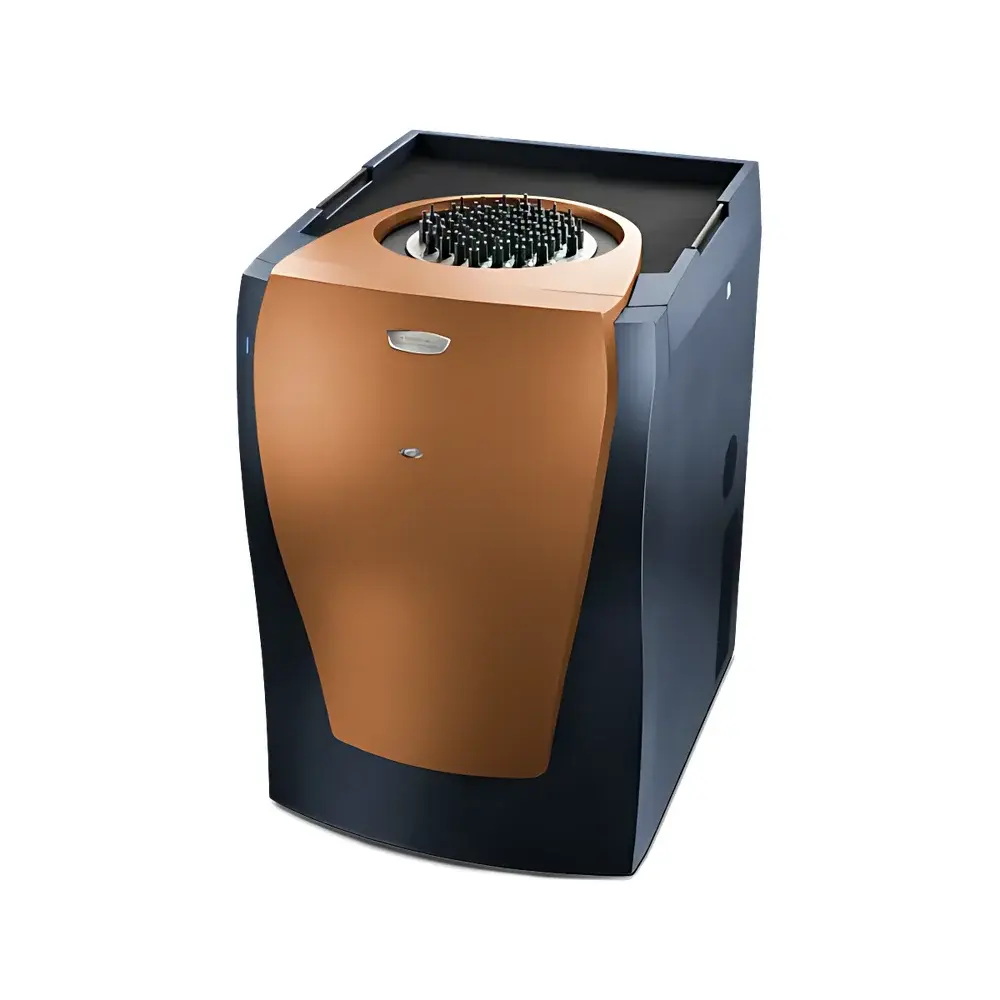
TA Instruments TAM48 Isothermal Microcalorimeter
| Brand | TA Instruments |
|---|---|
| Origin | USA |
| Model | TAM 48 |
| Simultaneous Sample Capacity | Up to 48 |
| Temperature Range | 4–150 °C |
| Temperature Accuracy | ±0.1 °C |
| Instrument Type | Isothermal Titration & Reaction Microcalorimeter |
| Compliance | Designed for GLP/GMP environments with audit-trail-ready software architecture |
Overview
The TA Instruments TAM48 is a high-throughput, isothermal microcalorimeter engineered for real-time, label-free detection and quantification of heat flow from chemical, biochemical, and physical processes. Unlike differential scanning calorimetry (DSC), which measures heat capacity changes during controlled temperature ramps, the TAM48 operates under strictly isothermal conditions—maintaining sample and reference cells at identical, highly stable temperatures while detecting minute thermal power differentials (down to <100 nW) arising from reactions, binding events, phase transitions, or metabolic activity. Its core measurement principle is based on thermopile-based heat conduction detection within precision-machined copper blocks, enabling direct, absolute quantification of enthalpy change (ΔH) without calibration against reference standards. This makes it uniquely suited for long-duration experiments—ranging from hours to weeks—where baseline stability and signal reproducibility are critical, such as in protein stability screening, catalyst deactivation studies, cement hydration kinetics, or microbial growth thermogenesis.
Key Features
- Modular, expandable architecture supporting up to 48 independent calorimetric channels via configurable TAM IV base units and auxiliary calorimeter stacks
- Advanced dual-stage temperature control system delivering ±0.1 °C accuracy and sub-millikelvin thermal stability over multi-day experiments
- Four primary calorimeter bays per TAM IV base unit, each accommodating interchangeable calorimeters optimized for specific applications—e.g., high-sensitivity (0.1 µW full scale), high-capacity (up to 10 mL ampoules), or low-volume (100 µL) configurations
- Dedicated accessory interface module supporting up to eight simultaneous external inputs—including pH electrodes, gas sensors, optical probes, or LED light sources—for correlative multimodal measurements
- Integrated voltage I/O module enabling synchronized acquisition from three analog probes (e.g., dissolved oxygen, redox potential, or turbidity) alongside thermal signals
- Robust mechanical design with vibration-damped isolation, EMI-shielded electronics, and passive thermal mass stabilization to minimize environmental drift
Sample Compatibility & Compliance
The TAM48 accommodates a broad spectrum of sample formats: sealed glass ampoules (1–10 mL), custom reactor vessels, multi-well plates (with adapter kits), and open-cell configurations for gas-permeable or volatile systems. It supports aqueous, organic, and heterogeneous matrices—including slurries, gels, polymers, pharmaceutical formulations, and biological suspensions. All hardware and firmware comply with ISO/IEC 17025 requirements for testing laboratories, and the instrument’s software platform is validated for use in regulated environments under FDA 21 CFR Part 11 and EU Annex 11 guidelines. Full electronic audit trails—including user logins, parameter changes, raw data modifications, and report generation timestamps—are automatically recorded and exportable in PDF/A or CSV format. The system supports IQ/OQ documentation packages and integrates seamlessly into LIMS environments via ASTM E1384-compliant data exchange protocols.
Software & Data Management
Control and analysis are performed using TAM Assistant v5.x—a Windows-based application built on a .NET framework with role-based access control and configurable workflow templates. Real-time visualization includes dual-axis thermal power vs. time plots with overlay capability, automatic peak integration, baseline correction algorithms (polynomial, spline, or manual), and kinetic modeling tools (e.g., Avrami, nth-order, or autocatalytic models). Data export supports HDF5, ASCII, and Excel-compatible formats. Batch processing enables parallel analysis of dozens of runs, with metadata tagging by sample ID, operator, protocol version, and environmental conditions. Raw thermal power data are stored in encrypted binary files with SHA-256 checksums to ensure data integrity throughout archival retention periods exceeding 15 years.
Applications
- Pharmaceutical development: Excipient compatibility screening, lyophilized product stability, antibody aggregation kinetics, and solid-state polymorph transition monitoring
- Materials science: Cement and concrete hydration profiling, polymer crosslinking dynamics, battery electrode side-reaction quantification, and nanomaterial surface reactivity assessment
- Life sciences: Enzyme inhibition assays, ligand-binding thermodynamics (Kd, ΔH, ΔS), microbial metabolic heat output under stress conditions, and cell viability monitoring in bioreactors
- Chemical process R&D: Catalyst performance decay tracking, reaction calorimetry for hazardous or low-yield syntheses, and crystallization onset detection in supersaturated solutions
- Food & agriculture: Shelf-life prediction via spoilage microorganism thermogenesis, starch gelatinization enthalpy mapping, and pesticide degradation kinetics in soil matrices
FAQ
What distinguishes the TAM48 from conventional DSC instruments?
The TAM48 performs isothermal microcalorimetry—not differential scanning calorimetry. It measures heat flow *at constant temperature*, enabling detection of slow, low-energy processes (e.g., enzymatic turnover or corrosion) that would be obscured by DSC’s ramp-driven thermal noise.
Can the TAM48 operate unattended for extended durations?
Yes. Its thermal architecture maintains baseline stability better than ±10 nW over 30-day continuous runs, with automated data logging, power-failure recovery, and remote status monitoring via Ethernet.
Is method validation support available for regulated labs?
TA Instruments provides comprehensive validation documentation (IQ/OQ/PQ), 21 CFR Part 11 compliance reports, and on-site qualification assistance through certified field service engineers.
How is cross-talk between adjacent calorimeter channels mitigated?
Each calorimeter channel is housed in an independently temperature-regulated copper block with >80 dB thermal isolation; inter-channel crosstalk is empirically verified to be <0.3% under maximum load conditions.
Does the system support custom scripting or API integration?
Yes. A COM-based automation interface allows integration with Python, MATLAB, or LabVIEW for custom experiment sequencing, real-time feedback control, and hybrid instrument orchestration (e.g., coupling with HPLC or FTIR).
Related Products



