
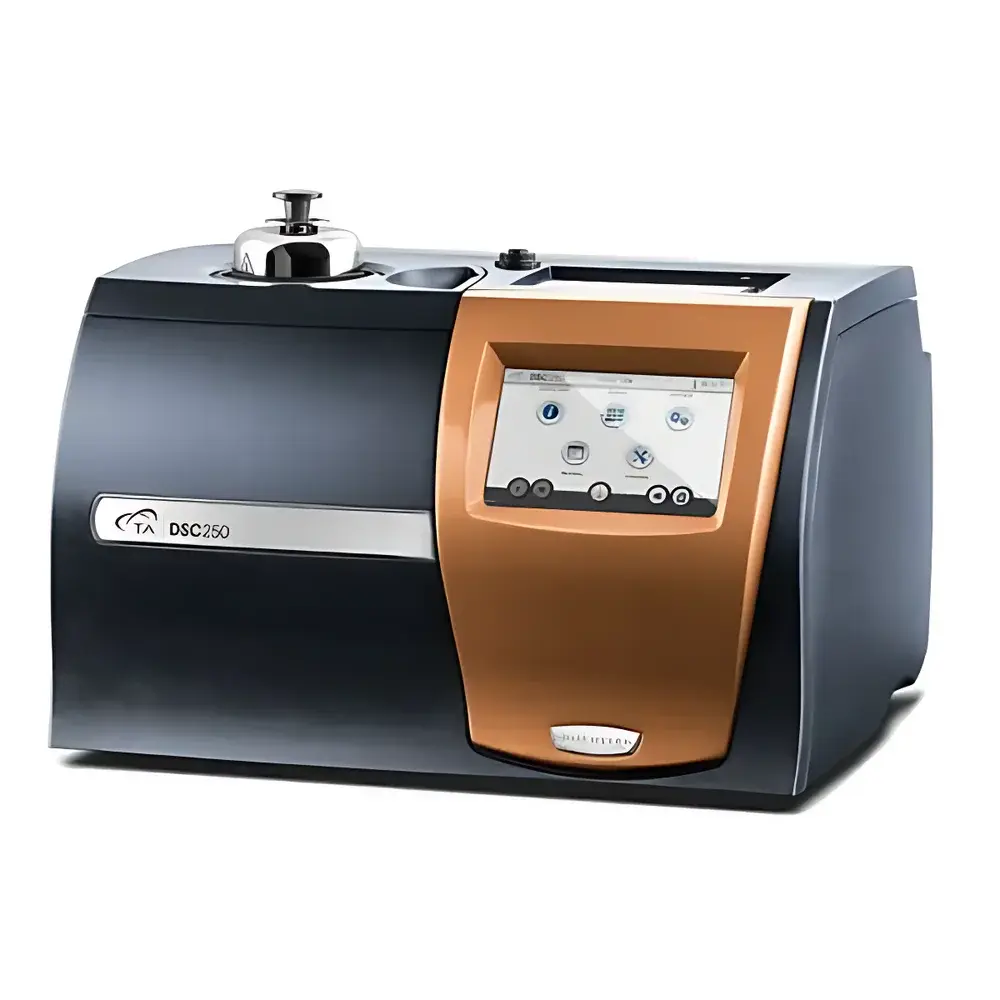
TA Instruments Discovery DSC 250 Differential Scanning Calorimeter
| Brand | TA Instruments |
|---|---|
| Origin | USA |
| Model | Discovery DSC 250 |
| Instrument Type | Differential Scanning Calorimeter (DSC) |
| Temperature Range | −180 °C to 725 °C |
| Temperature Accuracy | ±0.05 °C |
| Temperature Precision | ±0.008 °C |
| Heating/Cooling Rate | up to 200 K/min |
| DSC Heat Flow Range | ±500 mW |
| Sample Capacity | Single-sample configuration |
| Cooling Option | Mechanical refrigeration (optional, extends low-temperature operation without liquid nitrogen) |
Overview
The TA Instruments Discovery DSC 250 is a high-performance differential scanning calorimeter engineered for precision thermal characterization across demanding research, quality control, and regulatory environments. Based on heat-flux DSC architecture with Tzero® thermal analysis technology, it measures the difference in heat flow between a sample and an inert reference as both are subjected to identical, precisely controlled temperature programs. This principle enables quantitative determination of endothermic and exothermic transitions—including glass transitions (Tg), melting (Tm), crystallization, solid-solid phase changes, oxidative induction time (OIT), and reaction enthalpies—with exceptional sensitivity and reproducibility. Designed for rigorous scientific use, the Discovery DSC 250 integrates patented Fusion Cell™ calorimetry, delivering industry-leading baseline flatness, signal-to-noise ratio, and resolution—critical for detecting weak thermal events in polymers, pharmaceuticals, biomaterials, and advanced composites.
Key Features
- Fusion Cell™ calorimeter architecture: Provides superior baseline stability (<0.01 µW drift over 60 min), enabling reliable detection of sub-millijoule transitions and accurate enthalpy quantification.
- Advanced T4P Tzero® heat-flow technology: Enables direct, single-run measurement and storage of specific heat capacity (Cp) without requiring separate calibration scans or post-processing corrections.
- Modulated DSC® (MDSC®) capability: Separates overlapping thermal events—such as reversing (heat capacity-related) and non-reversing (kinetic) components—within a single experiment, improving interpretation of complex material behavior.
- One-Touch-Away™ touchscreen interface: Intuitive, context-aware UI with real-time method editing, instrument status monitoring, and guided workflows—designed to reduce operator training time and minimize procedural errors.
- Linear autosampler (optional): Supports up to 48 positions with programmable tray mapping, automated calibration verification, and scheduled validation routines compliant with GLP/GMP requirements.
- Mechanical refrigeration system (optional): Achieves stable operation down to −180 °C without liquid nitrogen, ensuring uninterrupted multi-day experiments and reducing operational costs and safety hazards.
- Tzero® sample preparation tools: Includes precision press and standardized hermetic aluminum pans for consistent sample mass, geometry, and thermal contact—key to inter-laboratory reproducibility.
Sample Compatibility & Compliance
The Discovery DSC 250 accommodates a broad spectrum of solid and semi-solid samples—from hygroscopic pharmaceutical powders and amorphous biologics to high-temperature ceramics and reactive metal alloys—using sealed, crimped, or vented pans compatible with inert (N2, Ar) or oxidative (air, O2) atmospheres. Its design conforms to ASTM E794 (melting and crystallization temperatures), ASTM E1356 (Tg determination), ISO 11357 series (polymer thermal analysis), and USP (pharmaceutical thermal characterization). Data acquisition and reporting support FDA 21 CFR Part 11 compliance when used with TRIOS software’s audit trail, electronic signatures, and secure user access controls—making it suitable for regulated QC laboratories operating under GxP frameworks.
Software & Data Management
Controlled by TRIOS™ software, the Discovery DSC 250 offers an integrated environment for instrument operation, real-time data visualization, advanced peak deconvolution, kinetic modeling (e.g., Ozawa-Flynn-Wall, Kissinger), Cp mapping, and automated report generation. The software includes built-in IQ/OQ/PQ protocols, customizable SOP templates, and batch processing for high-throughput screening. All raw data files (.dsc) are stored in open, ASCII-based formats supporting third-party analysis and long-term archival integrity. Audit trails record every parameter change, calibration event, and user action—ensuring full traceability for internal audits and regulatory inspections.
Applications
- Pharmaceutical development: Polymorph screening, amorphous content quantification, excipient compatibility studies, and stability-indicating assay validation.
- Polymer science: Crystallinity assessment, crosslink density estimation, degradation onset evaluation, and blend miscibility analysis via Cp deviation.
- Materials engineering: Phase diagram construction for metallic alloys, glass transition mapping in composites, and thermal aging kinetics of elastomers.
- Food science: Fat crystallization profiling, starch gelatinization enthalpy, and shelf-life prediction via oxidative induction time (OIT).
- Academic research: Reaction enthalpy determination in catalytic systems, hydration/dehydration thermodynamics in MOFs, and nanoconfined phase behavior in thin films.
FAQ
What is the maximum heating rate supported by the Discovery DSC 250?
The instrument achieves linear heating and cooling rates up to 200 K/min across its full temperature range, enabling rapid screening and high-resolution kinetic analysis.
Does the system require liquid nitrogen for low-temperature operation?
No—optional mechanical refrigeration extends operation to −180 °C without cryogens, supporting unattended overnight runs and eliminating supply chain dependencies.
Can specific heat capacity (Cp) be measured directly without separate calibration?
Yes—T4P Tzero® technology allows absolute Cp determination in a single scan using built-in reference materials and dynamic baseline correction.
Is the software compliant with FDA 21 CFR Part 11 requirements?
TRIOS software supports full Part 11 compliance when configured with role-based access control, electronic signatures, and immutable audit trails—validated per laboratory SOPs.
What warranty coverage applies to the calorimeter and furnace?
TA Instruments provides an industry-exclusive five-year limited warranty on both the Fusion Cell™ calorimeter and the furnace assembly—reflecting confidence in long-term thermal and mechanical stability.



