
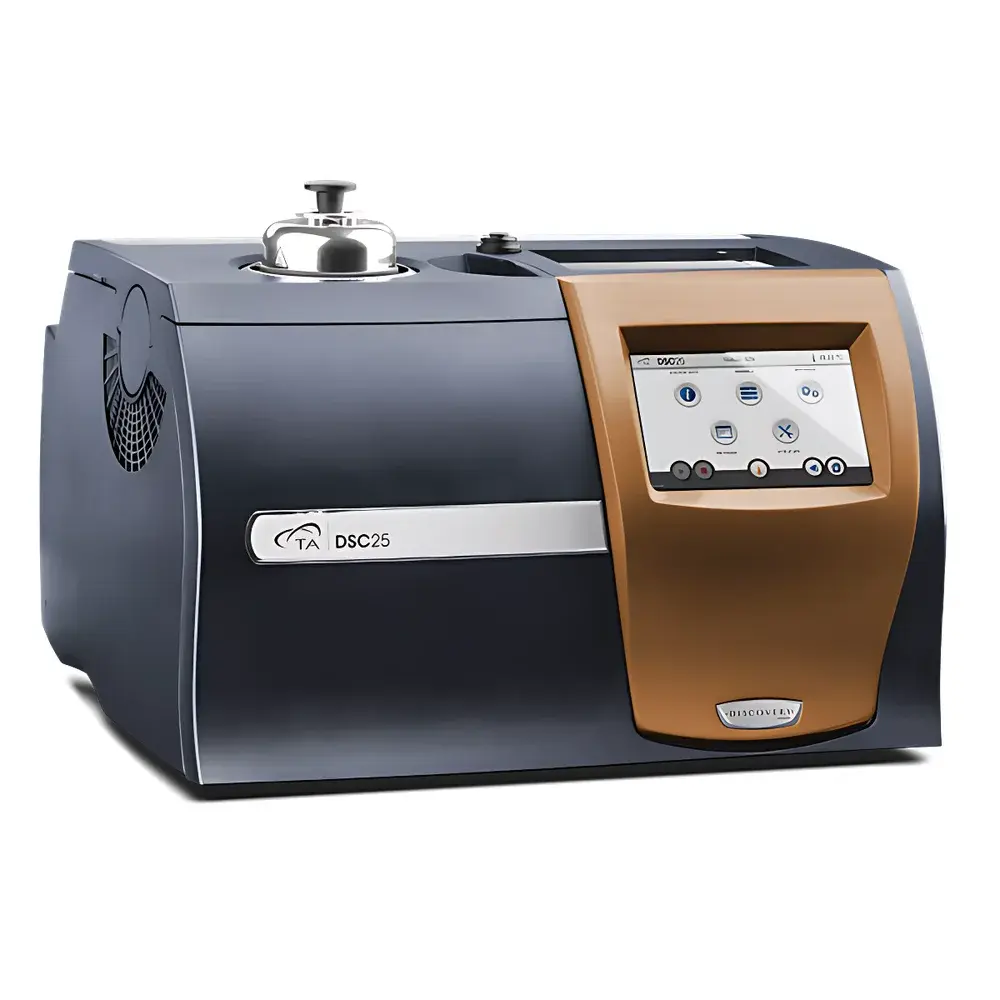
TA Instruments Discovery DSC 25 Differential Scanning Calorimeter
| Brand | TA Instruments |
|---|---|
| Origin | USA |
| Model | Discovery DSC 25 |
| Sample Capacity | Single |
| Instrument Type | Differential Scanning Calorimeter (DSC) |
| Temperature Range | −180 °C to 725 °C |
| Temperature Accuracy | ±0.1 °C |
| Heating/Cooling Rate | Up to 200 K/min |
| Temperature Precision | ±0.01 °C |
| DSC Heat Flow Range | ±500 mW |
Overview
The TA Instruments Discovery DSC 25 is a high-performance differential scanning calorimeter engineered for precision thermal characterization across academic, pharmaceutical, polymer, and materials science laboratories. Operating on the principle of heat flux DSC—measuring the differential heat flow between a sample and an inert reference as both are subjected to identical, controlled temperature programs—the instrument delivers quantitative thermodynamic data essential for understanding phase transitions, reaction kinetics, and material stability. Its wide operational temperature range (−180 °C to 725 °C), coupled with exceptional thermal resolution and baseline stability, enables reliable detection of subtle endothermic and exothermic events—including glass transitions (Tg), melting enthalpies (ΔHfus), cold crystallization, oxidative induction time (OIT), and cure kinetics—even in low-mass or thermally insensitive samples.
Key Features
- Fusion Cell™ Calorimetric Sensor: A patented, monolithic heat flux sensor architecture delivering industry-leading baseline flatness (<0.01 µW/h drift), high sensitivity (detecting <0.1 µW heat flow changes), and superior reproducibility across repeated runs.
- T4P Tzero® Technology: Advanced four-point temperature sensing integrated into the furnace and sensor assembly ensures real-time, direct measurement of specific heat capacity (Cp) in a single scan—eliminating the need for separate calibration runs or post-acquisition Cp derivation.
- Modulated DSC® (MDSC®) Capability: Enables separation of reversing (e.g., Tg, Cp) and non-reversing (e.g., enthalpic relaxation, decomposition) thermal events within a single experiment—critical for analyzing complex polymers, amorphous pharmaceuticals, and multi-component composites.
- One-Touch-Away™ Touchscreen Interface: Intuitive, context-aware GUI with embedded method templates, drag-and-drop sequence building, and real-time parameter validation—designed for rapid method deployment without software training overhead.
- Linear Auto-Sampler (Optional): Robust, programmable 48- or 72-position carousel supporting unattended operation over extended periods; includes automated lid actuation, pressure-controlled sample containment, and integrated calibration verification at user-defined intervals.
- Mechanical Refrigeration Options: Compatible with liquid-nitrogen-free cooling systems (e.g., RCS 90), enabling stable sub-ambient operation down to −180 °C without cryogen handling—ideal for GLP-compliant long-duration stability studies.
Sample Compatibility & Compliance
The Discovery DSC 25 accommodates standard hermetic and vented aluminum, gold-plated, or high-purity sapphire pans (10–50 mg typical mass), with optional high-pressure cells for volatile or reactive samples. All hardware and firmware comply with ISO 11357 series standards for DSC methodology and ASTM E794 (melting point), E1356 (Tg determination), and E1965 (oxidative induction time). Software supports 21 CFR Part 11 compliance via electronic signatures, audit trails, role-based access control, and immutable data archiving—fully validated for GMP environments in pharmaceutical development and QC labs.
Software & Data Management
TRIOS™ software provides unified control, analysis, and reporting in a single platform. Key modules include: AutoCalibrate (NIST-traceable temperature and enthalpy calibration using indium, zinc, and tin standards), SmartAnalysis (AI-assisted peak deconvolution for overlapping transitions), Reaction Kinetics Suite (model-free and model-fitting approaches per ASTM E698 and ISO 11358), and Report Studio (customizable templates with embedded metadata, export to PDF/Excel/XML, and LIMS integration via ASTM E1482-compliant output). Raw data files (.q40) retain full instrument metadata, ensuring full traceability from acquisition through regulatory submission.
Applications
- Quantitative determination of Tg, melting point (Tm), crystallinity %, and enthalpy of fusion in thermoplastics and biopolymers
- Stability assessment of active pharmaceutical ingredients (APIs) and formulations under accelerated aging conditions (ICH Q1A)
- Characterization of lipid phase behavior, protein denaturation, and lyophilized cake structure in biologics
- Analysis of crosslinking kinetics in thermosets and UV-curable resins
- Determination of oxidative induction time (OIT) and onset temperature (OOT) per ASTM D3895 and ISO 11357-6
- Specific heat capacity mapping for thermal modeling of battery electrode materials and aerospace composites
FAQ
What is the minimum detectable heat flow change?
The Fusion Cell™ sensor achieves a noise floor of <0.05 µW under standard operating conditions, enabling detection of transitions with enthalpy changes as low as 0.1 J/g.
Can the Discovery DSC 25 perform isothermal measurements?
Yes—it supports isothermal hold steps at any temperature within its operating range, with stability better than ±0.02 °C over 24 hours.
Is MDSC® available as a field-upgrade option?
MDSC® functionality is embedded in the instrument’s firmware and requires only software activation and appropriate modulation parameters—no hardware modification is needed.
How does the Tzero®压样器 (press) improve reproducibility?
The Tzero® press applies consistent, calibrated force (typically 100–200 N) to seal sample pans, minimizing air gaps and thermal contact resistance—reducing inter-run variability in onset temperature and enthalpy by up to 50% compared to manual crimping.
What validation documentation is provided for regulated environments?
TA Instruments supplies IQ/OQ protocols, system suitability test procedures, and a complete 21 CFR Part 11 compliance package—including electronic signature validation reports and audit trail configuration guides—upon request.



