
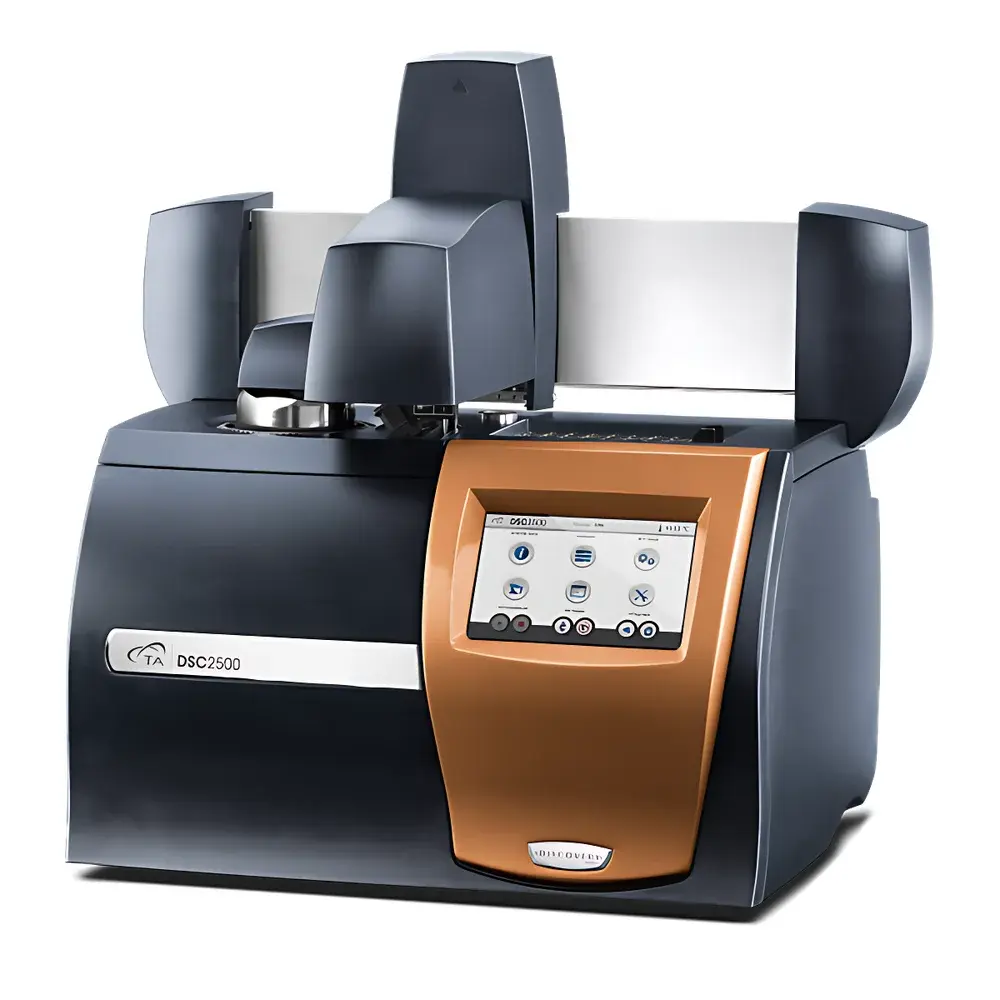
TA Instruments Discovery DSC 2500 Differential Scanning Calorimeter
| Brand | TA Instruments |
|---|---|
| Origin | USA |
| Model | Discovery DSC 2500 |
| Instrument Type | Differential Scanning Calorimeter |
| Temperature Range | –180 °C to 725 °C |
| Temperature Accuracy | ±0.025 °C |
| Temperature Precision | ±0.005 °C |
| Heating/Cooling Rate | up to 200 K/min |
| DSC Heat Flow Range | ±500 mW |
| Sample Throughput | Single-sample configuration |
| Cooling Option | Mechanical refrigeration (optional, extends low-temperature operation without LN₂) |
Overview
The TA Instruments Discovery DSC 2500 is a high-performance differential scanning calorimeter engineered for precision thermal characterization across demanding research and quality control environments. Operating on the heat-flux DSC principle, it measures the difference in heat flow between a sample and an inert reference as both are subjected to identical, controlled temperature programs. This enables quantitative determination of endothermic and exothermic transitions—including glass transitions (Tg), melting (Tm), crystallization, solid-solid phase changes, oxidative induction time (OIT), and reaction enthalpies—with exceptional baseline stability and signal-to-noise ratio. Designed for scientific rigor, the instrument integrates patented Fusion Cell™ technology—a monolithic, low-thermal-mass sensor architecture—that delivers industry-leading baseline flatness, sensitivity (<0.01 µW), and resolution (<0.1 °C for overlapping transitions). Its wide operational range (–180 °C to 725 °C) supports characterization of cryogenic polymers, high-temperature ceramics, pharmaceuticals, and energetic materials under inert, oxidative, or controlled humidity atmospheres.
Key Features
- Fusion Cell™ calorimetric sensor: Monolithic design with minimized thermal lag and drift, enabling reproducible baseline performance over extended temperature ramps and multi-day experiments.
- Advanced T4P Tzero® heat-flux technology: Delivers true heat capacity (Cp) measurement in a single scan—no separate calibration or baseline subtraction required—fully compliant with ASTM E1269 and ISO 11357-4.
- Modulated DSC® (MDSC®) capability: Separates reversing (e.g., Tg, Cp) and non-reversing (e.g., enthalpic relaxation, curing) thermal events via periodic temperature modulation, enhancing interpretation of complex material behavior.
- One-Touch-Away™ touchscreen interface: Intuitive, context-aware navigation with real-time method editing, live data preview, and embedded help—designed for both novice users and expert thermodynamic analysts.
- Linear AutoSampler (optional): Programmable 48- or 72-position tray with motorized lid, integrated calibration verification, and automated validation routines per ASTM E967 and USP <1163>.
- Mechanical refrigeration system (–180 °C capability): Eliminates dependency on liquid nitrogen while maintaining thermal stability and repeatability at cryogenic temperatures—critical for polymer Tg analysis and battery electrolyte studies.
- Tzero® sample preparation tools: Precision press and standardized hermetic aluminum pans ensure consistent sample mass, geometry, and thermal contact—reducing inter-operator variability.
Sample Compatibility & Compliance
The Discovery DSC 2500 accommodates a broad spectrum of sample forms: solids (powders, films, fibers), semi-crystalline polymers, lyophilized biopharmaceuticals, metallic alloys, and reactive inorganic compounds. Standard crucibles include hermetic aluminum, high-pressure stainless steel, and sealed gold-plated pans for volatile or oxidizing systems. The platform supports full regulatory compliance workflows: audit-trail-enabled software (TRIOS™) meets FDA 21 CFR Part 11 requirements; calibration protocols align with NIST-traceable standards; and validation documentation satisfies ISO/IEC 17025, ICH Q5C, and GMP/GLP laboratory accreditation criteria. All thermal data files retain full metadata—including instrument ID, operator, date/time stamp, atmospheric conditions, and calibration history—for traceability and reprocessing.
Software & Data Management
TRIOS™ software provides unified control, analysis, and reporting in a modular architecture. Core modules include Method Wizard (for SOP-driven experiment setup), Smart Analysis (automated peak detection with customizable baselines), Cp Calculator (direct heat capacity derivation), Kinetics Neo (model-free and model-fitting kinetic analysis per ASTM E698), and Report Studio (customizable templates exportable to PDF, Excel, or LIMS). Data integrity safeguards include electronic signatures, role-based access control, versioned method libraries, and encrypted database storage. Raw data (.q4d format) preserves all detector-level signals for retrospective reanalysis—ensuring long-term data utility beyond initial acquisition.
Applications
- Pharmaceutical development: Polymorph screening, amorphous content quantification, excipient compatibility, and stability-indicating assays per ICH Q1E guidelines.
- Polymers & composites: Crystallinity calculation, crosslink density estimation, aging kinetics, and filler-matrix interaction analysis.
- Battery materials: Solid-electrolyte interphase (SEI) formation enthalpy, cathode thermal runaway onset, and electrolyte decomposition profiling.
- Food science: Starch gelatinization, fat polymorphism, and moisture-induced phase transitions.
- Metals & ceramics: Allotropic transformations, sintering behavior, and glass-ceramic nucleation kinetics.
FAQ
What distinguishes the Fusion Cell™ from conventional DSC sensors?
Its monolithic construction eliminates thermal interfaces found in stacked-sensor designs, reducing thermal resistance and improving response time, baseline fidelity, and long-term drift stability—key for high-precision Cp and low-enthalpy transition detection.
Can the Discovery DSC 2500 perform ASTM E1356-compliant heat capacity measurements?
Yes—its Tzero® technology and integrated calibration routines fully support ASTM E1356, including dynamic Cp determination across variable heating rates and temperature ranges.
Is mechanical refrigeration sufficient for sub-ambient studies requiring high reproducibility?
Affirmative—the optional RCS90 cooling system maintains ±0.01 °C temperature stability at –180 °C with <0.1 % RSD in repeated Tg measurements on standard polycarbonate.
How does the instrument support GLP-compliant data archiving?
TRIOS™ enforces ALCOA+ principles: Attributable, Legible, Contemporaneous, Original, Accurate data with immutable audit trails, electronic signatures, and secure backup to network drives or cloud repositories.
Does MDSC® require specialized training to interpret results?
No—TRIOS™ includes guided MDSC analysis workflows with auto-deconvolution of reversing/non-reversing components, plus annotated reports aligned with ASTM E1958 recommendations for best-practice interpretation.



