
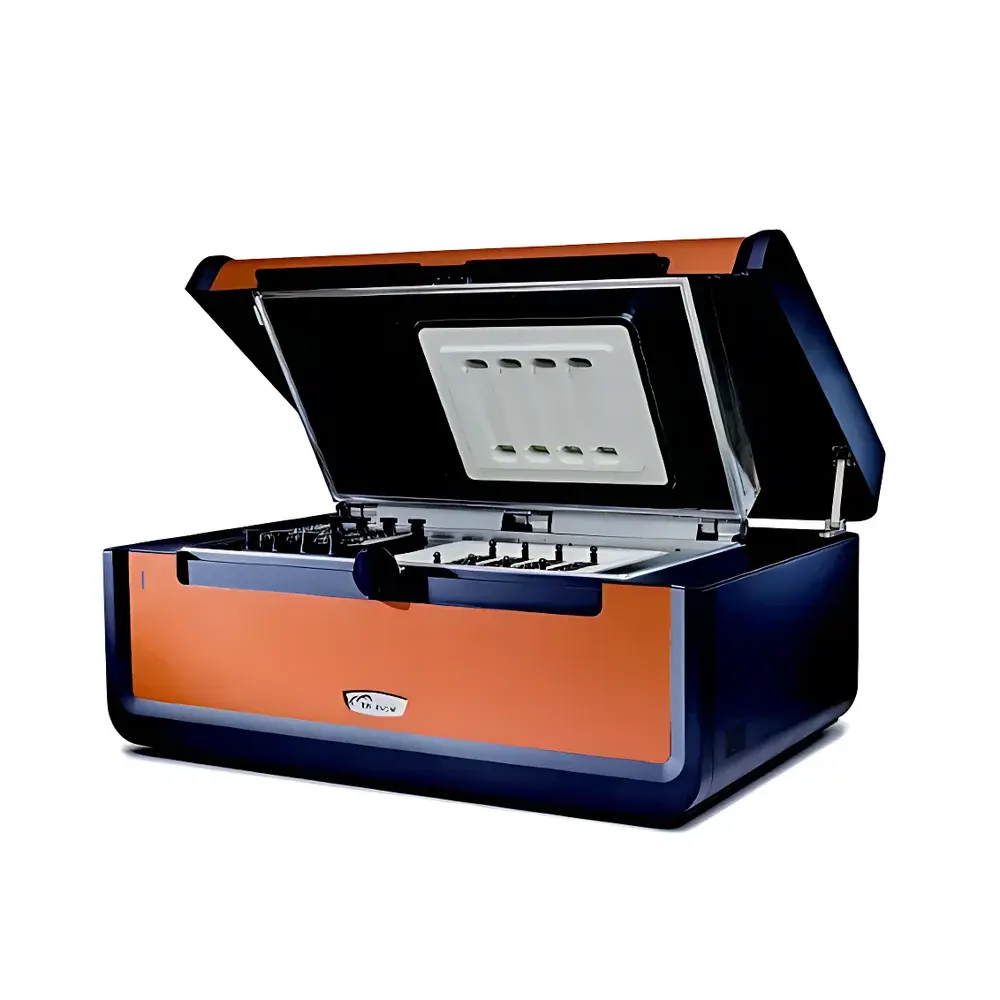
TA Instruments RS-DSC Rapid Screening Differential Scanning Calorimeter
| Brand | TA Instruments |
|---|---|
| Origin | USA |
| Manufacturer Type | Authorized Distributor |
| Product Origin | Imported |
| Model | RS-DSC |
| Sample Throughput | Multi-sample simultaneous measurement |
| Instrument Type | Differential Scanning Calorimeter (DSC) |
| Temperature Range | 20–100 °C |
| Temperature Accuracy | ±0.02 °C |
Overview
The TA Instruments RS-DSC Rapid Screening Differential Scanning Calorimeter is a purpose-built thermal analysis platform engineered for high-throughput, label-free assessment of thermal stability in biopharmaceutical formulations. Operating on the principle of heat-flux differential scanning calorimetry, the RS-DSC precisely quantifies endothermic and exothermic transitions—primarily protein unfolding events—as a function of temperature. Unlike conventional DSC systems optimized for single-sample, high-resolution thermodynamic profiling, the RS-DSC integrates parallel sample loading, rapid thermal ramping, and automated data acquisition to deliver reproducible melting temperature (Tm) and onset temperature (Tonset) values across multiple undiluted samples in under 30 minutes per run. Its design directly addresses the need for early-stage biophysical characterization in drug development workflows where speed, sample conservation, and compatibility with formulation-relevant concentrations (e.g., 50–200 mg/mL mAbs) are critical operational constraints.
Key Features
- Undiluted Sample Analysis: Eliminates dilution-related artifacts by enabling direct measurement of concentrated biopharmaceutical solutions—no buffer exchange or concentration adjustment required.
- Multi-Sample Parallelism: Accommodates up to 12 standard 40 µL capillary-based sample cells in a single instrument run, supporting comparative screening across variants, excipients, or pH conditions.
- Controlled Thermal Precision: Maintains ±0.02 °C temperature accuracy across its 20–100 °C operating range, ensuring high inter-run reproducibility for Tm determination (CV < 0.15 °C typical).
- Low-Volume Capability: Optimized for minimal sample consumption (as low as 25 µL per measurement), preserving precious clinical-stage material.
- Robust Thermal Architecture: Features active cell temperature control with dual-sensor feedback and symmetric furnace geometry to minimize baseline drift and improve signal-to-noise ratio during fast scans (up to 10 °C/min).
Sample Compatibility & Compliance
The RS-DSC is validated for use with monoclonal antibodies (mAbs), Fc-fusion proteins, bispecifics, and other engineered biologics formulated in common pharmaceutical buffers (e.g., histidine, acetate, phosphate). It supports native-state analysis without denaturants or dyes, preserving structural relevance. From a regulatory perspective, the system supports audit-ready operation under GLP and GMP-aligned environments: raw data files include embedded metadata (operator ID, timestamp, instrument serial number, calibration status), and software logs all user actions—including method edits and result exports—in a tamper-evident audit trail compliant with FDA 21 CFR Part 11 requirements when deployed with TA Instruments’ Trios Enterprise Edition software.
Software & Data Management
Controlled via TA Instruments’ Trios Software v6.x, the RS-DSC enables fully automated method setup, real-time thermal curve visualization, and batch-wise analysis of transition parameters. The software includes built-in algorithms for automatic peak identification, baseline correction using polynomial fitting, and multi-peak deconvolution for complex unfolding profiles (e.g., domain-specific transitions in IgG1 molecules). All data are stored in vendor-neutral .tdf format, exportable to CSV or ASTM E1461-compliant XML for integration into LIMS or statistical process control platforms. Optional IQ/OQ documentation packages and electronic signature support are available to facilitate qualification in regulated laboratories.
Applications
- Comparative thermal stability screening of antibody candidates during lead selection
- Excipient optimization studies evaluating impact on conformational stability
- Formulation robustness assessment across pH, ionic strength, and surfactant gradients
- Stability-indicating assay development for accelerated stability programs
- Supporting comparability assessments during process changes or manufacturing site transfers
- Correlation of Tm with long-term storage behavior and aggregation propensity
FAQ
Does the RS-DSC require sample dilution prior to analysis?
No. The RS-DSC is specifically designed to analyze undiluted, high-concentration biopharmaceutical formulations (typically 50–200 mg/mL), eliminating dilution-induced destabilization and preserving native solution conditions.
Can the RS-DSC measure multiple transitions within a single protein?
Yes. With sufficient signal resolution and appropriate scan rate selection, the system can resolve sequential domain unfolding events—such as CH2 and CH3 domain transitions in IgG molecules—provided the thermal separation between transitions exceeds ~2 °C.
Is the RS-DSC compliant with pharmacopeial standards?
While not explicitly referenced in USP <1084> or Ph. Eur. 2.2.43 as a standalone method, the RS-DSC generates thermodynamic parameters consistent with those obtained from reference DSC instruments used in compendial biopharmaceutical characterization, and its data output meets the traceability and documentation requirements outlined in ICH Q5C and Q5E guidelines.
What maintenance is required to ensure long-term accuracy?
Annual calibration verification using certified indium and zinc standards is recommended. Routine cleaning of the sample chamber and periodic validation of temperature sensor response are documented in the instrument’s Preventive Maintenance Guide included with the system.



