
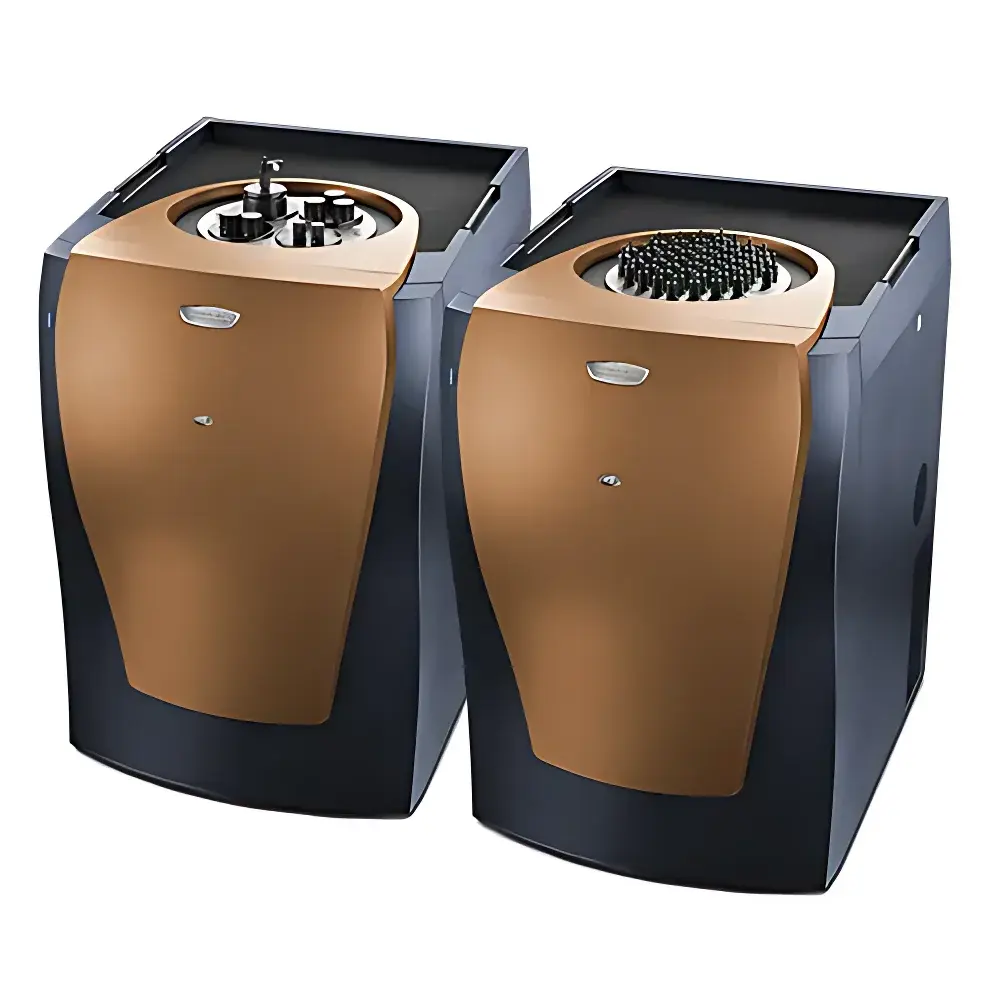
TA Instruments TAM IV Isothermal Microcalorimeter
| Brand | TA Instruments |
|---|---|
| Origin | USA |
| Model | TAM IV |
| Simultaneous Sample Capacity | Multiple |
| Temperature Range | 4–150 °C |
| Temperature Accuracy | ±0.1 °C |
Overview
The TA Instruments TAM IV is an isothermal microcalorimeter engineered for high-sensitivity, long-term thermal monitoring of chemical, physical, and biological processes under constant-temperature conditions. Unlike differential scanning calorimeters (DSC) that measure heat flow during temperature ramps, the TAM IV operates exclusively in isothermal mode—detecting minute heat fluxes (down to <0.1 µW) generated or absorbed during reactions, phase transitions, adsorption, crystallization, enzymatic activity, or microbial metabolism. Its core measurement principle relies on thermopile-based heat conduction detection within a highly stable, multi-zone temperature-controlled block, enabling baseline stability of <±10 nW over 72 hours. Designed for quantitative thermodynamic and kinetic analysis—not just event detection—the TAM IV delivers raw heat flow (µW) vs. time data that supports calculation of reaction enthalpy (ΔH), rate constants, activation energy (Ea), and equilibrium constants without labeling or perturbation.
Key Features
- Modular architecture supporting up to 8 independent ampoule channels in a single instrument base—enabling parallel, unattended measurement of multiple samples under identical isothermal conditions.
- Active temperature control with dual-stage Peltier elements and precision RTD feedback, ensuring ±0.1 °C accuracy across the full 4–150 °C operating range and thermal uniformity ≤0.01 °C between channels.
- Low-drift thermopile sensor array with <0.05 µW noise floor and <10 nW 24-hour baseline drift—optimized for extended experiments (days to weeks) required in stability studies, corrosion monitoring, or slow biocatalytic reactions.
- Hermetically sealed sample chambers with optional gas purging (N2, Ar, synthetic air) and pressure-rated ampoules (up to 10 bar) for reactive or volatile systems.
- Rugged mechanical design with vibration-damped optical table integration capability and EMI-shielded electronics—suitable for shared core facilities and regulated environments.
Sample Compatibility & Compliance
The TAM IV accommodates diverse sample formats—including liquid solutions, powders, gels, thin films, electrodes, and solid-state materials—in standard 1–4 mL glass or stainless-steel ampoules. Custom cell configurations support electrochemical cells, fiber-reinforced composites, and hydrated biomaterials. All hardware and firmware comply with ISO/IEC 17025 requirements for calibration traceability, and the system supports 21 CFR Part 11-compliant software operation when paired with TA’s CALISTO platform (audit trail, electronic signatures, role-based access). Method validation documentation aligns with ICH Q5C (stability), ASTM E2043 (isothermal calorimetry), and USP (microcalorimetry in pharmaceutical development).
Software & Data Management
CALISTO v5.x provides instrument control, real-time visualization, and advanced kinetic modeling (e.g., nth-order, autocatalytic, diffusion-limited models) directly within the acquisition interface. Raw heat flow data are stored in vendor-neutral HDF5 format with embedded metadata (temperature setpoint, sample ID, operator, timestamp, calibration coefficients). Export options include CSV, Excel, and MATLAB-compatible .mat files. Batch processing tools enable automated baseline correction, peak integration, and Arrhenius plot generation across multi-temperature datasets. For GxP environments, optional IQ/OQ/PQ documentation packages and change control logs are available.
Applications
- Pharmaceutical: Real-time monitoring of protein aggregation, excipient compatibility, lyophilized product stability, and container-closure integrity testing.
- Materials Science: Quantification of cement hydration kinetics, polymer crosslinking rates, metal corrosion thermodynamics, and self-healing material activation energy.
- Life Sciences: Label-free assessment of cell metabolic activity, antimicrobial efficacy (MIC/MBC), enzyme inhibition kinetics, and vaccine thermal stability.
- Energy: Solid-state battery side-reaction quantification, catalyst deactivation profiling, and hydrogen storage material reversibility analysis.
- Geochemistry & Environmental: Clay mineral hydration/dehydration enthalpies, contaminant sorption thermodynamics, and microbial degradation heat signatures in soil/water matrices.
FAQ
What distinguishes the TAM IV from conventional DSC instruments?
The TAM IV is not a DSC—it performs isothermal microcalorimetry only. It measures heat flow at fixed temperature with sub-microwatt sensitivity over extended durations, whereas DSC applies controlled temperature ramps and detects transient heat flow peaks with lower absolute sensitivity.
Can the TAM IV be used for kinetic modeling of irreversible reactions?
Yes. Its continuous, high-resolution heat flow output enables numerical integration and fitting to mechanistic models—including nucleation-growth, diffusion-controlled, and complex multi-step pathways—without assumptions of reversibility.
Is remote monitoring supported for unattended long-term experiments?
Yes. CALISTO supports secure network deployment with email/SMS alerts for instrument faults, sample completion, or deviation thresholds—validated for 30+ day continuous runs in GMP labs.
How is calibration traceability maintained?
Each TAM IV ships with NIST-traceable calibration certificates for temperature (ITS-90) and heat flow (electrical substitution method), updated annually via TA-certified service engineers.
Does the system meet GLP audit requirements?
When configured with CALISTO in 21 CFR Part 11 mode—including electronic signatures, audit trails, and user permission hierarchies—the TAM IV satisfies GLP/GMP data integrity standards per FDA and EMA guidance.
Related Products



