
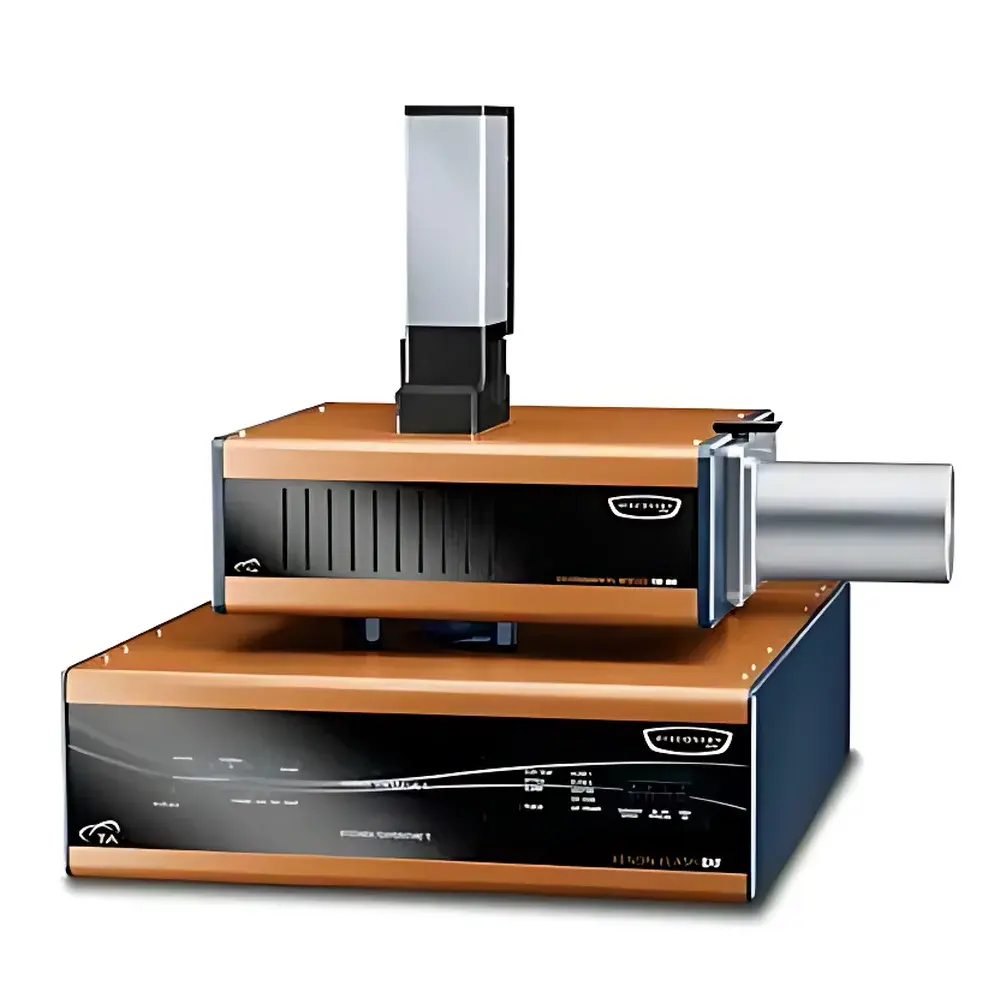
TA Instruments Discovery Xenon Flash Thermal Conductivity Analyzer
| Brand | TA Instruments |
|---|---|
| Origin | USA |
| Model | DXF-200 / DXF-500 / DXF-900 |
| Measurement Principle | Laser Flash Method (Xenon Lamp-Based) |
| Maximum Sample Diameter | 25 mm |
| Pulse Width | 400–600 µs |
| Optical System | Reflective, Multi-Faceted Light Guide |
| Temperature Range Options | Up to 200 °C / 500 °C / 900 °C (Model-Dependent) |
| Compliance | ASTM E1461, ISO 22007-4, DIN EN 821-2 |
Overview
The TA Instruments Discovery Xenon Flash Thermal Conductivity Analyzer (DXF Series) is a high-performance, benchtop thermal diffusivity and conductivity measurement system engineered for precision and operational efficiency in R&D laboratories and quality control environments. Unlike conventional laser flash analyzers that rely on solid-state or Q-switched Nd:YAG lasers, the DXF employs a High-Speed Xenon Discharge (HSXD) pulse source—delivering equivalent thermal diffusivity resolution and signal-to-noise performance at significantly lower total cost of ownership. The system operates on the standardized laser flash method (ASTM E1461, ISO 22007-4), wherein a short, uniform energy pulse irradiates the front surface of a plane-parallel sample, and the resulting transient temperature rise on the rear surface is recorded via an infrared detector. Thermal diffusivity (α) is calculated from the time-dependent temperature response curve; thermal conductivity (λ) is then derived using λ = α·ρ·Cp, where ρ is density and Cp is specific heat capacity (typically measured separately via DSC or supplied as literature data).
Key Features
- High-efficiency reflective optical architecture featuring a custom multi-faceted light guide that homogenizes xenon flash illumination across the full sample surface—enabling uniform energy deposition even for samples up to 25 mm in diameter.
- Pulse width precisely controlled between 400 µs and 600 µs—shorter than many commercial laser-based systems—minimizing lateral heat loss and improving temporal resolution for accurate onset detection.
- Three modular platform configurations (DXF-200, DXF-500, DXF-900) with integrated high-stability furnace assemblies, supporting continuous operation from ambient to 200 °C, 500 °C, or 900 °C respectively.
- No consumables or alignment-sensitive optics: the xenon lamp requires no periodic realignment, offers >10⁶ pulse lifetime, and eliminates the need for expensive laser diodes or cooling water circuits.
- Robust mechanical design with inert atmosphere capability (N2, Ar, vacuum) to prevent oxidation during high-temperature measurements of metals, ceramics, and composites.
Sample Compatibility & Compliance
The DXF accommodates solid, isotropic, and semi-crystalline materials—including metals, alloys, refractory ceramics, polymers, carbon-based composites, and geological specimens—in disk or pellet form (thickness: 0.5–5 mm; diameter: 6–25 mm). Its large-aperture optical path supports statistically representative analysis of heterogeneous or particle-filled systems (e.g., filled thermoplastics, metal matrix composites), reducing measurement uncertainty associated with microstructural variability. All models comply with international standard test methods for thermal diffusivity determination: ASTM E1461 (Standard Test Method for Thermal Diffusivity by the Flash Method), ISO 22007-4 (Plastics — Determination of Thermal Conductivity and Thermal Diffusivity — Part 4: Laser Flash Method), and DIN EN 821-2 (Advanced Technical Ceramics — Thermal Diffusivity — Part 2: Flash Method). Data acquisition and reporting support GLP/GMP traceability requirements including audit trails, user access control, and electronic signature readiness per FDA 21 CFR Part 11 when used with optional software modules.
Software & Data Management
Controlled via TA Instruments’ TRIOS™ Software Suite, the DXF provides fully integrated instrument control, real-time pulse monitoring, automated baseline correction, and multi-curve fitting using standard and advanced algorithms (e.g., Cowan, Degenerate, and Parker models). Raw thermal response data are stored in vendor-neutral formats (CSV, HDF5) and include full metadata: pulse energy, sample geometry, furnace temperature, atmosphere conditions, and detector calibration parameters. Batch processing workflows enable rapid evaluation of material families across temperature ramps. Exported datasets integrate seamlessly with third-party analysis tools (MATLAB®, Python SciPy, OriginLab) and LIMS platforms via OPC UA or RESTful API interfaces. Optional IQ/OQ/PQ documentation packages support regulated laboratory validation protocols.
Applications
- Thermal management material development (TIMs, heat spreaders, phase change materials)
- High-temperature ceramic qualification for aerospace and nuclear applications
- Quality assurance of sintered metal powders and additive manufacturing builds
- Thermal property mapping of layered structures (e.g., battery electrode coatings, thin-film substrates)
- Structure–property correlation studies in polymer nanocomposites and bio-based thermoplastics
- Reference material certification and interlaboratory comparison programs
FAQ
How does the xenon flash source compare to laser sources in terms of accuracy and repeatability?
The DXF achieves thermal diffusivity measurement repeatability ≤2% RSD (n=10) across its operating range—comparable to Class-A laser flash systems—due to optimized pulse uniformity, low-noise IR detection, and rigorous thermal boundary condition control.
Can the DXF measure anisotropic materials?
While primarily designed for isotropic solids, directional thermal behavior can be assessed through controlled sample orientation and complementary modeling; however, dedicated anisotropy modules require orthogonal sample sets and are not natively supported.
Is furnace calibration traceable to NIST standards?
Yes—each DXF furnace assembly includes factory-installed, NIST-traceable thermocouples (Type S or K depending on model), with calibration certificates provided upon delivery and re-certification services available annually.
What sample preparation guidelines apply?
Samples must be flat, parallel, and free of surface contaminants; coating with graphite or gold is recommended for highly reflective or transparent materials to ensure uniform absorption and minimize radiative losses.
Does the system support automated sample changers?
Not natively; the DXF is optimized for manual, high-precision single-sample throughput. For unattended multi-sample analysis, integration with robotic handling platforms requires custom engineering consultation through TA Instruments’ Application Engineering Group.



