
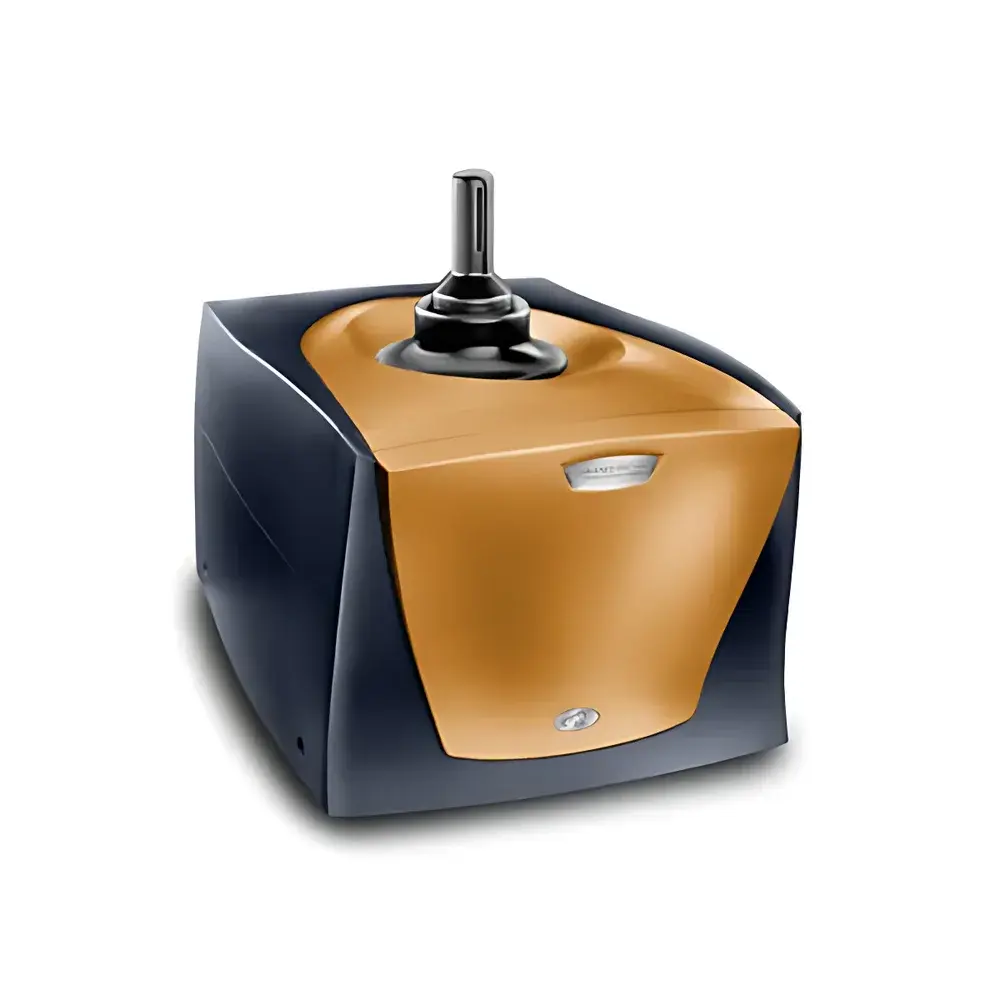
Nano ITC Isothermal Titration Calorimeter
| Brand | TA Instruments |
|---|---|
| Origin | USA |
| Model | Nano ITC |
| Temperature Range | 2–80 °C |
| Cell Volume Options | 1.0 mL (standard) or 0.19 mL (low-volume) |
| Thermal Control | Solid-state Peltier heating/cooling |
| Injection System | Removable syringe with high-precision stepper motor drive |
| Software | ITCRun and NanoAnalyze™ |
Overview
The Nano ITC Isothermal Titration Calorimeter is a high-sensitivity, research-grade instrument engineered for quantitative thermodynamic characterization of biomolecular interactions in solution. Operating on the principle of isothermal titration calorimetry (ITC), the Nano ITC directly measures the heat absorbed or released during sequential injections of ligand into a macromolecule-containing sample cell under strictly isothermal conditions. Unlike indirect methods relying on optical or electrochemical proxies, ITC provides model-free determination of binding affinity (Ka), stoichiometry (n), enthalpy (ΔH), and entropy (ΔS) in a single experiment—without labeling, immobilization, or modification of native biomolecules. The Nano ITC’s true power-compensation architecture eliminates baseline drift and thermal lag, enabling detection of heat changes as low as 0.1 μcal per injection—critical for weak-affinity interactions (Kd up to mM range) and dilute samples typical in structural biology, fragment-based drug discovery, and enzyme kinetics studies.
Key Features
- True isothermal operation via solid-state Peltier elements for rapid, stable, and precise temperature control across 2–80 °C (±0.001 °C stability)
- Dual-cell volume configuration: 1.0 mL standard cell for robust signal-to-noise in routine assays; 0.19 mL low-volume cell for precious or scarce samples (e.g., membrane proteins, synthetic peptides, or isotopically labeled complexes)
- High-precision, computer-controlled syringe drive with sub-microliter injection accuracy (typical precision ±0.2% RSD over full volume range)
- Removable injection syringe assembly enabling rapid exchange, solvent-compatible cleaning, and cross-contamination minimization between experiments
- Integrated thermal equilibration monitoring and real-time baseline correction algorithms to ensure data integrity during extended runs
- Low thermal mass design and optimized cell geometry to reduce mixing artifacts and improve peak resolution for multi-site or cooperative binding events
Sample Compatibility & Compliance
The Nano ITC accommodates a broad range of aqueous and buffered solutions—including those containing detergents (e.g., DDM, CHAPS), glycerol, DMSO (≤5% v/v), and reducing agents—without compromising thermal stability or measurement fidelity. Sample cells are constructed from chemically inert, high-conductivity materials compatible with standard ITC protocols for proteins, nucleic acids, carbohydrates, small-molecule inhibitors, and synthetic polymers. Instrument firmware and software comply with ALCOA+ principles for data integrity. Raw heat-flow data and processed thermograms are stored with immutable timestamps, user IDs, and audit trails. NanoAnalyze™ supports export to CSV, XML, and HDF5 formats for integration into LIMS or ELN systems. While not pre-certified as GMP-compliant out-of-the-box, the Nano ITC meets foundational requirements for GLP-regulated environments when deployed with documented SOPs, periodic calibration verification (per ASTM E2405), and system suitability testing per USP .
Software & Data Management
ITCRun serves as the acquisition interface—providing real-time visualization of raw power signals, automated baseline subtraction, and customizable injection sequences (variable volume, spacing, and dwell time). NanoAnalyze™ delivers comprehensive post-acquisition analysis: nonlinear regression fitting against one- or two-set-of-sites models, global fitting across multiple temperatures or concentrations, statistical evaluation of fit residuals, and Monte Carlo error propagation for derived thermodynamic parameters. Batch processing mode enables consistent re-analysis of large datasets (e.g., SAR series or thermal denaturation screens). All analysis steps are fully traceable: parameter initial guesses, convergence criteria, covariance matrices, and goodness-of-fit metrics (χ², AIC, F-test) are logged and exportable. Software adheres to FDA 21 CFR Part 11 requirements when operated in validated configurations with electronic signatures and role-based access controls enabled.
Applications
- Characterization of protein–ligand, protein–DNA/RNA, antibody–antigen, and receptor–peptide binding thermodynamics
- Fragment-based lead discovery (FBLD) where low-concentration screening demands maximal sensitivity
- Enzyme inhibition mechanism studies (competitive, uncompetitive, mixed-type) via direct measurement of inhibitor binding ΔH
- Validation of computational docking predictions and molecular dynamics simulations with experimental ΔH and ΔS values
- Thermal stability profiling through van’t Hoff analysis of Ka vs. temperature
- Quality control of biologics batch consistency by monitoring binding enthalpy reproducibility (RSD < 3% across replicates)
FAQ
What is the minimum sample concentration required for reliable Nano ITC measurements?
For the 1.0 mL cell, typical working concentrations range from 10–100 µM for the macromolecule and 100–1000 µM for the ligand. For the 0.19 mL cell, concentrations may be increased proportionally to maintain signal amplitude while conserving material.
Can the Nano ITC be used with non-aqueous solvents?
The instrument is optimized for aqueous buffers. Use of organic solvents beyond trace additives (e.g., ≤5% DMSO or ethanol) is not recommended due to thermal conductivity mismatch and potential damage to Peltier elements and seals.
How often does the Nano ITC require calibration?
Electrical calibration (power gain) is performed automatically at startup. Physical calibration using electrical heating pulses is recommended before critical experiments or after extended idle periods, per TA Instruments’ Standard Operating Procedure TR-ITC-001.
Is third-party data analysis supported?
Yes—raw .itc files contain complete metadata and unprocessed heat-flow time series, enabling import into Python (via pytc), MATLAB, or R-based thermodynamic modeling frameworks.
Does the Nano ITC support automated sample handling?
The base system operates manually. Integration with third-party autosamplers (e.g., HTP-120 or similar) is possible via TTL-triggered external control but requires custom cabling and validation.



