
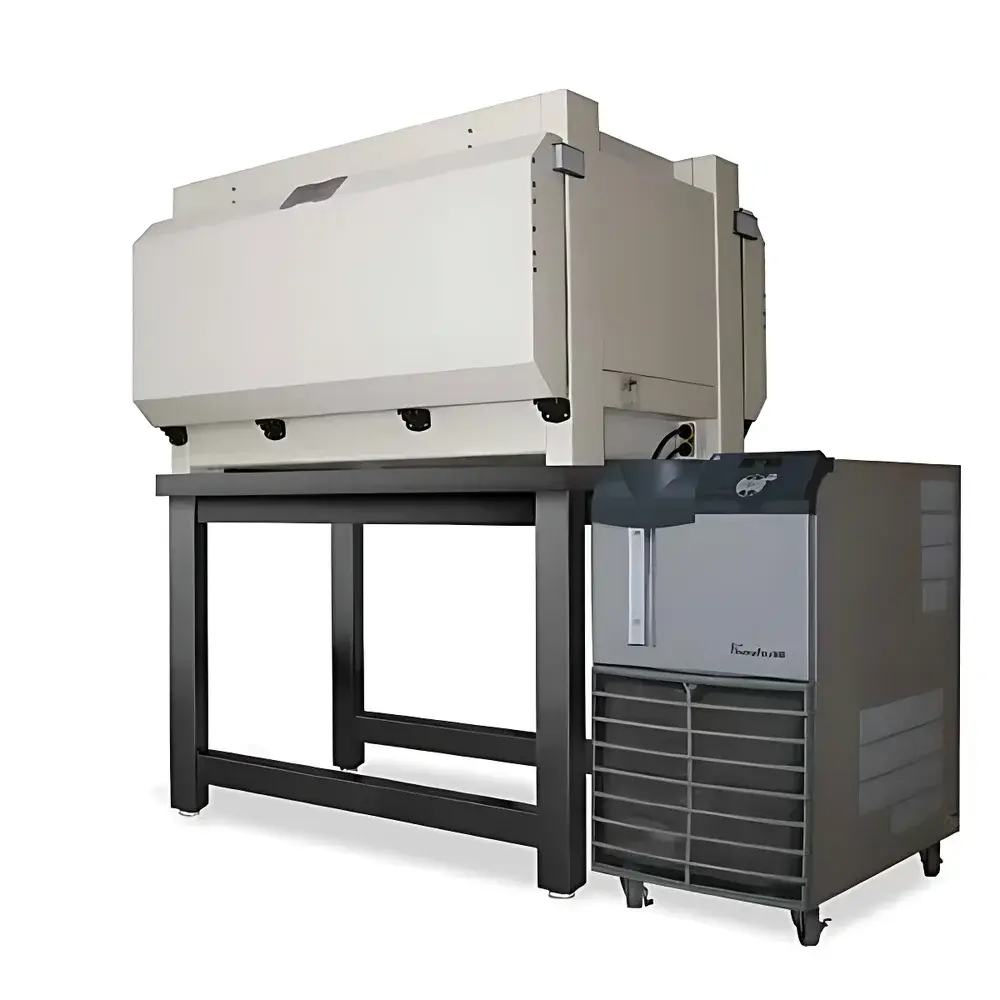
TA Instruments FOX 600 GHP Guarded Hot Plate Thermal Conductivity Analyzer
| Brand | TA Instruments |
|---|---|
| Origin | USA |
| Model | FOX 600 GHP |
| Measurement Principle | Guarded Hot Plate (GHP) |
| Compliance Standards | ASTM C177, ISO 8302, DIN EN 12667 |
| Operating Temperature Range | 90 °C to 250 °C |
| Sample Configuration | Single-specimen, symmetric arrangement |
| Thickness Measurement Method | Optical encoder-based digital displacement sensing |
| Temperature Uniformity Verification | 40 matched thermocouples |
| Thermal Stability Architecture | Dual-zone active temperature control with inert gas purge capability |
| Instrument Class | Primary-standard absolute thermal conductivity measurement system |
Overview
The TA Instruments FOX 600 GHP is a primary-standard guarded hot plate (GHP) thermal conductivity analyzer engineered for absolute, traceable measurement of thermal conductivity (λ) in low-conductivity insulating materials. Unlike comparative or transient techniques, the GHP method applies Fourier’s law directly under steady-state conditions: λ is calculated from the precisely measured electrical power input to the central hot plate, the known sample thickness (d), the uniform cross-sectional area (A), and the stabilized temperature difference (ΔT) across the specimen. This first-principles approach eliminates calibration dependencies on reference materials, making the FOX 600 GHP suitable for metrological-grade validation, certification testing, and regulatory submission where measurement uncertainty and traceability to NIST or national standards are critical. Designed specifically for high-temperature insulation characterization—particularly in the 90 °C to 250 °C range—the instrument features a dual-zone thermal architecture with independent control of hot and cold plates, minimizing lateral heat loss and ensuring axial one-dimensional heat flow per ISO 8302 requirements.
Key Features
- Single-specimen guarded hot plate configuration compliant with ASTM C177, ISO 8302, and DIN EN 12667 for absolute thermal conductivity determination
- Dual-zone active temperature control system with real-time feedback from 40 matched Type T thermocouples—ensuring ±0.05 °C temperature uniformity across both hot and cold plates
- Optical encoder-based digital thickness measurement with sub-micrometer resolution, eliminating mechanical hysteresis and enabling precise d-value input for λ calculation
- High-stability graphite heating elements and low-thermal-expansion ceramic insulation housing for long-term dimensional integrity at elevated temperatures
- Integrated inert gas purge ports (N₂ or Ar) to suppress convection and oxidation effects during high-temperature testing of organic or ceramic fiber boards
- Modular guard ring design with independently controlled thermal boundary to minimize edge losses and maintain >99.5% effective heat flux containment
Sample Compatibility & Compliance
The FOX 600 GHP accommodates rigid and semi-rigid flat specimens up to 305 mm × 305 mm (12″ × 12″) and thicknesses ranging from 10 mm to 100 mm. Compatible material classes include mineral wool, calcium silicate, aerogel composites, ceramic fiber boards, polyimide foams, and vacuum-insulated panels (VIPs). All measurements adhere to the strict geometric and thermal equilibrium criteria defined in ASTM C177 Annex A1 (for high-temperature applications) and ISO 8302 Annex B (for thermal uniformity verification). The system supports GLP-compliant operation through hardware-enforced test sequence logging, electronic signature-capable audit trails, and full compliance with FDA 21 CFR Part 11 requirements when paired with TA Instruments’ TRIOS GHP software module.
Software & Data Management
TRIOS GHP software provides fully automated test execution, real-time thermal equilibrium monitoring, and uncertainty propagation analysis per ISO/IEC 17025 guidelines. It calculates thermal conductivity, thermal resistance (R-value), and apparent thermal conductivity trends as a function of mean temperature. Raw thermocouple voltages, power supply outputs, and encoder position data are stored in HDF5 format with embedded metadata—including operator ID, environmental conditions, calibration certificate IDs, and instrument configuration snapshots. Export options include ASTM E145-compliant test reports, CSV time-series logs, and PDF certificates bearing digital signatures and NIST-traceable calibration statements.
Applications
- Validation of high-temperature insulation performance for industrial furnace linings and aerospace thermal protection systems
- Third-party certification testing for building envelope materials under ASHRAE 90.1 and EN ISO 10456 regulatory frameworks
- Development and QA of next-generation aerogel and nano-porous insulation products requiring <0.025 W/m·K accuracy at 200 °C
- Interlaboratory comparison studies coordinated by NIST, PTB, or UKAS-accredited proficiency testing schemes
- Supporting DOE and EU Horizon R&D programs focused on energy-efficient process heating and waste-heat recovery systems
FAQ
What distinguishes the guarded hot plate method from transient plane source (TPS) or laser flash analysis?
The GHP method delivers absolute thermal conductivity values without reliance on reference standards, whereas TPS and laser flash require calibration against known materials and assume homogeneous, isotropic behavior—making them unsuitable for heterogeneous or anisotropic insulators.
Can the FOX 600 GHP measure materials with thermal conductivity above 0.5 W/m·K?
While optimized for low-conductivity insulators (typically <0.2 W/m·K), the system can characterize higher-conductivity materials such as graphite foams or metal matrix composites when configured with enhanced cooling capacity and reduced ΔT gradients.
Is the instrument capable of measuring thermal conductivity as a function of temperature?
Yes—TRIOS GHP software enables multi-point temperature sweeps with automatic equilibrium detection, generating λ vs. T curves with uncertainty bands derived from repeated measurements at each setpoint.
How is traceability maintained for calibration and operation?
All temperature sensors are calibrated against NIST-traceable SPRTs; power meters are certified to ISO/IEC 17025 by an ILAC-MRA signatory lab; and thickness encoders are verified using laser interferometry with ≤±0.1 µm uncertainty.
Does the system support automated sample loading or robotic integration?
The standard configuration is manually loaded; however, custom integration with Cartesian gantry systems or SEMI-compliant wafer handlers is available via RS-485 and EtherCAT interfaces for high-throughput production environments.



