
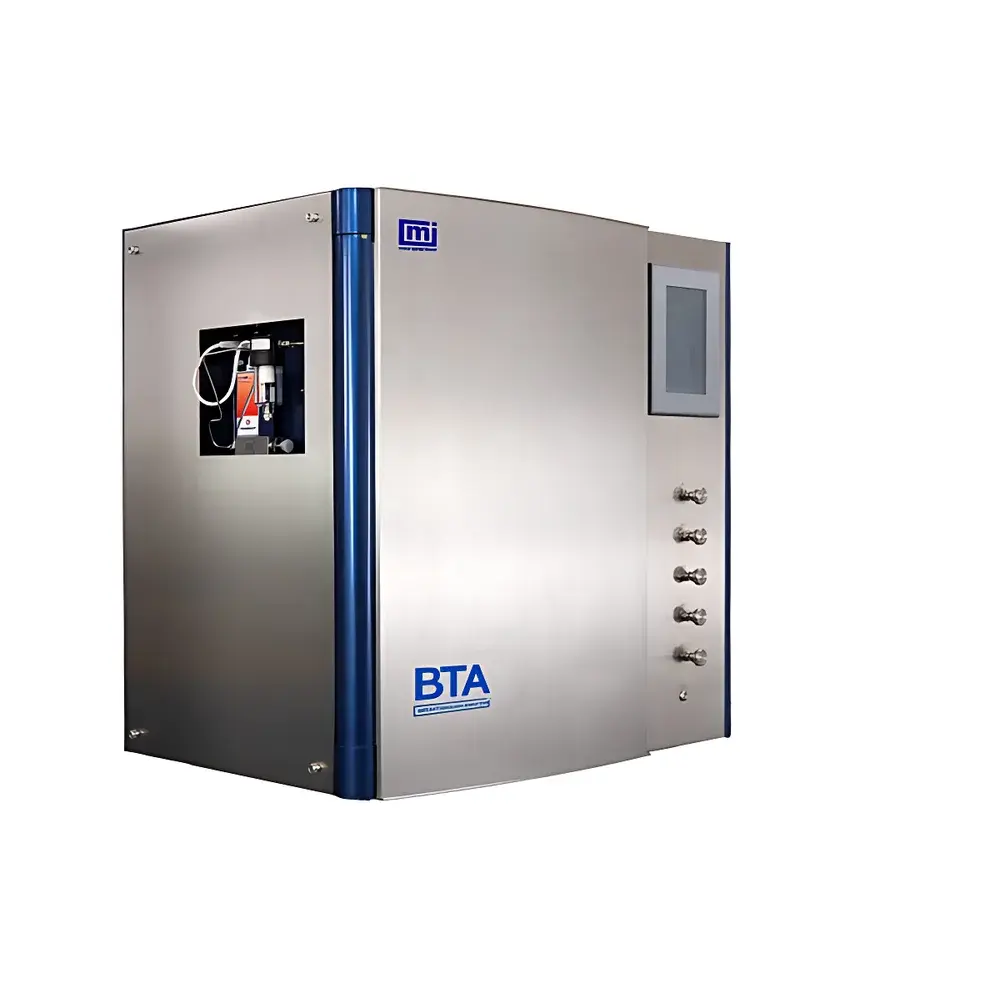
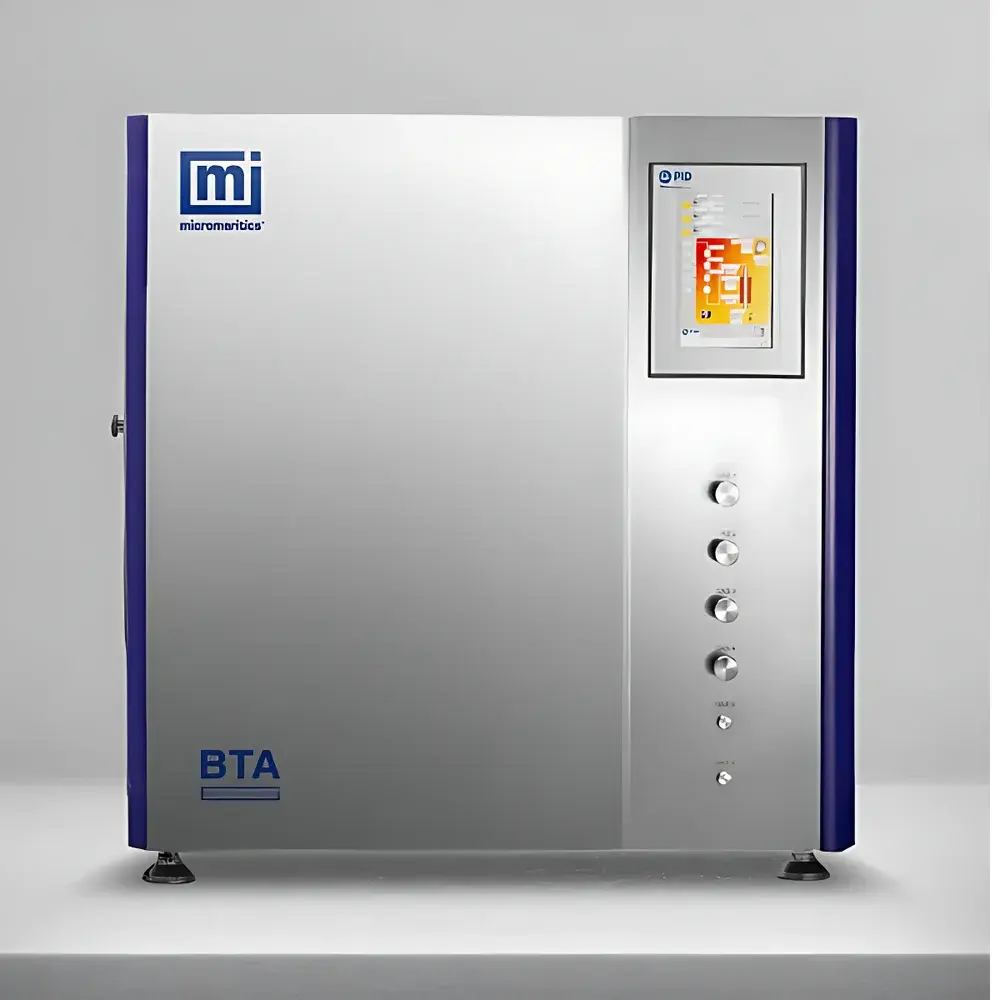
Micromeritics BTA Breakthrough Curve Analyzer
| Brand | Micromeritics |
|---|---|
| Origin | USA |
| Manufacturer Type | Authorized Distributor |
| Product Category | Imported Instrument |
| Model | BTA |
| Instrument Type | Physical/Chemical Adsorption Analyzer |
| Measurement Principle | Dynamic Breakthrough Adsorption |
| Gas Inlet Ports | 6 |
| Maximum Heating Temperature | 1,050 °C |
| Isothermal Stability Range | Up to 200 °C |
| Pressure Range | Up to 30 bar |
| Key Functionality | Competitive Adsorption, Multi-component Transient Adsorption Profiling |
Overview
The Micromeritics BTA Breakthrough Curve Analyzer is a purpose-built dynamic adsorption system engineered for high-fidelity characterization of adsorbent materials under realistic process conditions. It operates on the principle of breakthrough curve analysis—measuring the time-resolved concentration profile of gas or vapor components as they pass through a packed adsorbent bed under controlled temperature, pressure, and flow conditions. Unlike static volumetric or gravimetric adsorption analyzers, the BTA captures kinetic, thermodynamic, and selectivity data simultaneously by monitoring effluent composition in real time using integrated or externally coupled detectors (e.g., MS, GC, FTIR). This enables quantitative determination of dynamic capacity, mass transfer zone (MTZ) length, adsorption kinetics, and competitive equilibrium behavior across multi-component mixtures—critical parameters for scaling adsorption-based separation processes such as CO₂ capture, hydrogen purification, VOC abatement, and energy storage media development.
Key Features
- Patented high-performance hybrid valve manifold minimizing system dead volume and ensuring rapid, reproducible gas switching with sub-second response times.
- Six independently controlled gas/vapor inlet ports supporting complex feed compositions—including inert carriers, reactive gases (e.g., CO₂, H₂, CH₄), and condensable vapors—with precise stoichiometric blending via calibrated mass flow controllers (MFCs).
- Dual-zone thermal management: a uniform isothermal hot zone (up to 200 °C, ±0.5 °C stability) surrounding the breakthrough column, and a separate high-temperature furnace (up to 1,050 °C) for in situ sample activation, regeneration, or high-temperature adsorption studies.
- Modular detector interface enabling seamless integration with quadrupole mass spectrometers (QMS), gas chromatographs (GC), or Fourier-transform infrared (FTIR) spectrometers for species-specific effluent quantification.
- Automated safety interlocks including door-locking during operation, over-temperature cutoffs, pressure relief protocols, and real-time alarm logging compliant with laboratory safety standards (ANSI Z9.5, ISO 13849-1).
- Configurable high-pressure operation up to 30 bar, validated for use with compressed gas mixtures and supercritical fluid systems.
Sample Compatibility & Compliance
The BTA accommodates powdered, granular, or extruded adsorbents ranging from 0.05 g to 2.5 g per test, with column diameters adaptable from 4 mm to 25 mm ID. It supports both metal oxide catalysts (e.g., Cu–BTC, Mg-MOF-74), zeolites (13X, 5A), activated carbons, silica gels, and novel porous polymers. All wetted parts are constructed from electropolished 316 stainless steel or VCR-compatible high-purity alloys, ensuring compatibility with corrosive or reactive streams (e.g., H₂S, NH₃, Cl₂). The system meets requirements for GLP-compliant data acquisition when paired with MicroActive software configured for 21 CFR Part 11 audit trails, electronic signatures, and secure user access levels. Test methodologies align with ASTM D6603 (dynamic adsorption capacity), ISO 15901-2 (pore size distribution via breakthrough), and USP for pharmaceutical excipient characterization.
Software & Data Management
MicroActive software serves as the unified control, acquisition, and analysis platform for the BTA. It provides full automation of pre-conditioning (degassing, purging, heating ramps), breakthrough experiment execution (flow programming, stepwise concentration changes, pressure ramping), and post-run modeling. Built-in solvers compute axial dispersion coefficients, Langmuir/Freundlich isotherm parameters, and Thomas/Yoon–Nelson breakthrough models directly from raw detector signals. Data export supports CSV, HDF5, and ASTM E1382-compliant formats. Version-controlled method templates ensure inter-laboratory reproducibility, while encrypted project archives meet ISO/IEC 27001 data integrity benchmarks. Optional remote monitoring via TLS-secured web interface allows off-site supervision without compromising firewall compliance.
Applications
- CO₂ capture screening: evaluating amine-functionalized sorbents under flue-gas-relevant humidity and trace impurity conditions (SOₓ, NOₓ, O₂).
- Hydrogen purification: quantifying H₂/CH₄ or H₂/CO selectivity in pressure-swing adsorption (PSA) cycles at elevated temperatures.
- VOC removal: determining breakthrough times and saturation capacities for activated carbon or MOF-based filters exposed to mixed hydrocarbon streams.
- Nuclear fuel cycle support: characterizing iodine or cesium adsorption on silver-exchanged zeolites under simulated off-gas atmospheres.
- Energy storage: assessing methane or hydrogen working capacity in porous carbons under cyclic loading/unloading at varying pressures and temperatures.
FAQ
What types of detectors can be interfaced with the BTA system?
The BTA features standardized analog/digital I/O and RS-485 ports compatible with commercial mass spectrometers (e.g., Hiden HPR-20), gas chromatographs (e.g., Agilent 7890B), and FTIR systems (e.g., Thermo Nicolet iS50). Detector synchronization is managed via TTL triggers and time-stamped data alignment within MicroActive.
Does the BTA support automated regeneration studies?
Yes. The software includes customizable thermal swing (TSA) and pressure swing (PSA) regeneration protocols, with real-time monitoring of desorbed species and cumulative capacity loss tracking across ≥100 cycles.
Can the system operate under humidified or liquid-vapor co-feed conditions?
Absolutely. An optional saturated vapor generator module delivers precise partial pressures of water, ethanol, or other condensables—enabling humidity-dependent breakthrough studies relevant to post-combustion CO₂ capture and air filtration R&D.
Is calibration traceable to NIST standards?
All MFCs are factory-calibrated against NIST-traceable reference standards (SRM 1968, SRM 2800), with recalibration certificates available upon request. Pressure transducers are certified to ANSI/ASME B40.100.
How is data integrity ensured during long-duration experiments?
MicroActive implements cyclic redundancy checking (CRC-32), automatic checkpoint saving every 30 seconds, and dual-write buffering to prevent data loss during power interruption or software reset.



