
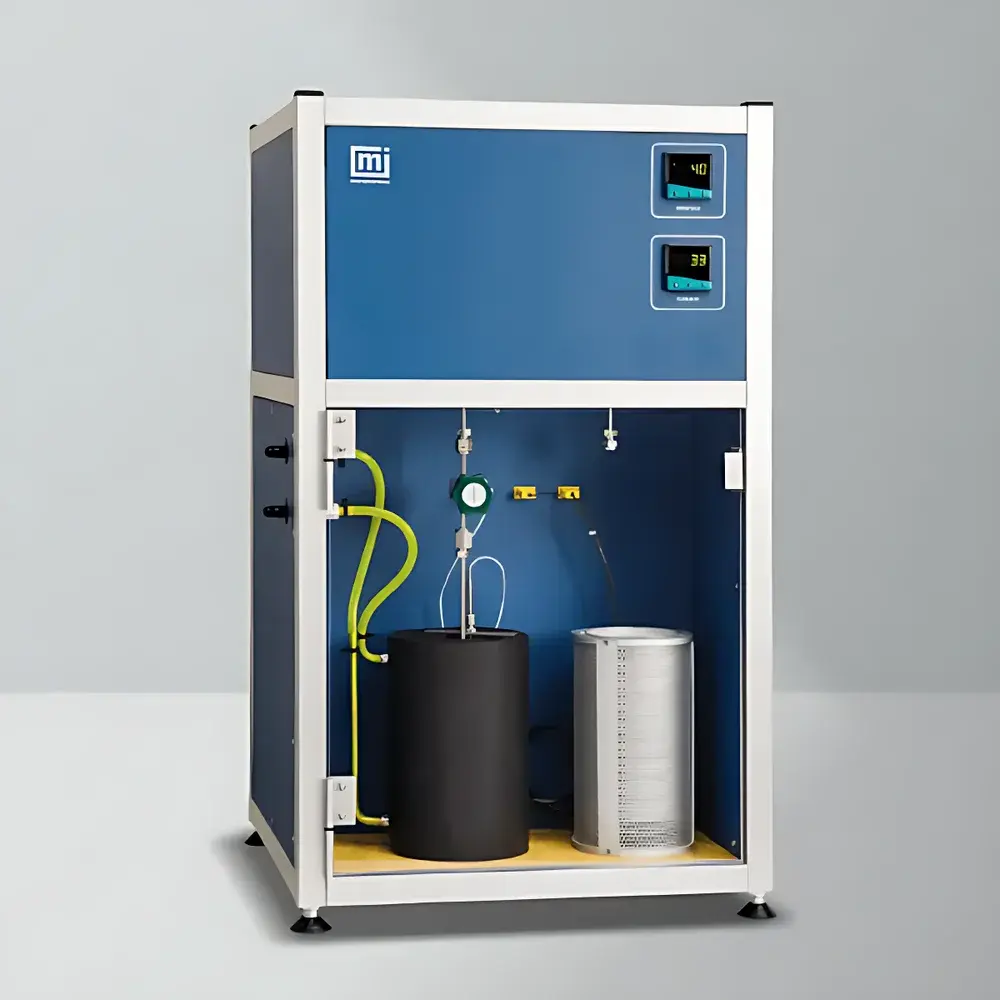
Micromeritics HPVA II High Pressure Volumetric Gas Adsorption Analyzer
| Brand | Micromeritics |
|---|---|
| Origin | USA |
| Model | HPVA-II |
| Measurement Principle | Static Volumetric Method (High-Pressure Capacity Technique) |
| Temperature Range | 30 K to 500 °C |
| Pressure Range | Ultra-High Vacuum (≤1×10⁻⁹ Torr) to 200 bar |
| Vacuum Level | <1×10⁻⁹ Torr |
| Compatible Gases | H₂, CH₄, CO₂, N₂, Ar, and other non-corrosive gases |
| Sample Requirement | As low as 5–50 mg |
| Sample Types | MOFs, Zeolites, Activated Carbons, Porous Polymers, Metal Hydrides, Catalyst Supports |
| Thermal Control Options | Liquid Cryogen Dewar (4 L stainless steel), External Circulating Bath, Resistive Heating Furnace, Closed-Cycle Cryocooler Integration |
Overview
The Micromeritics HPVA II High Pressure Volumetric Gas Adsorption Analyzer is an engineered platform for quantitative characterization of gas-solid interactions under extreme thermodynamic conditions. It operates on the static volumetric principle—measuring pressure changes in a calibrated, thermostatted system following incremental gas dosing—to generate high-fidelity adsorption and desorption isotherms across pressures from ultra-high vacuum (<1×10⁻⁹ Torr) up to 200 bar and temperatures spanning 30 K to 500 °C. This capability enables rigorous thermodynamic and kinetic analysis of physisorption and chemisorption processes critical to energy storage, carbon capture, catalysis, and separations science. Unlike dynamic or gravimetric approaches, the HPVA II’s sealed, rigid-volume architecture ensures exceptional mass balance integrity and long-term baseline stability—essential for reproducible uptake quantification at sub-micromole precision.
Key Features
- Ultra-Wide Operational Envelope: Seamless coverage from cryogenic (30 K) to high-temperature (500 °C) regimes, supported by interchangeable thermal control modules—including a 4 L stainless steel liquid cryogen Dewar, programmable resistive furnace, and compatibility with closed-cycle refrigerators for automated low-T operation.
- High-Integrity Vacuum & Pressure Management: Dual-stage turbomolecular pumping system achieves base pressures <1×10⁻⁹ Torr; pressure transducers traceable to NIST standards cover ranges from 0–1000 mbar (capacitance manometer) to 0–200 bar (strain-gauge transducer), with active temperature compensation.
- Modular Sample Cell Design: Standard cells accommodate 5–50 mg of powder, monoliths, or pellets; optional high-surface-area or reactive-material cells include sapphire viewports, integrated thermocouples, and corrosion-resistant linings for aggressive gas environments (e.g., H₂S, NH₃).
- Automated Gas Dosing & Purity Management: Eight independent gas inlets with electropneumatic valves, internal gas purifiers (oxygen/moisture scrubbers), and real-time gas purity verification via integrated residual gas analyzer (RGA) option.
- Robust Mechanical Architecture: All-welded stainless-steel manifold, helium-leak-tested to <1×10⁻¹⁰ atm·cm³/s; vibration-isolated optical table mounting; ESD-safe grounding and Class I Division 2 electrical certification for hazardous area deployment.
Sample Compatibility & Compliance
The HPVA II accommodates diverse advanced materials including metal–organic frameworks (MOFs), zeolitic imidazolate frameworks (ZIFs), covalent organic frameworks (COFs), activated carbons, templated silicas, and transition-metal hydrides. Its design complies with ASTM D3663 (Standard Test Method for Surface Area of Catalysts), ISO 15901-2 (Porous materials — Mercury porosimetry and gas adsorption), and supports method development aligned with USP (Water Content) and ISO 13785 (Hydrogen storage materials). Full audit trail logging, electronic signatures, and 21 CFR Part 11–compliant software mode are available for GLP/GMP-regulated laboratories conducting material qualification for DOE, IEA, or industrial hydrogen infrastructure programs.
Software & Data Management
MicroActive software provides fully interactive isotherm analysis—supporting Langmuir, BET, Dubinin–Astakhov, Toth, and Virial models—with simultaneous multi-isotherm fitting, uncertainty propagation, and thermodynamic derivative calculation (isosteric heat of adsorption, entropy, Gibbs free energy). Raw data (pressure, temperature, time, valve state) are stored in HDF5 format with embedded metadata (instrument ID, calibration certificates, operator ID, environmental logs). Export options include ASTM-compliant CSV, ISA-88 S88 batch records, and direct integration with LIMS via OPC UA or RESTful API. All processing steps are scriptable in Python using the included MicroActive SDK.
Applications
- Hydrogen storage capacity and deliverable energy density assessment per SAE J2718 and ISO 16111 protocols
- CO₂ adsorption enthalpy and selectivity modeling for post-combustion capture and direct air capture sorbent screening
- Methane working capacity evaluation for ANG (adsorbed natural gas) vehicle tank systems
- Adsorbate–adsorbent interaction mapping in battery electrode interfaces (e.g., Li–S cathodes, solid-state electrolyte wetting)
- Thermal stability and decomposition onset detection during in situ high-T isotherm acquisition
- Validation of molecular simulation outputs (GCMC, DFT) against experimental isotherms at supercritical conditions
FAQ
What gases are supported for analysis on the HPVA II?
H₂, CH₄, CO₂, N₂, Ar, O₂, and He are standard; custom configurations support C₂H₆, C₃H₈, SF₆, and other non-corrosive gases with appropriate sealing and sensor selection.
Can the HPVA II perform isosteric heat of adsorption calculations?
Yes—via the Clausius–Clapeyron method applied to multiple isotherms acquired at different temperatures, with full error propagation and confidence interval estimation in MicroActive.
Is remote operation and monitoring supported?
The system includes Ethernet-connected PLC control, VNC-enabled instrument server, and optional cloud-based telemetry for real-time status alerts and diagnostic log streaming.
How is sample outgassing handled prior to adsorption measurement?
Programmable vacuum/temperature ramping profiles allow controlled degassing under dynamic vacuum or inert purge, with real-time mass spectrometry monitoring available via RGA integration.
Does the HPVA II meet regulatory requirements for pharmaceutical or nuclear applications?
With 21 CFR Part 11 software mode enabled, full electronic record integrity, role-based access control, and change-controlled firmware updates satisfy FDA, EMA, and IAEA documentation mandates for qualified material testing environments.



