
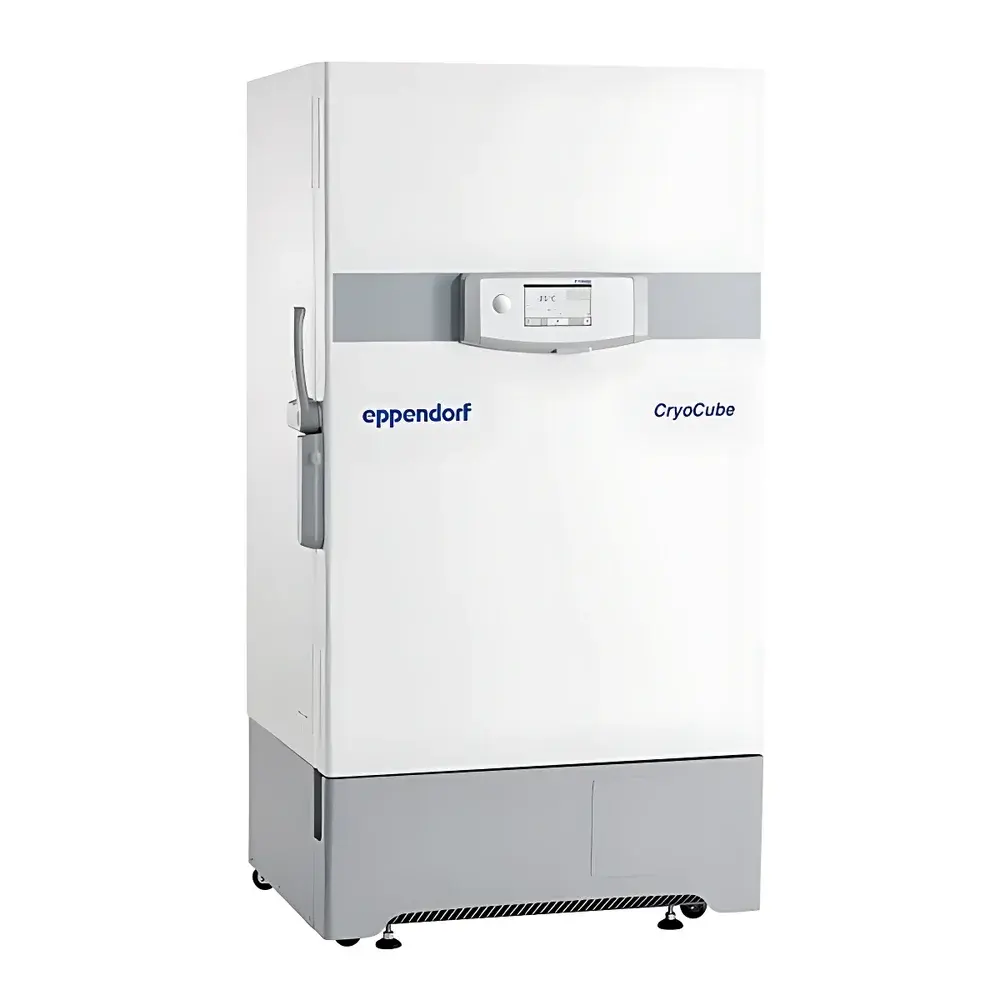
Eppendorf CryoCube F740hi Ultra-Low Temperature Freezer
| Brand | Eppendorf |
|---|---|
| Origin | United Kingdom |
| Manufacturer Type | Original Equipment Manufacturer (OEM) |
| Import Status | Imported |
| Model Series | CryoCube F740 |
| Effective Storage Volume | 740 L |
| Interior Dimensions (W×D×H, mm) | 865 × 621 × 1390 |
| Exterior Dimensions (W×D×H, mm) | 1090 × 980 × 1973 |
| Power Supply | 230 V, 50 Hz |
| Rated Power Consumption | 1000 W |
| Noise Level | 41.3 dB(A) |
| Refrigerant | R290/R170 (hydrocarbon blend) |
| Certification | ENERGY STAR® Qualified |
Overview
The Eppendorf CryoCube F740hi is a high-capacity, energy-optimized ultra-low temperature (ULT) freezer engineered for long-term cryopreservation of sensitive biological materials—including primary cells, stem cell lines, genomic DNA, RNA, proteins, and clinical biospecimens—at stable –80 °C operating temperatures. Built upon Eppendorf’s PhysioCare design philosophy, the system integrates ergonomic workflow optimization with thermodynamic efficiency and robust mechanical architecture. Its dual-stage cascade refrigeration system delivers rapid cooldown (<12 hours from ambient to –80 °C) and exceptional temperature recovery performance following door openings—critical for maintaining sample integrity in high-throughput biorepositories and GxP-compliant laboratories. The unit complies with IEC 61010-1 (safety of laboratory equipment) and IEC 60529 (IPX4-rated condensate management), and its hydrocarbon-based refrigerant blend (R290/R170) meets global environmental directives including the EU F-Gas Regulation and Montreal Protocol phase-down schedules.
Key Features
- Dual-stage cascade refrigeration system with high-efficiency compressors, enabling rapid initial cooldown and <4 min temperature recovery after 30-second door opening (tested per ISO 23747:2022 Annex D)
- ENERGY STAR® certified operation—reducing annual energy consumption by up to 35% compared to legacy R404A-based ULT freezers of equivalent volume
- 41.3 dB(A) acoustic emission level, achieved via repositioned front air filter geometry and dedicated rear sound-dampening chamber
- Intuitive 7-inch capacitive touchscreen interface with multilingual support and real-time display of internal temperature, compressor status, alarm history, and door-open duration
- Electronic door lock with role-based user authentication (administrator, operator, technician) and audit-trail logging compliant with FDA 21 CFR Part 11 requirements
- VisioNize Cloud Connect integration for remote monitoring, configurable email/SMS alerts, and encrypted data export via front-panel USB 2.0 port (CSV/Excel format)
Sample Compatibility & Compliance
The CryoCube F740hi supports standard cryogenic storage configurations—including 2-inch and 1.4-inch冻存盒 (cryoboxes), rack-mounted vials (0.5–5.0 mL), and stacked cryo-canisters—without compromising thermal uniformity across the 740 L chamber. Internal airflow is validated per ISO 14644-1 Class 5 cleanroom-grade laminar distribution, minimizing frost accumulation on sample surfaces. All materials in contact with stored specimens comply with USP Class VI biological safety testing. The system is validated for continuous operation under GLP and GMP environments, with full documentation packages available (IQ/OQ/PQ protocols, calibration certificates traceable to NIST standards). It meets ASTM F2636-21 for ULT freezer performance verification and supports ISO 20387:2018 biobanking quality management requirements.
Software & Data Management
VisioNize software provides secure, browser-based access to real-time and historical environmental data—including temperature trends (±0.2 °C accuracy), compressor runtime, defrost cycles, and alarm event logs. Data encryption (AES-256 at rest and TLS 1.2+ in transit), automatic daily backups, and configurable retention policies ensure regulatory readiness. Audit trails record all user actions—including parameter changes, unlock events, and report generation—with immutable timestamps. Integration with LIMS platforms (via HL7 or RESTful API) enables automated sample inventory synchronization and chain-of-custody tracking. All firmware updates are digitally signed and delivered through Eppendorf’s secure update portal.
Applications
- Long-term archival storage of human tissue samples, PBMCs, and induced pluripotent stem cells (iPSCs) in academic biobanks and clinical trial repositories
- Stabilization of thermolabile enzymes, monoclonal antibodies, and mRNA-LNP formulations during QC/QA release testing
- Supporting ISO/IEC 17025-accredited testing laboratories requiring documented cold chain continuity for reference material storage
- Enabling decentralized sample logistics in multi-site pharmacovigilance and companion diagnostic development programs
- Integration into automated sample handling workflows via dry-contact door interlock signaling and Modbus TCP communication protocol
FAQ
What is the temperature uniformity specification across the 740 L chamber?
Temperature variation is ≤ ±2.5 °C (max deviation) at steady state (–80 °C), measured at 9 standardized points per IEC 60068-3-5.
Does the CryoCube F740hi support validation services for GxP environments?
Yes—Eppendorf offers factory-verified IQ/OQ protocols, third-party PQ execution support, and electronic signature-enabled documentation packages aligned with Annex 11 and ALCOA+ principles.
Can VisioNize data be exported in machine-readable formats for enterprise analytics platforms?
Yes—CSV exports include ISO 8601 timestamps, sensor IDs, and metadata tags; JSON and XML APIs are available under enterprise licensing agreements.
Is the R290/R170 refrigerant compatible with existing facility HVAC or fire suppression systems?
Hydrocarbon refrigerants require no modification to standard lab ventilation but mandate compliance with local building codes for flammable refrigerant containment (e.g., ASHRAE 15-2022 Section 8.9.2); installation clearance and leak detection recommendations are provided in the Technical Installation Manual.
How frequently does the system require preventive maintenance?
Compressor oil analysis and condenser coil inspection are recommended every 12 months; full service intervals are extended to 24 months under typical usage (≤4 door openings/day) per Eppendorf Service Bulletin SB-F740-2023-01.
Related Products




