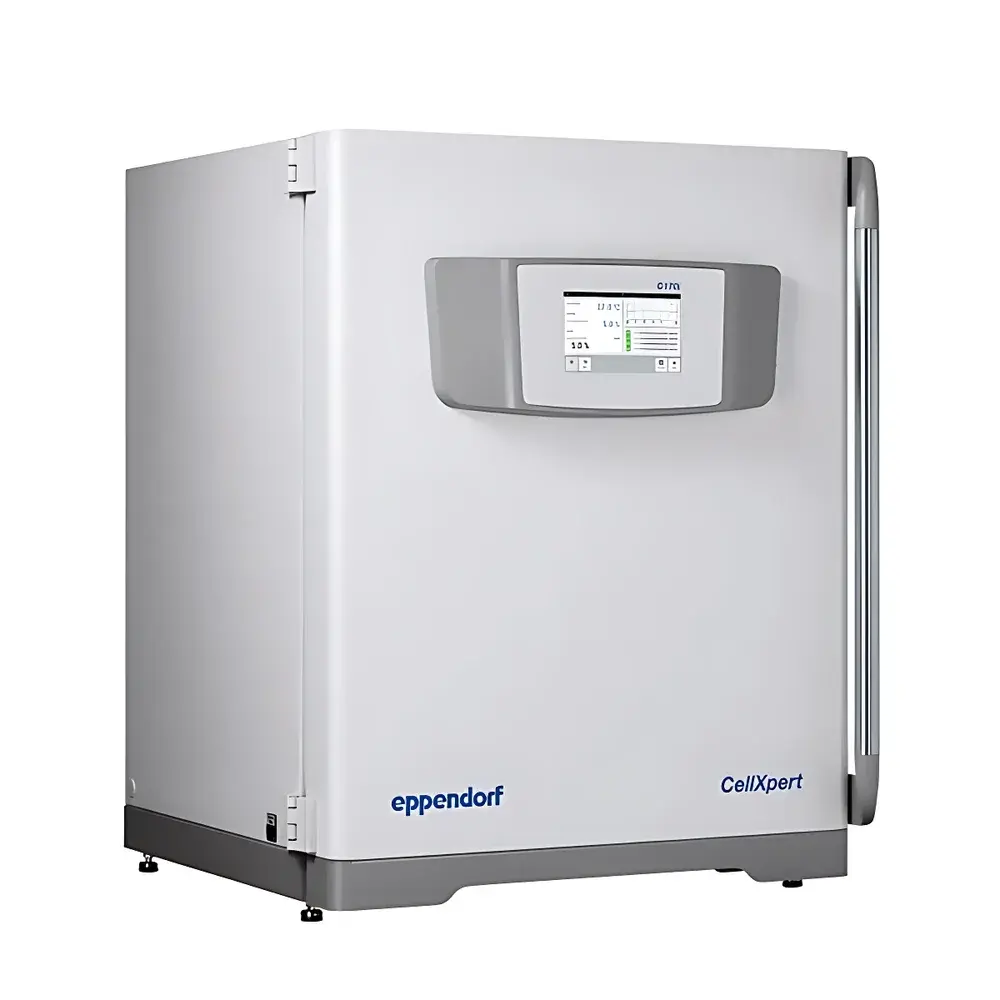
Eppendorf CellXpert C170i Carbon Dioxide Incubator
| Brand | Eppendorf |
|---|---|
| Origin | Germany |
| Manufacturer Type | Original Equipment Manufacturer (OEM) |
| Import Status | Imported |
| Model | CellXpert C170i |
| Temperature Range & Accuracy | 4–50 °C |
| Temperature Uniformity | ±0.3 °C |
| Humidity Range & Accuracy | 90–95 %RH |
| Chamber Capacity | 170 L |
Overview
The Eppendorf CellXpert C170i Carbon Dioxide Incubator is a high-performance, 170 L benchtop CO2 incubator engineered for precision cell culture applications requiring stringent environmental control. It employs a fan-free, six-sided direct heating system—eliminating air turbulence and thermal gradients—to maintain exceptional temperature homogeneity (±0.3 °C) across the entire chamber volume. This architecture ensures stable, reproducible conditions critical for sensitive mammalian cell lines, including embryonic stem cells (ESCs), mesenchymal stem cells (MSCs), induced pluripotent stem cells (iPSCs), and complex 3D organoid cultures. The incubator operates within a certified temperature range of 4–50 °C and delivers humidity control at 90–95 %RH via integrated water-jacketed evaporation and saturation monitoring—without reliance on external humidification reservoirs or ultrasonic misting that may introduce microbial risk. Manufactured in Germany to ISO 13485-certified quality standards, the C170i meets foundational requirements for GLP-compliant laboratories and supports alignment with ISO/IEC 17025 and FDA 21 CFR Part 11 when paired with validated VisioNize data management protocols.
Key Features
- Fan-free six-wall heating system: Eliminates convective airflow, reducing shear stress on adherent and suspension cultures while increasing usable internal volume by up to 25% compared to forced-air designs.
- Rapid environmental recovery: Achieves ≤5-minute stabilization of both temperature and CO2 concentration (±0.1 %) after door opening—without overshoot—minimizing transient stress during routine handling.
- 180 °C dry-heat decontamination cycle: Fully automated, validated sterilization protocol eliminating bacterial endospores, mycoplasma, and fungi; includes real-time chamber temperature profiling and post-cycle cooling verification.
- Modular expansion capability: Field-upgradable options include O2 control (hypoxia/anoxia modules), integrated CO2 sensor redundancy, and Ethernet-based remote alarm interfaces compliant with BACnet/IP and Modbus TCP.
- VisioNize™ embedded interface: 7-inch capacitive touchscreen with intuitive workflow navigation, multi-user access control (role-based permissions), and timestamped event logging—including door openings, parameter changes, and sterilization cycles.
Sample Compatibility & Compliance
The CellXpert C170i is validated for use with standard T-flasks (up to 225 cm²), stackable culture vessels, multiwell plates (6–384-well), and specialized bioreactor-compatible platforms. Its stainless-steel interior (AISI 316L), seamless chamber corners, and removable shelving support rigorous cleaning validation per ISO 14644-1 Class 5 cleanroom practices. All firmware and VisioNize software are developed under IEC 62304 Class B medical device software lifecycle requirements. The system complies with EN 61010-1 (safety), EN 61326-1 (EMC), and supports audit-ready documentation for ISO 9001, ISO 13485, and EU Annex 11 (Computerized Systems) compliance frameworks.
Software & Data Management
VisioNize firmware provides native audit-trail functionality with immutable, encrypted event logs—including user ID, timestamp, parameter values, and contextual annotations. Data export is supported in CSV and PDF formats, with optional integration into LIMS or ELN systems via RESTful API (OAuth 2.0 secured). Electronic signatures, user authentication (LDAP/Active Directory), and configurable retention policies align with 21 CFR Part 11 Subpart B requirements. Firmware updates are delivered through signed, version-controlled packages with rollback capability and integrity checksum verification.
Applications
- Long-term maintenance and expansion of pluripotent stem cell lines under defined hypoxic (5% O2) or normoxic (21% O2) conditions.
- High-fidelity 3D organoid differentiation protocols requiring sustained humidity stability and minimal CO2 fluctuation over multi-day timelines.
- GMP-aligned cell banking operations where traceability, environmental consistency, and sterilization validation are mandated.
- Co-culture experiments involving primary human cells and immune cell subsets, where microenvironmental fidelity directly impacts functional readouts.
- Preclinical toxicology assays using metabolically active hepatocyte spheroids or neuronal co-cultures sensitive to thermal transients.
FAQ
What is the recommended calibration frequency for the CO2 sensor?
Eppendorf recommends annual calibration using NIST-traceable gas standards; internal diagnostics monitor sensor drift continuously and alert users when recalibration is advised.
Can the C170i be integrated into a centralized building management system (BMS)?
Yes—via optional BACnet/IP or Modbus TCP gateway modules, enabling real-time status monitoring, alarm forwarding, and remote parameter adjustment within enterprise infrastructure.
Is the 180 °C decontamination cycle validated against specific microbial strains?
The cycle has been independently verified per ISO 14644-1 Annex B to achieve ≥6-log reduction of Bacillus atrophaeus spores and Mycoplasma hominis, with full thermographic mapping confirming uniform chamber temperature distribution.
Does the incubator support dual-language UI operation?
VisioNize supports English, German, French, Spanish, Japanese, and simplified Chinese language packs—configurable per user profile without firmware reflash.
What power supply specifications are required for uninterrupted operation?
The unit operates on 100–240 V AC, 50/60 Hz, with optional UPS compatibility via dry-contact alarm outputs and programmable shutdown sequencing to preserve sample integrity during grid failure.