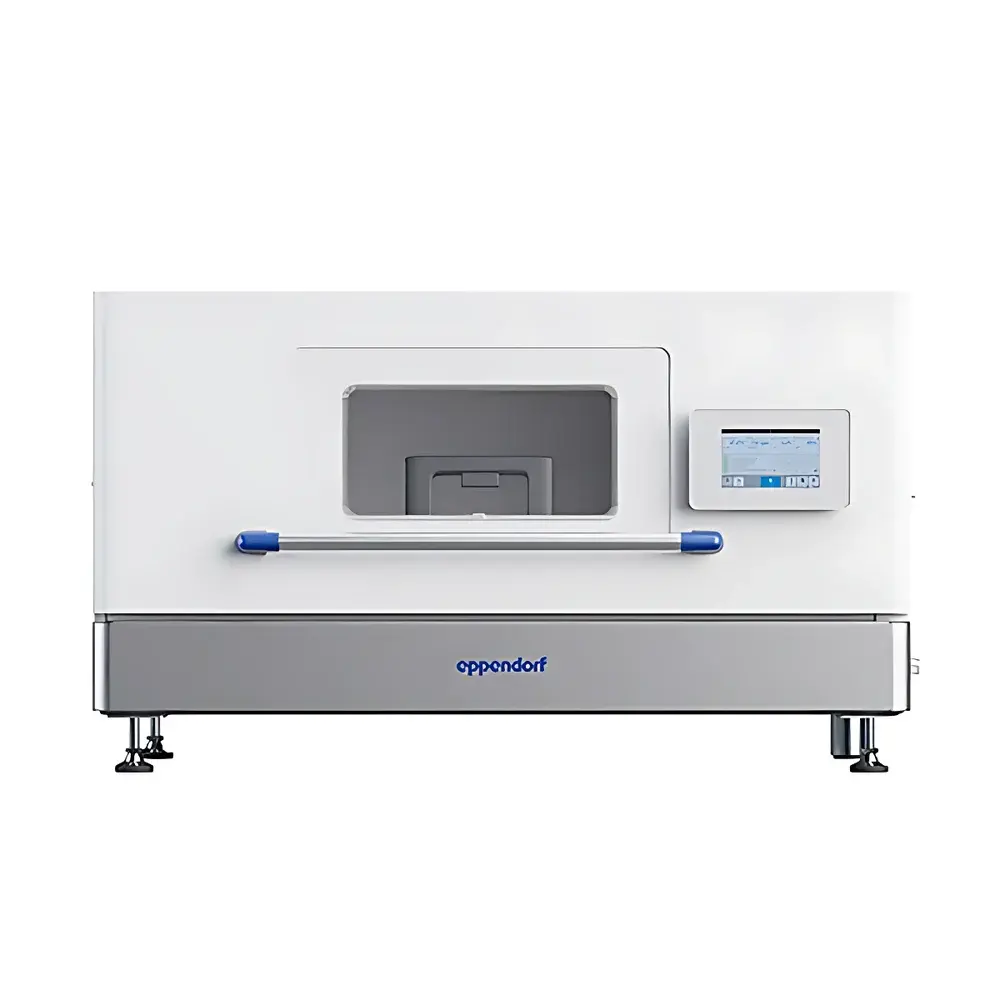
Eppendorf CellXpert CS220 CO₂ Incubated Shaker
| Brand | Eppendorf |
|---|---|
| Origin | Germany |
| Manufacturer | Eppendorf AG |
| Type | Air-jacketed CO₂ incubated shaker |
| CO₂ Detection | Thermal Conductivity (TC) sensor |
| Temperature Range & Accuracy | +8 °C above ambient to 60 °C |
| CO₂ Concentration Range & Accuracy | 0.1–20% (±0.1% at 5% CO₂) |
| Humidity Control | Active dual-directional humidification, up to 85% rH, condensation-free operation |
| Chamber Capacity | 220 L |
| External Dimensions (W×D×H) | 77.3 × 131.8 × 80.5 cm |
Overview
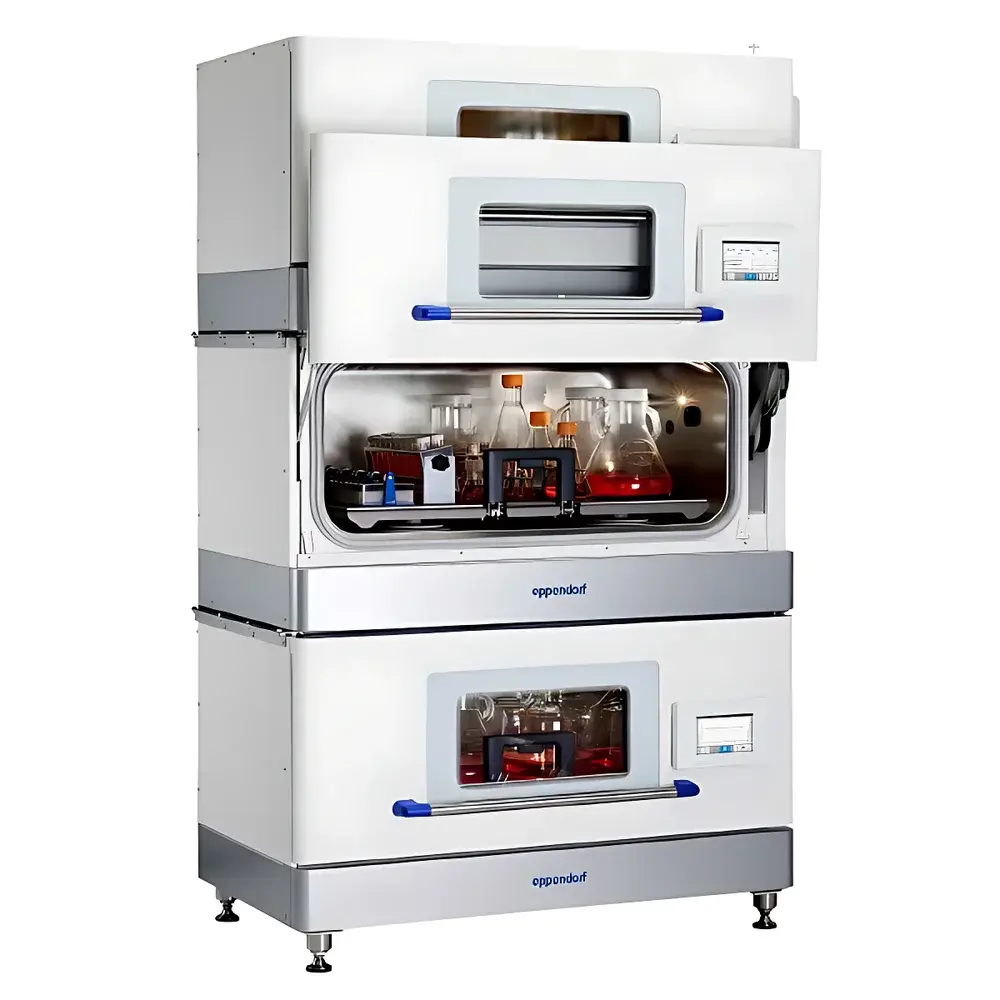
The Eppendorf CellXpert® CS220 CO₂ Incubated Shaker is an engineered solution for high-throughput suspension culture of mammalian cells under tightly controlled physiological conditions. Combining precise CO₂-regulated incubation with orbital shaking in a single integrated platform, it operates on the principle of air-jacketed thermal regulation and closed-loop CO₂ feedback control via thermal conductivity sensing—ensuring stable gas composition, temperature homogeneity, and mechanical consistency across the entire 220 L chamber. Designed specifically for bioprocess development, upstream cell line screening, and scalable suspension culture workflows, the CS220 eliminates the need for separate incubators and shakers—reducing footprint, cross-contamination risk, and operational variability. Its modular stackable architecture (up to three units vertically aligned) supports laboratory space optimization without compromising accessibility or serviceability.
Key Features
- Integrated 180 °C dry-heat sterilization cycle with guided workflow and downloadable performance verification reports—validated per ISO 14644-1 Class 5 cleanroom-compatible protocols and compliant with GLP/GMP documentation requirements.
- Eppendorf X-drive™ orbital drive system featuring four load-bearing support shafts, engineered for continuous 24/7 operation with <0.5 mm amplitude deviation over 10⁶ cycles—delivering long-term mechanical reproducibility critical for kinetic studies and process transfer.
- Single-piece seamless stainless-steel inner chamber with radiused corners (per EN ISO 14159:2008 hygienic design standard), zero internal airflow obstructions, no hidden crevices, and only two removable components (shaking plate and base plate)—enabling full-chamber decontamination in ≤90 seconds.
- Active dual-directional humidity control maintaining up to 85% relative humidity (rH) without condensation formation—even during frequent door openings or temperature ramping—critical for extended culture durations and sensitive monoclonal antibody production runs.
- 7-inch VisioNize™ capacitive touchscreen interface supporting multi-level user permissions (admin/operator/guest), real-time parameter logging (CO₂, temp, rH, shake speed, door events, alarms), and CSV export compliant with FDA 21 CFR Part 11 audit trail requirements.
- Front-access sliding shaking plate and top-hinged outer door minimize lab floor space intrusion and streamline flask loading/unloading—especially when used with Corning® or Thomson Optimum Growth® vessels (up to 8 × 5 L, 25 × 1 L, or 102 × 125 mL flasks per run).
Sample Compatibility & Compliance
The CS220 accommodates standard tissue culture flasks (T25 to T225), roller bottles, and single-use bioreactor bags mounted on compatible holders. Its uniform temperature distribution (±0.3 °C at 37 °C, per ISO 15378 Annex B validation methodology) and CO₂ homogeneity (<±0.2% deviation across chamber volume) meet ASTM E1915-22 criteria for cell culture incubator qualification. The stainless-steel chamber complies with EN ISO 14159:2008 for hygienic equipment design, while the sterilization cycle adheres to VDI 2083 Part 10 cleanroom validation principles. All electronic subsystems are CE-marked and conform to IEC 61010-1 safety standards for laboratory equipment.
Software & Data Management
VisioNize™ firmware provides role-based access control, configurable alarm thresholds (e.g., CO₂ drift >±0.3%, door open >60 s), and time-stamped event logs—including operator ID, parameter changes, and sterilization cycle metadata. Data export supports traceable CSV files with ISO 8601 timestamps, suitable for quality assurance review and regulatory submissions. Optional integration with Eppendorf’s LabManager™ enterprise software enables centralized fleet monitoring, predictive maintenance alerts, and automated calibration certificate management—fully aligned with ISO/IEC 17025 and GxP data integrity expectations.
Applications
- High-density suspension culture of CHO, HEK293, and hybridoma cells for recombinant protein and mAb production.
- Stem cell expansion under controlled hypoxic or normoxic CO₂ setpoints (e.g., 2–5% for pluripotency maintenance).
- Bioprocess parameter scouting: simultaneous evaluation of pH-independent CO₂ effects on growth kinetics and metabolite profiles.
- Long-term stability studies requiring uninterrupted environmental control over 7–14 day intervals.
- Quality control labs performing USP compliant cell-based assay validation where instrument qualification (IQ/OQ/PQ) is mandated.
FAQ
What validation documentation is provided with the CS220?
Factory-installed IQ/OQ protocols compliant with ISO 13485 and EU Annex 15 are included; PQ templates for temperature, CO₂, humidity, and shake uniformity are available upon request.
Can the CS220 be integrated into a building management system (BMS)?
Yes—via optional RS485 Modbus RTU or Ethernet/IP interface for remote status monitoring and alarm forwarding.
Is the 180 °C sterilization cycle validated for mycoplasma eradication?
Independent third-party testing confirms ≥6-log reduction of Mycoplasma hominis and Acholeplasma laidlawii after 30 minutes at 180 °C, consistent with ISO 14644-1 cleanliness recovery benchmarks.
How does the active humidity control prevent condensation without water reservoirs?
A closed-loop vapor recirculation system with Peltier-assisted dew point modulation maintains saturated air equilibrium—eliminating free water surfaces while achieving stable 85% rH across all shelf levels.
Does the CS220 support custom shake profiles (e.g., ramping speed or intermittent agitation)?
No—shaking is fixed at 30–300 rpm (±1 rpm accuracy) with programmable dwell times; variable-profile operation requires external controller integration via digital I/O ports.