
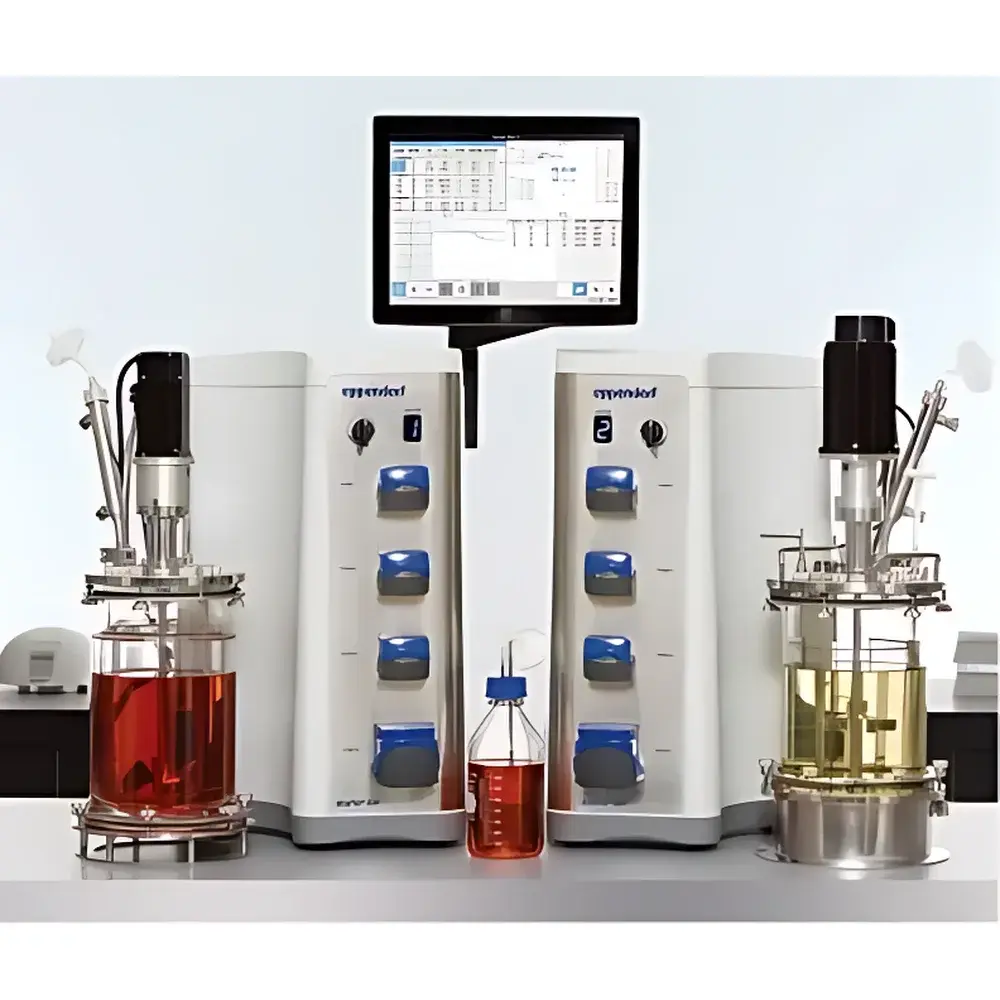
Eppendorf BioFlo 320 Benchtop Bioreactor
| Brand | Eppendorf |
|---|---|
| Origin | USA |
| Manufacturer Type | Original Equipment Manufacturer (OEM) |
| Product Category | Imported |
| Model | BioFlo 320 |
| Working Volume | 0.6 – 10.5 L |
| Total Volume | 2.5 – 14.0 L |
| Aeration System | 1, 3, or 4 thermal mass flow controllers |
| pH Control Range | 2.0 – 12.0 |
| Dissolved Oxygen (DO) Control Range | 0 – 200% air saturation |
| Temperature Control Range | 5°C (cooling fluid inlet) to 90°C |
Overview
The Eppendorf BioFlo 320 is a modular, benchtop bioreactor system engineered for precision control and reproducibility in both microbial fermentation and mammalian or insect cell culture processes. Operating on the fundamental principles of stirred-tank reactor (STR) dynamics, it integrates real-time monitoring and closed-loop feedback control of critical process parameters—including temperature, pH, dissolved oxygen (DO), agitation speed, and gas flow rates—within a compact, GMP-compliant architecture. Designed for scalability and operational flexibility, the BioFlo 320 supports both autoclavable glass or stainless-steel vessels and single-use BioBLU® bioreactor bags, enabling seamless transition from lab-scale process development to pilot-scale validation. Its robust mechanical design features direct-coupled and magnetic drive motor options, minimizing mechanical shear while ensuring stable operation across a wide range of viscosities and cell densities.
Key Features
- Modular vessel compatibility: Supports reusable vessels (2.5–14.0 L total volume) and single-use BioBLU® bags (0.25–40 L scalable range), with standardized port configurations for rapid reconfiguration.
- Dual-mode aeration architecture: Independent thermal mass flow controllers (1, 3, or 4 channels) enable precise regulation of headspace and subsurface gas delivery via annular or microbubble spargers—critical for oxygen-sensitive mammalian cultures and high-density bacterial fermentations.
- Advanced agitation system: Includes Eppendorf-exclusive packed-bed and cell-lift impellers optimized for perfusion-based suspension cultures, reducing shear stress while enhancing mass transfer efficiency.
- Electrode agnosticism: Universal analog/digital electrode interface accommodates both legacy analog sensors and intelligent sensor management (ISM) digital electrodes from Mettler Toledo and other ISO/IEC 17025-compliant suppliers.
- Integrated fluid handling: Up to six independently programmable peristaltic pumps support feed, harvest, base/acid addition, and antifoam dosing with volumetric accuracy traceable to NIST standards.
- Industrial connectivity: Built-in Ethernet interface compliant with IEEE 802.3, enabling simultaneous monitoring and control of up to eight BioFlo 320 systems via Eppendorf SCADA software—fully compatible with OPC UA and Modbus TCP protocols for enterprise-level integration.
Sample Compatibility & Compliance
The BioFlo 320 is validated for use with a broad spectrum of biological systems, including Escherichia coli, Pichia pastoris, CHO-K1, HEK293, and Sf9 cells. Vessel materials meet USP Class VI and FDA 21 CFR Part 11 requirements for single-use components, while reusable vessels comply with ASME BPE-2022 surface finish specifications (Ra ≤ 0.4 µm). The system supports GLP/GMP documentation workflows through audit-trail-enabled software logging, electronic signatures, and configurable user access levels aligned with Annex 11 and ISO 13485:2016 frameworks.
Software & Data Management
Eppendorf BioCommand™ software provides intuitive graphical configuration of PID control loops, multistep batch/perfusion protocols, and real-time trend visualization. All process data—including raw sensor outputs, calculated derived variables (e.g., OUR, CER, RQ), and event logs—are stored in an encrypted SQLite database with optional export to CSV, Excel, or ASTM E1394-compliant formats. Remote access functionality supports secure HTTPS-based connections and role-based authentication, facilitating cross-site collaboration and regulatory submission readiness.
Applications
- Process development and optimization for recombinant protein expression in microbial and mammalian systems.
- Scale-down modeling of commercial bioreactors for comparability studies and platform process qualification.
- Continuous and perfusion-based cell culture for monoclonal antibody production and viral vector manufacturing.
- Metabolic flux analysis requiring tightly controlled DO/pH gradients and dynamic feeding strategies.
- Education and training in bioprocess engineering curricula, supporting hands-on instruction in PAT (Process Analytical Technology) implementation.
FAQ
Can the BioFlo 320 be validated for GMP manufacturing environments?
Yes—the system supports IQ/OQ/PQ documentation packages, 21 CFR Part 11-compliant electronic records, and full traceability of calibration events, parameter changes, and operator actions.
Is it possible to upgrade from analog to digital electrode support post-purchase?
Yes—hardware and firmware upgrades are available through Eppendorf Field Service Engineers, enabling retroactive integration of ISM-capable sensors without vessel replacement.
What is the maximum allowable working pressure for the reusable vessels?
Standard glass vessels are rated for 1.5 bar(g) operating pressure; stainless-steel variants support up to 3.0 bar(g) with appropriate pressure relief and safety interlock configuration.
Does the system support fed-batch and continuous perfusion modes out of the box?
Yes—preconfigured control algorithms for exponential, linear, and constant-rate feeding, as well as perfusion rate ramping and cell retention logic, are embedded in BioCommand™ v5.2 and later.
How is temperature uniformity maintained across the working volume?
Jacketed vessel design with PID-controlled recirculating chiller/heater units ensures ±0.2°C spatial uniformity (measured at three radial/axial positions) under standard operating conditions.
Related Products




