
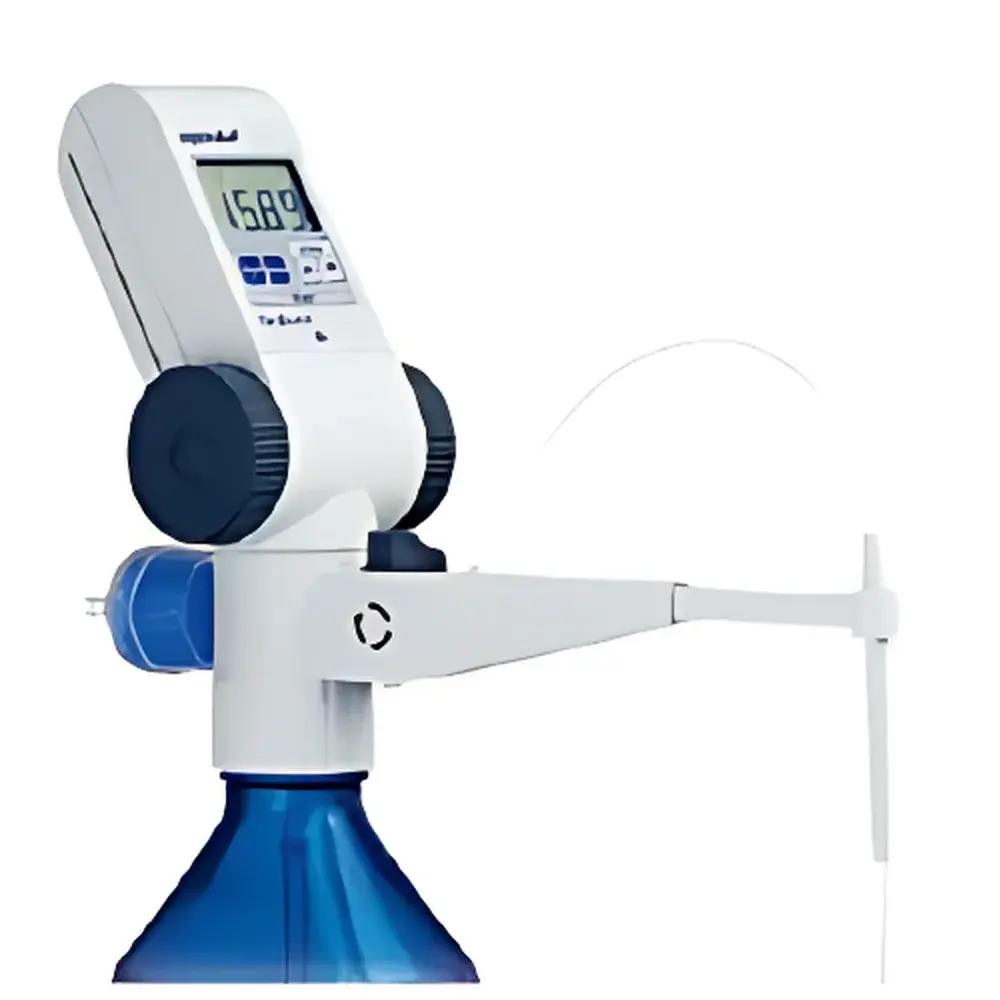
Eppendorf Top Buret Digital Buret
| Brand | Eppendorf |
|---|---|
| Country of Origin | Germany |
| Manufacturer Type | Original Equipment Manufacturer (OEM) |
| Import Status | Imported |
| Model | Top Buret |
| Price Range | USD 650 – 1,300 |
Overview
The Eppendorf Top Buret Digital Buret is a precision-engineered manual titration instrument designed to bridge the gap between traditional glass burets and fully automated titration systems. Unlike conventional piston-driven or peristaltic dispensers, the Top Buret employs Eppendorf’s proprietary pulse-free dispensing technology—based on a high-resolution stepper motor coupled with a calibrated glass syringe and integrated pressure-compensated valve system—to deliver volumetric accuracy without flow pulsation. This enables smooth, continuous liquid delivery across the full volume range, minimizing parallax error, reducing operator fatigue, and improving repeatability in endpoint detection. The device operates independently of external software or PC connectivity, making it ideal for routine QC labs, teaching laboratories, and GLP-compliant environments where simplicity, traceability, and robustness are prioritized over automation complexity.
Key Features
- Patented discharge safety valve prevents accidental leakage during handling, transport, or pause intervals—critical for corrosive, volatile, or hazardous titrants (e.g., HCl, NaOH, KMnO₄).
- Integrated rechargeable lithium-ion battery with real-time charge-level indicator (LED bar display), supporting >8 hours of continuous operation per full charge.
- Modular design: electronic control unit is fully detachable from the dispensing module, enabling rapid cleaning, calibration verification, and field-serviceable component replacement without system downtime.
- 360° rotatable discharge tip with dual-axis height adjustment—horizontal range: 142–220 mm; vertical range: 10–200 mm—ensuring ergonomic compatibility with standard titration stands, magnetic stirrers, and sample vessels of varying geometry.
- Telescopic pipette holder (210–370 mm extension) accommodates both standard 50 mL and oversized 1 L reagent bottles; optional desiccant tube adapter available for moisture-sensitive titrants (e.g., Karl Fischer reagents).
- One-button calibration routine compliant with ISO 8655-3 and ASTM E542, supporting gravimetric or volumetric verification at three user-defined points (e.g., 10 mL, 50 mL, 100 mL).
Sample Compatibility & Compliance
The Top Buret is validated for use with aqueous, alcoholic, and moderately polar organic solvents (e.g., ethanol, acetone, THF) within viscosity limits of ≤25 mPa·s at 20 °C. It is not recommended for highly viscous, particulate-laden, or strongly oxidizing media (e.g., concentrated HNO₃, bromine solutions) without prior compatibility testing. All wetted parts—including the glass syringe barrel, PTFE-coated plunger, and FEP discharge tubing—meet USP Class VI biocompatibility requirements. The instrument complies with IEC 61010-1 for laboratory electrical safety and carries CE marking under the EU Machinery Directive 2006/42/EC. Routine calibration records support audit readiness for ISO/IEC 17025, FDA 21 CFR Part 11 (when paired with Eppendorf’s optional data logger accessory), and GMP/GLP documentation workflows.
Software & Data Management
The Top Buret operates as a standalone instrument with no embedded firmware-based data logging. However, its analog voltage output (0–5 V DC) and RS-232 interface enable seamless integration with third-party lab information management systems (LIMS), electronic lab notebooks (ELN), or custom SCADA platforms. When used with Eppendorf’s optional Top Buret Data Logger (sold separately), users gain timestamped volume dispensed logs, calibration history, battery status tracking, and exportable CSV files—all compliant with ALCOA+ principles (Attributable, Legible, Contemporaneous, Original, Accurate). Audit trails include operator ID entry (via optional RFID badge reader), session start/end timestamps, and change logs for calibration parameters.
Applications
- Standardization of acid/base titrants (e.g., HCl vs. Na₂CO₃, NaOH vs. KHP) in pharmaceutical raw material release testing (USP ).
- Redox titrations (e.g., iodometry, cerimetry) requiring stable, non-pulsating flow to avoid premature endpoint drift.
- Water quality analysis (e.g., chloride by Mohr method, hardness by EDTA titration) per APHA Standard Methods 23rd ed.
- Academic teaching labs—enabling students to master titration technique while eliminating common errors associated with stopcock control and meniscus reading.
- In-process control in fine chemical synthesis where intermediate stoichiometric additions must be manually verified prior to scale-up.
FAQ
Does the Top Buret require regular recalibration?
Yes—calibration is recommended before first use, after any mechanical impact or disassembly, and at least once per week in high-throughput environments. Full calibration takes <90 seconds using distilled water and an analytical balance.
Can it be used with hydrofluoric acid (HF) solutions?
No. HF etches glass and degrades PTFE seals. Use only with HF-compatible alternatives (e.g., fluoropolymer-lined syringes) after formal validation—not supported out-of-the-box.
Is the battery replaceable by the end user?
Yes—the lithium-ion pack is serviceable with standard Torx T8 tools and requires no soldering. Replacement kits include pre-programmed EEPROM for battery health monitoring.
What is the minimum dispensing increment?
The smallest selectable increment is 0.1 mL; however, volumetric accuracy at this level is ±0.3% (k=2) per ISO 8655-3 when calibrated at 0.1 mL, 1 mL, and 10 mL points.
Does Eppendorf provide IQ/OQ documentation?
Yes—factory-issued Installation Qualification (IQ) and Operational Qualification (OQ) protocols are available upon request and include test scripts, acceptance criteria, and blank execution forms aligned with Annex 15 and GAMP 5 guidelines.



