
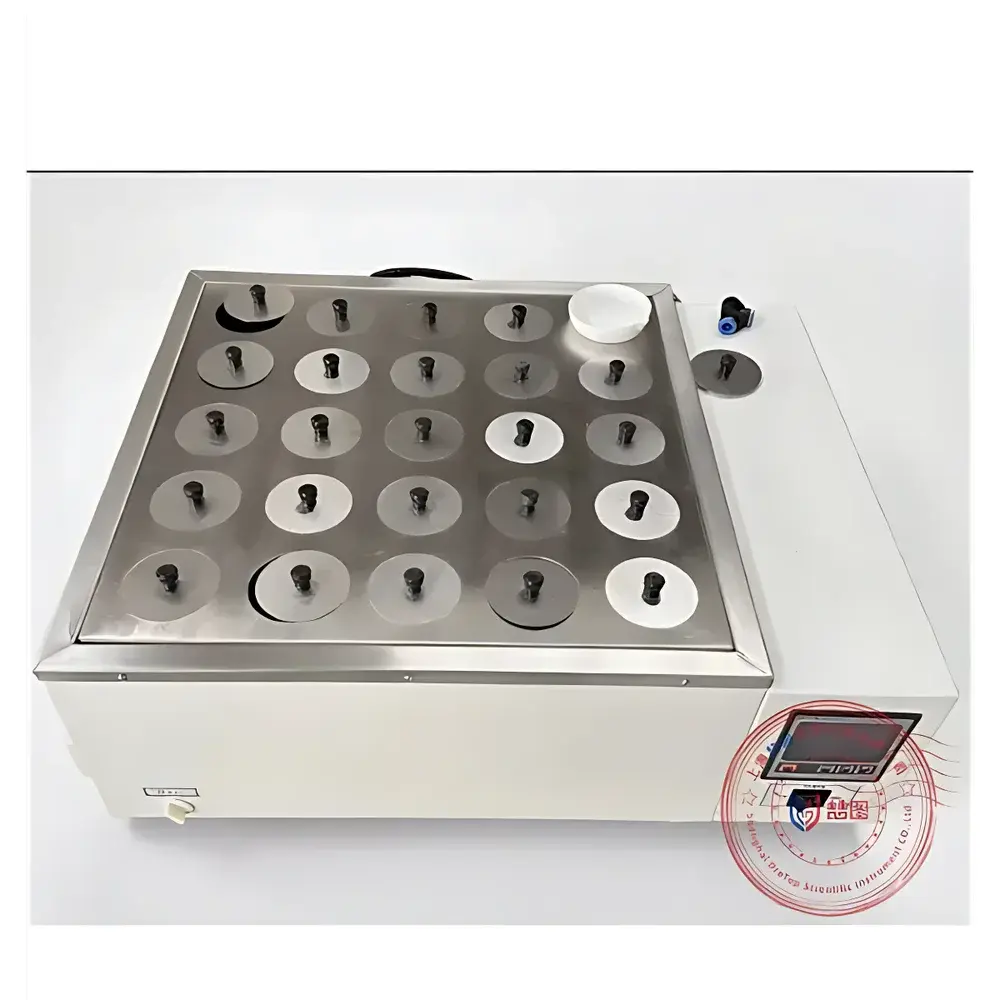
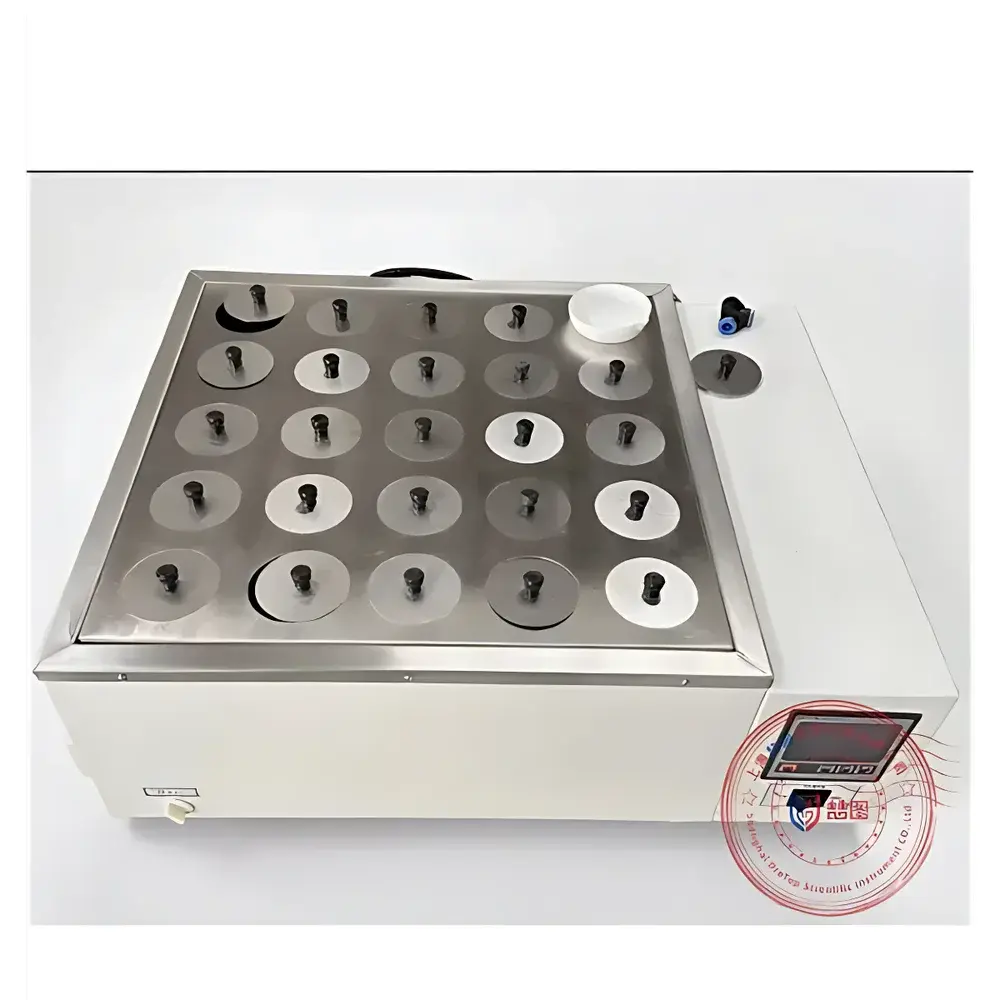
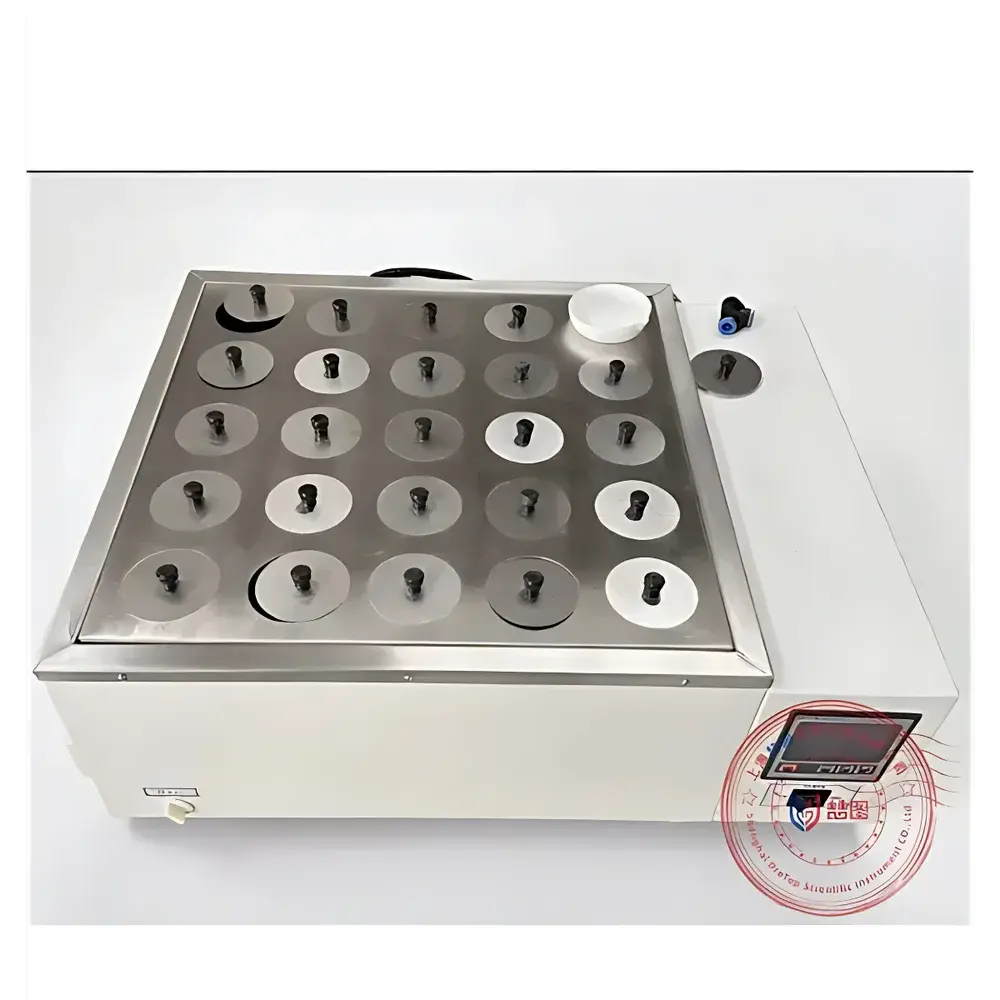
DRETOP WS-F30-II Intelligent Multi-Port Constant-Temperature Water Bath
| Brand | DRETOP |
|---|---|
| Origin | Shanghai, China |
| Model | WS-F30-II |
| Temperature Range | RT+5°C to 100°C |
| Temperature Control Accuracy | ±0.5°C |
| Bath Volume (at Standard Water Depth of 65 mm) | ~18.7 L (600×600×65 mm) |
| Heating Power | 3000 W |
| External Dimensions (W×D×H) | 600×600×(H not specified) mm |
| Number of Ports | 25 (5×5 array) |
| Port Diameter | 70 mm |
| Center-to-Center Port Spacing | 15 mm |
| Dry-Run Protection | Integrated Level-Sensing Module |
| Auto-Replenishment | Optional External Water Supply Interface (10 mm OD Quick-Connect Fitting) |
| Thermal Uniformity | Verified Across All Zones (Per ASTM E145-22 Annex A3 for Liquid Baths) |
| Construction | Stainless Steel 304 Inner Chamber & Lid, Electrostatically Powder-Coated Exterior |
| Compliance | GLP/GMP-Aligned Safety Architecture (ASTM B117 Salt Spray Tested, PTFE-Compatible Interior Surface) |
Overview
The DRETOP WS-F30-II Intelligent Multi-Port Constant-Temperature Water Bath is an engineered thermal platform designed for high-throughput, precision-controlled aqueous heating in regulated laboratory environments. It operates on the principle of convective heat transfer via immersion in a temperature-stabilized water medium, with thermal uniformity maintained across all 25 independently usable ports through optimized heater placement, multi-layer insulation, and forced convection dynamics within the stainless steel bath chamber. Unlike single-chamber alternatives, the WS-F30-II supports parallel processing of up to 25 vessels—such as round-bottom flasks, test tubes, or digestion vials—enabling consistent evaporation, hydrolysis, enzyme incubation, dissolution testing, or sample equilibration without cross-contamination or thermal crosstalk. Its architecture complies with core design expectations outlined in ASTM E145-22 (Standard Specification for Gravity-Convection and Forced-Ventilation Ovens), adapted for liquid-phase thermal baths, and integrates fail-safes required under GLP and GMP-aligned workflows—including real-time dry-run detection, power-loss parameter retention, and programmable alarm thresholds.
Key Features
- 25-port modular configuration (5×5 grid) with 70 mm diameter openings and 15 mm center-to-center spacing—optimized for standard lab glassware including 50–500 mL round-bottom flasks;
- Microprocessor-based PID temperature controller with dual digital display (setpoint + actual temperature), ±0.5°C accuracy over full operating range (RT+5°C to 100°C);
- Integrated dry-run protection system: capacitive water-level sensor continuously monitors bath volume; automatic heater cutoff and audible/visual alert triggered when level falls below safe operational threshold;
- Non-corrosive internal construction: 304 stainless steel tank, lid, and perforated support grid; interior surface compatible with PTFE-coated accessories and resistant to prolonged exposure to weak acids/bases (validated per ASTM B117 salt spray test, ≥96 h);
- Dual-layer thermal insulation with drip-proof sealing and bottom-mounted drain valve for rapid, residue-free water exchange;
- Intelligent power recovery: embedded non-volatile memory retains setpoints, timer status, and alarm configurations during unexpected power interruption—resumes operation automatically upon restoration;
- User-configurable thermal alarms: deviation threshold adjustable in 0.1°C increments; alarm activation initiates both acoustic signal and hardware-level heater disablement.
Sample Compatibility & Compliance
The WS-F30-II accommodates standard borosilicate glassware, polypropylene centrifuge tubes, and stainless steel digestion vessels up to 500 mL capacity per port. Its uniform thermal field—verified by 9-point probe mapping per ICH Q5C guidelines—ensures reproducible kinetics across all positions, critical for dissolution testing (USP ), stability studies, or enzymatic reaction profiling. The unit meets structural and safety benchmarks referenced in ISO/IEC 17025:2017 (Clause 6.4.2 – Equipment Suitability), and its audit-trail-capable control logic supports compliance with FDA 21 CFR Part 11 when paired with optional logging software. All electrical components conform to IEC 61010-1:2010 for laboratory equipment safety.
Software & Data Management
While the base WS-F30-II operates via standalone front-panel interface, it supports integration with optional 30-segment programmable controllers (sold separately) enabling time-temperature ramping profiles for complex protocols such as gradient hydrolysis or staged extraction. Real-time temperature data can be logged via RS-485 Modbus RTU output (available on upgraded firmware versions), allowing synchronization with LIMS or ELN platforms. Event logs—including alarm triggers, power cycles, and manual overrides—are timestamped and stored onboard for ≥30 days, satisfying GLP documentation requirements for traceability and review.
Applications
- Pharmaceutical QC: USP -compliant dissolution testing across multiple vessels simultaneously;
- Environmental analysis: EPA Method 3510C liquid-phase extractions and Kjeldahl digestion pre-heating;
- Biotechnology: Enzyme activity assays requiring precise thermal equilibration prior to spectrophotometric readout;
- Materials science: Polymer solubilization, nanoparticle dispersion stabilization, and solvent reflux preparation;
- Academic research: High-density teaching labs performing parallel titrations, calibration curve generation, or kinetic studies.
FAQ
Does the WS-F30-II support external data logging?
Yes—when equipped with the optional RS-485 communication module, it outputs real-time temperature and status data via Modbus RTU protocol for integration into SCADA or laboratory informatics systems.
What is the maximum recommended vessel height for use with the 70 mm ports?
Vessels up to 300 mm tall are fully supported when placed on the standard stainless steel mesh insert; taller configurations require custom-height support grids (available upon request).
Is the auto-refill function factory-installed or optional?
Auto-refill requires connection to a pressurized water source via the provided 10 mm OD quick-connect fitting and is implemented as an add-on accessory—not included in the base configuration.
How is thermal uniformity validated across the 25-port array?
Uniformity is confirmed using calibrated PT100 probes at nine representative locations (center + four corners + midpoints of each side) per ASTM E145-22 Annex A3 methodology, with deviation ≤±0.8°C at 37°C and ≤±1.2°C at 95°C.
Can the unit operate unattended for extended periods?
Yes—the combination of dry-run detection, power-loss memory, and configurable thermal alarms enables secure 24/7 operation under supervised but unattended conditions, consistent with ISO/IEC 17025 Clause 7.2.1 requirements for equipment reliability.



