
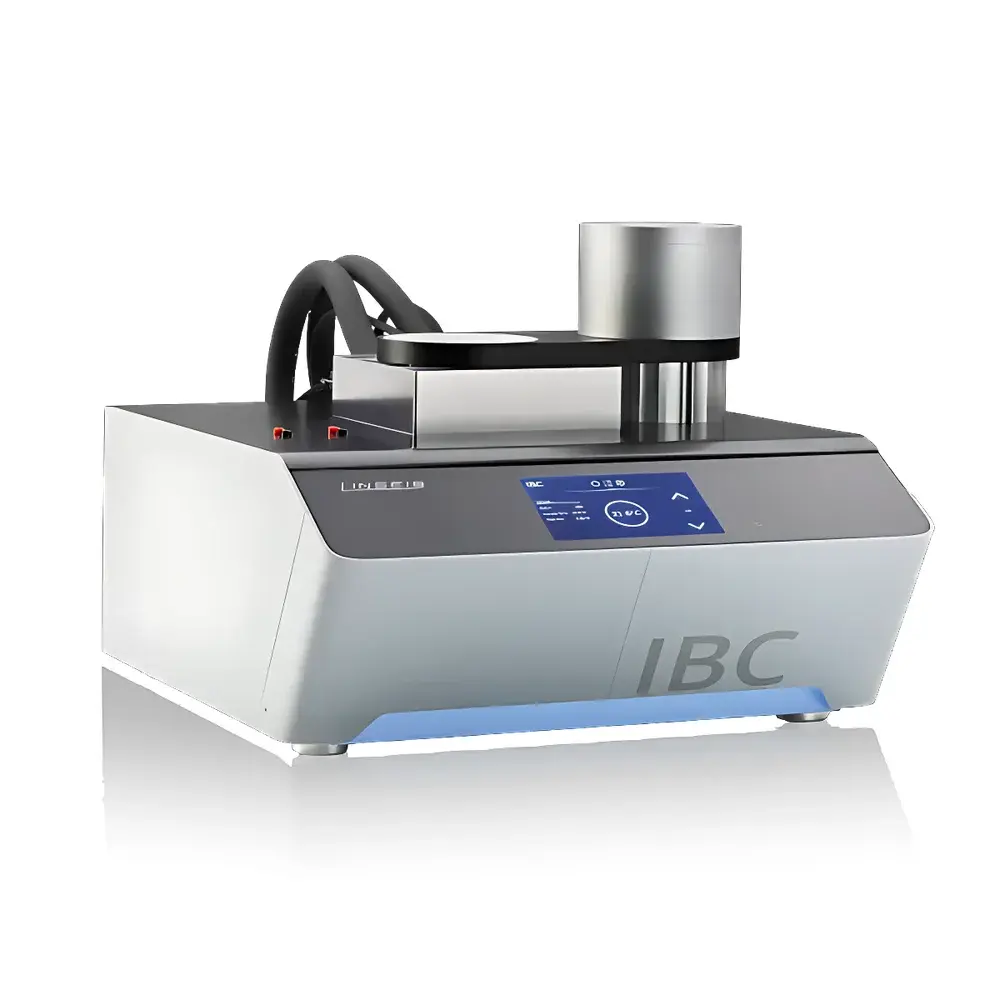
LINSEIS IBC L91 Battery Isothermal Calorimeter
| Brand | LINSEIS |
|---|---|
| Origin | Germany |
| Model | IBC L91 |
| Temperature Range | −40 °C to 140 °C |
| Temperature Resolution | 0.0001 °C |
| Temperature Stability | 0.01 K |
| Temperature Accuracy | 0.001 °C |
| Calorimetric Resolution | 0.1 mW |
| Calorimetric Accuracy | 0.5 mW |
| Maximum Power Measurement | 10 W (for 80 × 80 mm stage) |
| Sample Height Capacity | up to 100 mm |
| Stage Dimensions | 80 × 80 mm, 300 × 300 mm, 600 × 600 mm (custom sizes available) |
| Thermal Sensor Count | 8 (standard for 80 × 80 mm stage) |
| Sampling Frequency | up to 10 Hz |
| Software | LINSEIS Platinum (included) |
| Power Supply | AC 230 V / 50 Hz |
| Max. Host Power Consumption | 120 W |
| Noise Level | 0.015 mV |
| Calibration | Integrated auto-calibration routine with reference heater |
Overview
The LINSEIS IBC L91 Battery Isothermal Calorimeter is a high-precision, benchtop instrument engineered for quantitative heat flow measurement during electrochemical cycling of rechargeable batteries under controlled thermal conditions. It operates on the principle of heat conduction calorimetry—measuring minute thermal power changes (in mW) across a thermally isolated sample stage using an array of calibrated thermopile sensors and high-stability temperature control. Unlike adiabatic or accelerating rate calorimeters, the IBC L91 maintains strict isothermal conditions at user-defined setpoints across its full operational range (−40 °C to +140 °C), enabling direct correlation between electrochemical activity and thermal dissipation without thermal lag artifacts. This capability is critical for evaluating battery safety margins, quantifying irreversible heat generation from side reactions (e.g., SEI growth, electrolyte decomposition), and validating thermal models used in battery management system (BMS) design. The system is purpose-built for R&D laboratories conducting cell-level characterization, aging studies, and quality assurance testing in compliance with ISO 12405-3, IEC 62660-2, and UL 1642 test frameworks.
Key Features
- Ultra-stable isothermal environment: ±0.01 K temperature stability over extended durations, achieved via dual-stage Peltier control and active thermal shielding.
- Sub-milliwatt calorimetric resolution: 0.1 mW detection limit with 0.5 mW absolute accuracy, validated traceably to NIST-traceable reference heaters.
- Multi-point thermal mapping: Eight integrated thermopile sensors per standard 80 × 80 mm stage provide spatially resolved heat flux data—essential for detecting localized hot spots and thermal gradients within pouch or cylindrical cells.
- Modular mechanical architecture: Interchangeable sample stages (80 × 80 mm, 300 × 300 mm, 600 × 600 mm) and customizable battery adapters (14500, 18650, coin-cell, prismatic, and custom geometries) support heterogeneous cell formats without hardware reconfiguration.
- Real-time synchronized acquisition: Simultaneous logging of voltage, current, surface temperature, heat flow, and derived parameters (e.g., Coulombic efficiency, entropic heat coefficient ∂T/∂Q) at up to 10 Hz sampling rate.
- Built-in metrological integrity: Automated calibration routines executed before each experiment; integrated reference heater enables in-situ drift correction and long-term reproducibility verification.
Sample Compatibility & Compliance
The IBC L91 accommodates commercial and prototype lithium-ion, lithium-metal, solid-state, and sodium-ion cells ranging from 5 mm coin cells to 100 mm tall prismatic modules. Its adjustable height mechanism (up to 100 mm clearance) and modular adapter system ensure mechanical compatibility without compromising thermal contact uniformity. All thermal interfaces utilize low-contact-resistance graphite pads certified for ≤0.5 K·cm²/W interfacial resistance. The system complies with GLP documentation requirements through audit-trail-enabled software logging, electronic signatures, and 21 CFR Part 11–compliant data handling (when configured with optional security package). Test protocols align with ASTM D7309 (heat release rate of Li-ion batteries), ISO 12405-3 (performance testing of traction batteries), and UN 38.3 thermal abuse subtests.
Software & Data Management
LINSEIS Platinum software provides a unified interface for instrument control, real-time visualization, and post-experiment analysis. Core functionalities include automated charge/discharge protocol scripting (CC/CV, pulse, EIS-coupled cycles), dynamic heat flow baseline subtraction, entropic heat coefficient calculation (dT/dQ), and cumulative energy balance reporting. Raw data are stored in HDF5 format with embedded metadata (timestamp, operator ID, calibration status, environmental log). Export options include CSV, MATLAB .mat, and ASTM E1447-compliant XML. The software supports batch processing for comparative aging studies and includes statistical tools for repeatability assessment (e.g., %RSD across n ≥ 3 replicates). Audit trails record all parameter modifications, calibration events, and user actions with time stamps and IP addresses—fully compliant with GMP Annex 11 and FDA data integrity guidelines.
Applications
- Quantification of reversible vs. irreversible heat generation during galvanostatic cycling to assess entropy-driven thermal effects and parasitic reaction kinetics.
- Thermal runaway onset evaluation under accelerated aging conditions (e.g., high-temperature storage, overcharge, external heating).
- Validation of electrochemical-thermal coupling models used in multiphysics simulation platforms (e.g., COMSOL, ANSYS Fluent).
- Comparative analysis of thermal efficiency across cathode chemistries (NMC, LFP, NCA) and anode architectures (Si-doped, graphite, Li-metal).
- Quality control screening for production cells: detection of abnormal heat signatures indicative of internal shorts, poor welds, or electrolyte fill defects.
- Low-temperature performance characterization: measurement of increased polarization losses and reduced coulombic efficiency below 0 °C.
FAQ
What types of battery formats can be tested on the IBC L91?
The system supports cylindrical (14500, 18650, 21700), prismatic, pouch, and coin-type cells. Custom fixtures are available for non-standard geometries including bipolar stacks and solid-state prototypes.
Does the IBC L91 require external potentiostats or power supplies?
No—the instrument integrates programmable current/voltage sourcing capabilities. Optional high-current modules (up to ±10 A) and external lab-grade power supplies can be synchronized via analog/digital I/O for advanced test scenarios.
How is temperature uniformity ensured across large-area stages (e.g., 600 × 600 mm)?
Multi-zone Peltier elements with independent PID loops and distributed thermal sensor feedback maintain ±0.02 K uniformity across the entire surface, verified by NIST-traceable IR thermography.
Can the system operate unattended for multi-day aging tests?
Yes—continuous operation for >168 hours is supported with automatic error recovery, email alerts on anomaly detection, and redundant data logging to internal SSD and network storage.
Is third-party software integration possible?
The IBC L91 provides TCP/IP and LabVIEW-compatible drivers, enabling seamless integration with MATLAB, Python (via PyLINSEIS), and industrial SCADA systems for automated factory-floor testing.



