
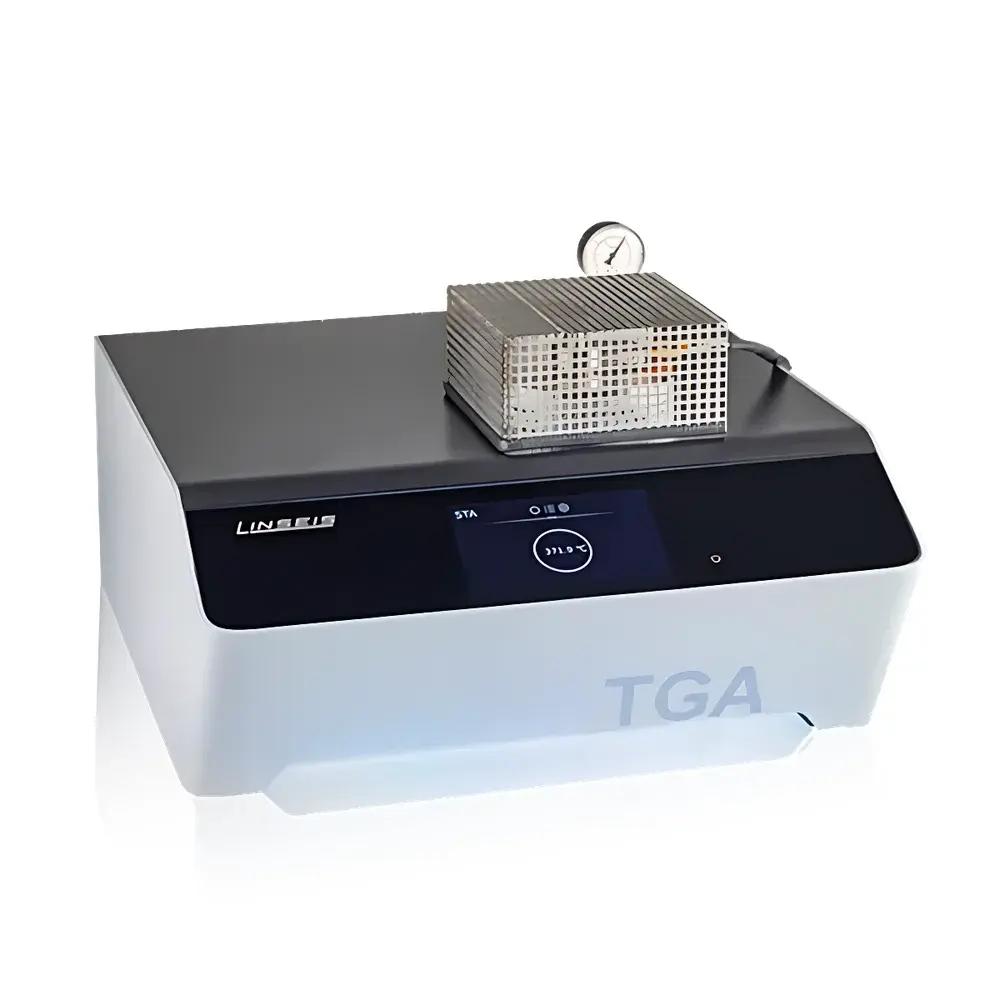
LINSEIS TGA L83 Thermogravimetric Analyzer
| Brand | LINSEIS |
|---|---|
| Origin | Germany |
| Model | TGA L83 |
| Temperature Range | RT to 1100 °C |
| Heating/Cooling Rate | 0.001–250 °C/min |
| Maximum Sample Mass | 5 g |
| Cooling Time | <12 min (1100 °C → 100 °C) |
| Vacuum Capability | up to 10⁻³ mbar |
| Atmosphere Control | Inert, oxidative, reductive, vacuum |
| Gas Dosing | Integrated MFC module with 3 gas channels (1 purge + 2 reactive) |
| Sample Autosampler | Up to 90 positions |
| Crucible Materials | Pt, Al₂O₃, Au, Ag, Al, graphite, W, stainless steel (HP) |
| EGA Compatibility | FTIR, MS, GC-MS |
| Interface | USB |
Overview
The LINSEIS TGA L83 Thermogravimetric Analyzer is a high-precision, top-loading thermal balance engineered for rigorous quantitative mass-change measurement under controlled temperature and atmospheric conditions. Based on the fundamental principle of thermogravimetry—continuous monitoring of sample mass as a function of temperature or time under defined gas environments—the TGA L83 delivers high reproducibility and long-term stability for compositional, kinetic, and decomposition pathway analysis. Its robust furnace architecture enables rapid thermal transients (0.001–250 °C/min), precise isothermal holds, and exceptional temperature homogeneity across the sample zone. With a maximum sample capacity of 5 g and calibrated sensitivity in the sub-microgram range, the system supports both small-scale research specimens and industrially relevant bulk samples. The instrument’s modular design allows seamless integration with evolved gas analysis (EGA) systems—including Fourier-transform infrared spectroscopy (FTIR), quadrupole mass spectrometry (MS), and gas chromatography–mass spectrometry (GC-MS)—enabling real-time correlation between mass loss events and chemical identity of volatiles.
Key Features
- Top-loading configuration with optimized thermal shielding and low thermal inertia furnace
- Temperature range from ambient (RT) to 1100 °C, with ±0.1 °C accuracy and ±0.05 °C repeatability
- Programmable heating and cooling rates spanning three orders of magnitude (0.001–250 °C/min); full cooldown from 1100 °C to 100 °C in under 12 minutes
- Vacuum-tight construction rated to 10⁻³ mbar, compatible with mechanical and turbomolecular pumping systems
- Integrated mass flow controller (MFC) module supporting three independent gas lines: one purge and two reactive gases, with automated switching and pressure regulation
- Optional DTA signal calculation derived from thermal imbalance detection—providing semi-quantitative insight into endothermic/exothermic transitions without requiring a dedicated DSC sensor
- USB-based digital interface compliant with Windows-based LINSEIS ThermoSoft™ platform for real-time data acquisition, calibration, and report generation
Sample Compatibility & Compliance
The TGA L83 accommodates diverse sample geometries and chemistries via interchangeable crucibles—standard options include platinum, alumina, gold, silver, aluminum, graphite, tungsten, and high-pressure stainless steel. This flexibility ensures compatibility with corrosive, reducing, oxidizing, and ultra-high-purity atmospheres. The system supports ASTM E1131, ISO 11358, and USP methodologies for residual solvent and moisture quantification. When operated with validated autosamplers and audit-trail-enabled software, it meets GLP and GMP requirements for regulated environments, including FDA 21 CFR Part 11 compliance when deployed with electronic signature and user-access controls. All gas-handling components are certified for Class 1 Div 2 hazardous location use where applicable.
Software & Data Management
Controlled by LINSEIS ThermoSoft™ v5.x, the TGA L83 provides intuitive method setup, multi-step temperature programming, and synchronized data logging at up to 10 Hz. The software includes built-in kinetic analysis modules (e.g., Kissinger, Ozawa-Flynn-Wall), derivative (DTG) computation, peak deconvolution, and automatic step identification. Raw data files (.tdf) are structured in ASCII-compatible format for third-party processing in MATLAB, Origin, or Python-based scientific stacks. Audit trails record all parameter changes, user logins, calibration events, and instrument status flags—ensuring full traceability for quality assurance documentation. Export options include PDF reports with embedded metadata, CSV for spreadsheet analysis, and XML for LIMS integration.
Applications
The TGA L83 serves critical roles in materials development, quality control, and failure analysis across sectors including advanced ceramics, battery electrode formulation, polymer degradation studies, cement hydration kinetics, pharmaceutical excipient stability, and catalytic material characterization. Representative use cases include: quantifying carbonate content in geological samples; assessing thermal stability of carbon-fiber composites under nitrogen vs. air; mapping dehydration/hydroxylation cycles in layered double hydroxides; determining char yield and oxidation onset in biochar; and validating shelf-life models for hygroscopic APIs. Its rapid thermal response also enables quasi-adiabatic measurements for reaction enthalpy estimation and non-isothermal kinetic modeling of solid-state decomposition pathways.
FAQ
Can the TGA L83 perform simultaneous DTA measurements?
No—it does not include a physical DTA sensor. However, the optional DTA calculation module estimates differential thermal effects computationally from asymmetrical heat flow patterns during mass transitions.
Is the 90-position autosampler compatible with all crucible types?
Yes, provided crucibles conform to standardized dimensions (e.g., Ø6.7 × 5 mm or Ø8 × 5 mm). Custom adapters are available for non-standard geometries.
What level of vacuum integrity is maintained during dynamic temperature ramps?
The chamber sustains ≤10⁻³ mbar throughout programmed heating/cooling sequences when paired with an appropriate vacuum pump and sealed gas manifold.
Does the system support automated calibration routines?
Yes—ThermoSoft™ includes guided procedures for temperature calibration (using Ni, In, Sn, Zn, Al, Ag standards) and mass calibration (using certified weights), with results logged in the audit trail.
How is data security ensured in regulated laboratories?
Through role-based access control, electronic signatures, immutable audit logs, and optional 21 CFR Part 11 add-ons that enforce user authentication, session timeouts, and data encryption at rest and in transit.



