
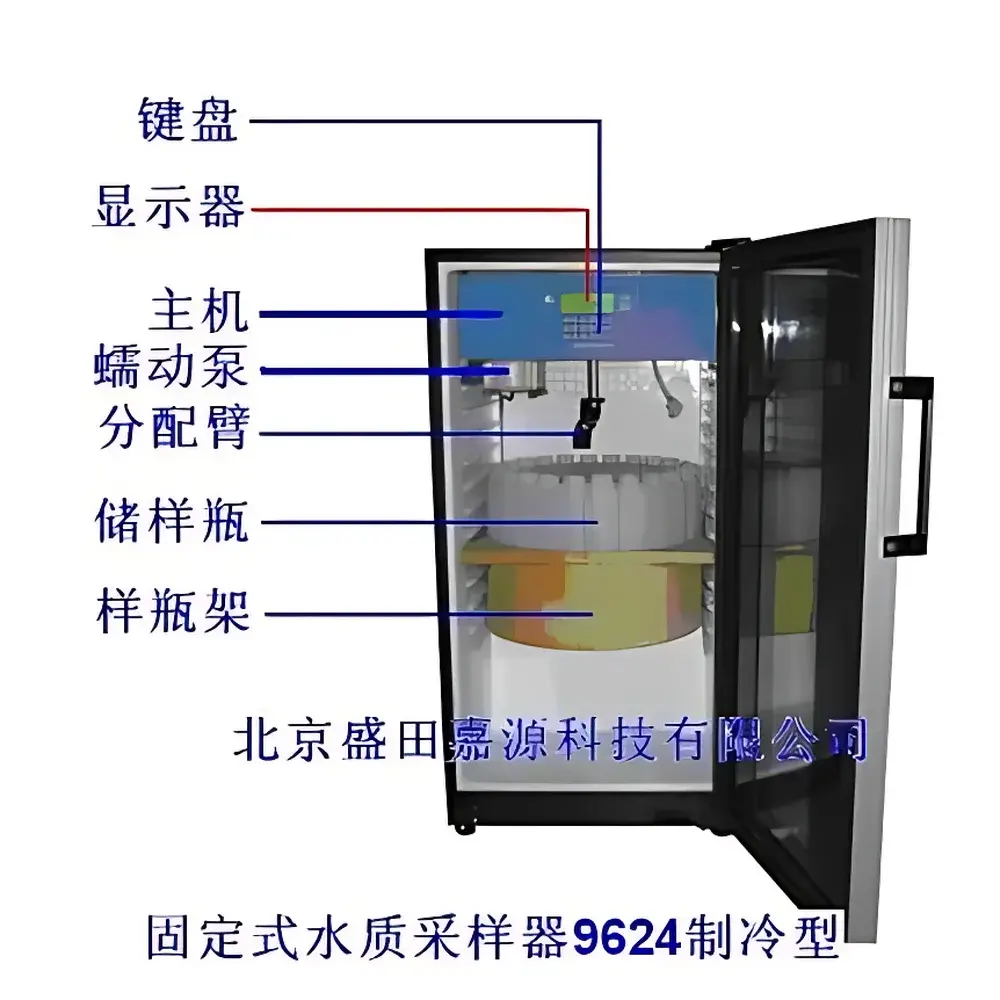
Sen9624 Fixed-Station Water Sampler
| [Origin | Beijing, China |
|---|---|
| Manufacturer Type | Authorized Distributor |
| Origin Category | Domestic (China) |
| Model | Sen9624 |
| Pricing | Upon Request |
| Power Supply | AC 220 V ±15%, 50 Hz |
| Rated Power | 450 W |
| Dimensions (L×W×H) | 500 × 530 × 960 mm |
| Weight | 40 kg |
| Operating Temperature | −5 °C to +50 °C |
| Sample Preservation | Compressor-cooled refrigeration (Haier), 0–8 °C adjustable |
| Sample Capacity | 24 × 1 L HDPE bottles |
| Sampling Precision | ±10 mL |
| Max. Vertical Suction Height | 7.2 m |
| Tubing | 8 m standard (5–25 m customizable), ID 10 mm high-strength silicone |
| Pump Type | Modular peristaltic pump with stainless-steel roller shaft and engineering plastic housing |
| Sampling Modes | Time-proportional (3–9999 min interval), flow-proportional (1–9999 pulses, 5–15 V positive pulse input), random, manual quantitative |
| Sample Volume Range | 50–1000 mL (1 mL increment) |
| Bottle Allocation Logic | Single sample to N bottles (replicates) or N samples to one bottle (composite) |
| Auto-rinse Cycles | 0–2 |
| Data Storage | 256 sets of flow data (timestamp, instantaneous & cumulative flow) + sampling timestamps |
| Communication | RS-232 (TXD/RXD/GND), 4–20 mA analog input, pulse input, remote control via wired/wireless uplink |
| Flow Measurement Capability (with optional ultrasonic probe) | 0.1 L/s – 10 m³/s |
| accuracy | ±1–5% depending on flume/weir calibration |
| Enclosure | Sealed dust-resistant black powder-coated steel cabinet with molded polymer interior and polyurethane foam insulation] |
Overview
The Sen9624 Fixed-Station Water Sampler is an industrial-grade, microprocessor-controlled automatic sampling system engineered for long-term, unattended operation in municipal wastewater treatment plants, surface water monitoring stations, industrial effluent discharge points, and regulatory compliance laboratories. It operates on the principle of programmable peristaltic aspiration combined with precision mechanical sample distribution—utilizing a 24-position radial carousel and a self-locking, self-lubricating distributor arm driven by a stepper motor with 15° incremental positioning (360°/24). This architecture ensures repeatable, contamination-minimized allocation of discrete or composite water specimens into individual HDPE storage vessels under controlled thermal conditions. The system integrates dual-mode sampling logic—time-based and flow-proportional—enabling strict adherence to ISO 5667-10, ASTM D3370, and EPA Method 1664B requirements for representative environmental sampling. Its compressor-based refrigeration subsystem maintains samples at 0–8 °C, preserving physicochemical integrity for subsequent analysis of BOD, COD, nutrients, metals, and microbiological parameters.
Key Features
- 24-position chilled sample storage: Each 1 L HDPE bottle is housed in a thermally insulated carousel within a Haier-branded compressor-cooled chamber, ensuring temperature stability across ambient extremes (−5 °C to +50 °C).
- High-reliability peristaltic pumping: Stainless-steel roller shaft, modular quick-release pump head, and 10 mm ID reinforced silicone tubing deliver consistent aspiration up to 7.2 m vertical lift with ±10 mL volumetric accuracy.
- Dual-sampling protocol support: Configurable time-proportional sampling (3–9999 min intervals) and flow-proportional sampling (1–9999 pulse counts, compatible with 5–15 V positive-pulse flow meters including WL-1 ultrasonic open-channel units).
- Flexible sample allocation logic: Supports both “one sample → multiple bottles” (for analytical replicates) and “multiple samples → one bottle” (for time-weighted composite analysis), programmable via embedded menu interface.
- Robust data governance: Stores 256 timestamped flow records (including date/time, instantaneous and cumulative flow) plus sampling events in non-volatile memory with circular overwrite; all entries retain power-loss resilience.
- Secure operational control: Password-protected configuration interface, motor overcurrent detection with audible/visual alarm, and soft-power toggle (front-panel “ON/OFF”) backed by hard-switch isolation for maintenance safety.
Sample Compatibility & Compliance
The Sen9624 accommodates aqueous matrices ranging from raw sewage and stormwater runoff to treated effluent and natural surface waters. Its chemically inert HDPE bottles, silicone fluid path, and absence of metal wetted surfaces prevent adsorption or leaching—critical for trace metal and organic contaminant preservation. The system meets structural and functional criteria referenced in ISO/IEC 17025-accredited environmental testing labs and supports GLP-compliant workflows through audit-trail-capable parameter logging. When integrated with certified primary flow measurement devices (e.g., calibrated Parshall or Palmer-Bowlus flumes), it satisfies U.S. EPA NPDES permit requirements for composite sampling and enables verification against 40 CFR Part 136 analytical validity criteria.
Software & Data Management
An embedded 8-bit microcontroller executes a deterministic real-time sampling scheduler with ten pre-programmable method slots—each storing independent timing, volume, rinse cycles (0–2), and distribution logic. All settings are accessible via a 192×64 dot-matrix monochrome LCD with full Chinese character support and tactile membrane keypad. Data export occurs via RS-232 serial interface (pins 7/TXD, 8/RXD, 9/GND) or optional wireless telemetry module. Remote command reception allows centralized SCADA-level orchestration—including immediate trigger, program upload/download, and status interrogation—without physical access. No proprietary drivers or cloud dependencies are required; raw ASCII-formatted logs are directly ingestible by LIMS or custom Python/MATLAB analysis pipelines.
Applications
- Regulatory compliance monitoring at wastewater treatment plant outfalls per EPA NPDES and EU Urban Wastewater Treatment Directive.
- Long-term trend analysis of riverine nutrient loading using time-integrated composites collected over diurnal or seasonal cycles.
- Industrial pretreatment program verification, where parallel sampling validates analytical reproducibility across QA/QC checkpoints.
- Stormwater management systems requiring event-driven sampling synchronized with rainfall gauges or flow pulse triggers.
- Research-grade hydrological studies involving synchronized multi-point sampling across distributed sensor networks.
FAQ
What flow measurement devices are compatible with the Sen9624 for proportional sampling?
The unit accepts standardized 5–15 V positive-pulse signals from any third-party flow meter—including ultrasonic (e.g., WL-1), magnetic, or turbine types—provided pulse width exceeds 10 ms and frequency remains below 10 Hz. Calibration must be performed independently per ISO 7748 or manufacturer specifications.
Can the refrigeration temperature be set below 0 °C?
No. The compressor-based cooling system is rated for 0–8 °C operation only. Sub-zero temperatures would risk freezing and rupture of stored samples and internal tubing.
Is the Sen9624 suitable for seawater or highly saline effluents?
Yes—provided the 10 mm silicone tubing and HDPE bottles are inspected regularly for swelling or degradation. For extended deployment in >35 ppt salinity, fluorosilicone tubing is recommended as an aftermarket upgrade.
How is data integrity ensured during power interruption?
All sampling timestamps and flow records reside in EEPROM with hardware write-protection. Power loss during active sampling halts the cycle safely; resumed operation continues from the next scheduled step without data corruption.
Does the system support MODBUS RTU or other industrial protocols?
Not natively. Communication is limited to ASCII-over-RS-232. Integration with MODBUS-enabled SCADA requires an external protocol converter (e.g., Moxa NPort or Red Lion DA series) configured in bridging mode.







