
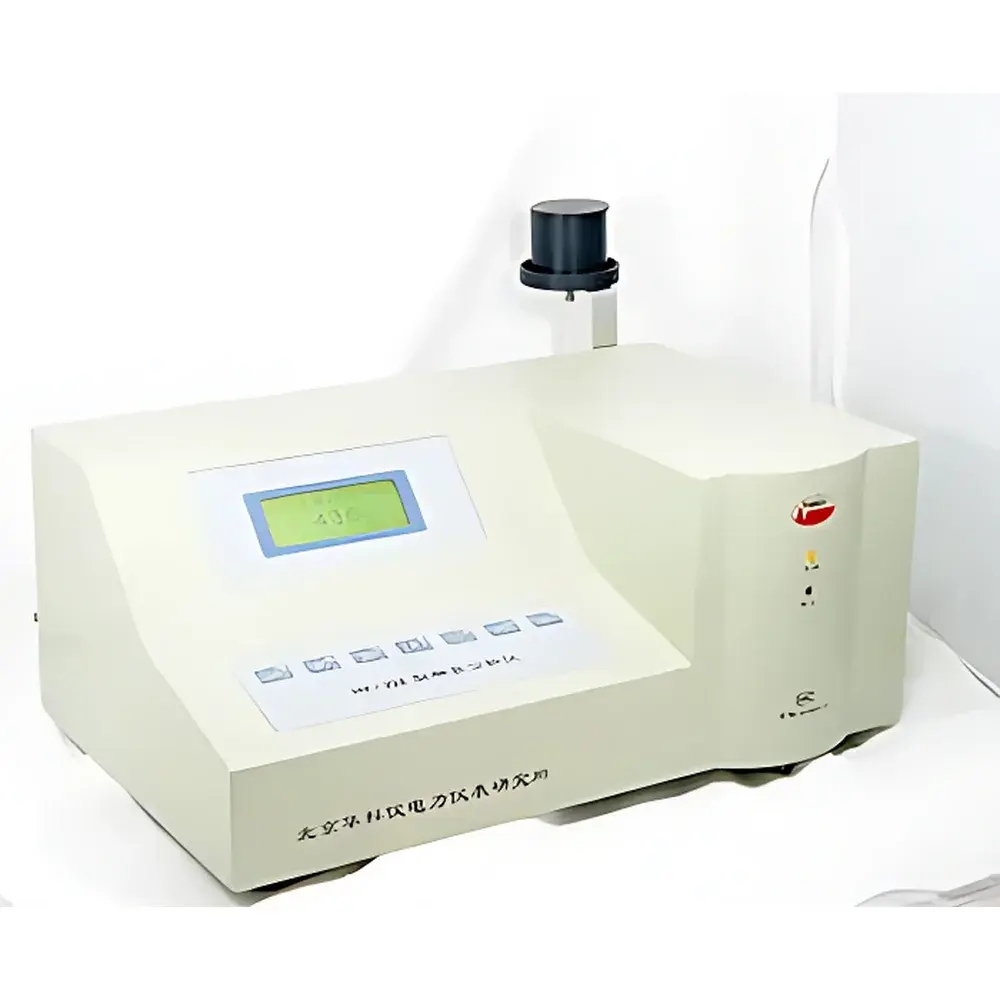
SENHK-228 Hydrazine Analyzer
| Origin | Beijing, China |
|---|---|
| Manufacturer Type | Authorized Distributor |
| Origin Category | Domestic (PRC) |
| Model | SENHK-228 |
| Price | Upon Request |
| Display | Chinese-language dot-matrix LCD |
| Range | 0–100 µg/L |
| Basic Error | ≤ ±2% F.S. |
| Resolution | 0.1 µg/L |
| Repeatability | ≤ 1% |
| Stability | ≤ ±1% F.S./4 h |
| Ambient Temperature | 5–45 °C |
| Relative Humidity | ≤ 90% RH (non-condensing) |
| Dimensions (L×W×H) | 420 × 190 × 280 mm |
| Power Supply | 198–242 VAC, 50 Hz ±1 Hz |
| Power Consumption | 30 VA |
| Weight | 5 kg |
Overview
The SENHK-228 Hydrazine Analyzer is a benchtop photometric analyzer engineered for trace-level quantification of hydrazine (N₂H₄) in ultrapure water systems, boiler feedwater, and nuclear reactor coolant loops. It operates on the principle of selective colorimetric reaction—hydrazine reacts with p-dimethylaminobenzaldehyde (DMAB) under acidic conditions to form a yellow azine derivative, whose absorbance is measured at a fixed wavelength (typically 455 nm). The instrument integrates a high-stability U.S.-sourced monochromatic LED light source, delivering narrow spectral bandwidth (<5 nm), low thermal drift, and consistent photon flux—critical for long-term baseline stability in continuous monitoring applications. Unlike reagent-intensive methods requiring precise dosing pumps or multi-step protocols, the SENHK-228 employs a simplified, reagent-free zero calibration using deionized water, minimizing operational complexity while maintaining metrological integrity across its full 0–100 µg/L measurement range.
Key Features
- U.S.-imported monochromatic LED light source: Optimized for peak emission at 455 nm with <0.5% intensity drift over 1,000 hours, ensuring signal consistency without lamp replacement.
- High-precision photodetector: Utilizes a U.S.-sourced silicon photodiode with integrated temperature compensation, enabling stable photocurrent conversion and reducing thermal artifact errors.
- Chinese-language dot-matrix LCD display: 128 × 64 pixel resolution with backlight; supports real-time concentration readout, status indicators, and menu navigation in native technical terminology.
- Intuitive hierarchical menu system: Structured navigation with contextual prompts reduces operator training time and minimizes misconfiguration risk in routine QC environments.
- Reagent-free zero calibration: Eliminates dependency on certified blank standards; uses conductivity-tested deionized water (≤0.1 µS/cm) as reference, lowering consumables cost and cross-contamination risk.
- Multi-point curve calibration (up to 6 points): Supports non-linear response mapping per ASTM D3756–22 Annex A1, improving accuracy across extended dynamic ranges where Beer–Lambert linearity deviates.
- Access control via password protection: Two-tier authentication (operator vs. administrator) restricts access to calibration parameters, data export, and system configuration—aligned with GLP audit requirements.
- Onboard data logging: Stores up to 6 independent measurement channels with timestamps; retains ≥10,000 records with automatic overwrite management.
Sample Compatibility & Compliance
The SENHK-228 is validated for aqueous matrices with total dissolved solids (TDS) <10 mg/L and turbidity 0.1 mg/L free chlorine, >1 mg/L Fe²⁺/Fe³⁺, or >5 mg/L formaldehyde—substances known to interfere with the DMAB-hydrazine chromophore formation. The analyzer complies with IEC 61010-1:2010 for electrical safety in laboratory equipment and meets EMC requirements per EN 61326-1:2013 Class A. While not certified to ISO/IEC 17025, its performance specifications align with method validation criteria outlined in USP and EP 2.2.45 for hydrazine determination in pharmaceutical water systems. Routine verification follows internal SOPs referencing NIST-traceable hydrazine reference solutions (e.g., AccuStandard HYD-100-1000).
Software & Data Management
Data retrieval is performed via RS-232 serial interface (DB9 connector) using ASCII-based command protocol. Exported records include timestamp (YYYY-MM-DD HH:MM:SS), channel ID, measured concentration (µg/L), calibration status flag, and operator ID (if entered). No proprietary software is required; raw output is compatible with Excel, LabArchives, or LIMS platforms supporting CSV ingestion. Audit trail functionality logs all calibration events, parameter changes, and user logins—including timestamps and action types—supporting FDA 21 CFR Part 11 compliance when paired with validated third-party electronic record systems. Firmware updates are delivered via UART bootloader mode using standard terminal emulators (e.g., Tera Term).
Applications
- Power generation: Monitoring hydrazine residual in boiler feedwater (ASME PTC 19.11–2020) to verify oxygen scavenging efficacy and prevent corrosion in supercritical steam cycles.
- Nuclear facilities: Ensuring hydrazine concentration remains within 10–50 µg/L limits in primary coolant (per EPRI TR-102313) to suppress radiolytic oxidation without promoting N-nitrosamine formation.
- Pharmaceutical manufacturing: Verifying absence of hydrazine carryover in purified water (PW) and water-for-injection (WFI) distribution loops per USP .
- Microelectronics: Quantifying trace hydrazine in rinse water post-CMP (chemical mechanical polishing) to avoid catalyst poisoning in subsequent plating baths.
- R&D laboratories: Supporting kinetic studies of hydrazine decomposition pathways under controlled pH/temperature conditions using programmable sampling intervals.
FAQ
What is the recommended frequency for zero calibration?
Zero calibration using deionized water should be performed daily prior to first use and after any maintenance event affecting optical path integrity (e.g., cuvette cleaning or LED replacement).
Can the SENHK-228 measure hydrazine in seawater or high-salinity samples?
No. High chloride ion concentration (>500 mg/L) causes severe interference via competitive complexation; sample dilution is not advised due to sub-ppb detection limit degradation.
Is the instrument suitable for unattended 24/7 operation?
Yes, provided ambient temperature remains within 5–45 °C and humidity stays below 90% RH without condensation; however, periodic visual inspection of optical windows is required every 72 hours.
Does the analyzer support external analog output (e.g., 4–20 mA)?
No. Analog output is not implemented; only digital communication via RS-232 is supported for integration into SCADA or DCS systems.
How is measurement uncertainty estimated for this device?
Combined standard uncertainty is calculated per GUM (JCGM 100:2008) using contributions from repeatability (k=1, ≤1%), basic error (k=2, ±2% F.S.), resolution (k=1, ±0.05 µg/L), and environmental influence (k=2, ±0.5% F.S. per 10 °C deviation).
Related Products



