
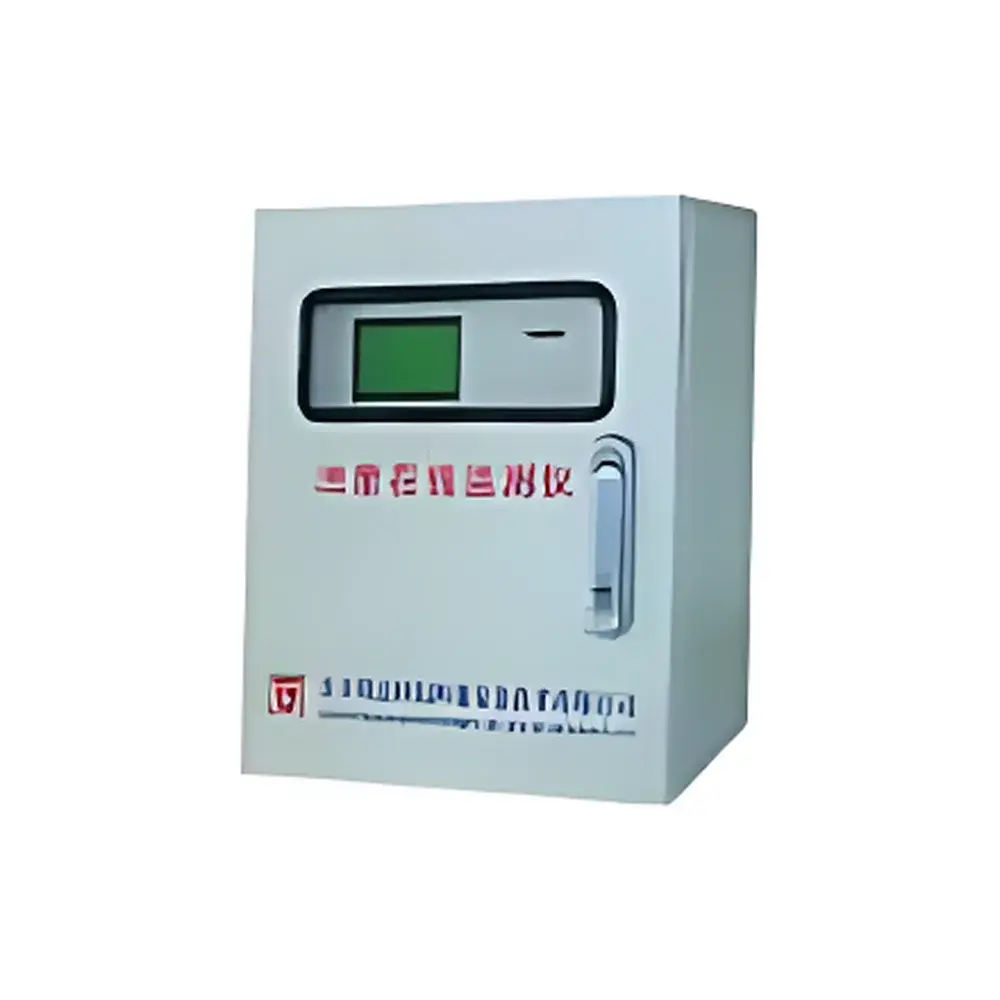
KSZD-20 Online Turbidity Monitor
| Origin | Beijing, China |
|---|---|
| Manufacturer Type | Authorized Distributor |
| Origin Category | Domestic (PRC) |
| Model | KSZD-20 |
| Price | Upon Request |
| Measurement Principle | Dual-Detector Transmitted & 90° Scattered Light (ISO 7027 Compliant) |
| Range Options | A-Type: 0–200 NTU / 0–4000 NTU |
| B-Type | 0–10 NTU / 0–200 NTU |
| Accuracy | ±5% (A-Type), ±3% (B-Type) |
| Repeatability | ±5% |
| Process Temp. | 0–40 °C |
| Ambient Op. Temp. | 0–50 °C |
| Humidity | 65 ± 20% RH |
| Output | Isolated 4–20 mA (scalable), RS232 Serial Interface |
| Power Supply | 220 V AC, 50 Hz |
| Installation | In-line Pipe Mount or Submersible Probe Mount |
| Configuration | Integrated or Remote Sensor + Controller |
Overview
The KSZD-20 Online Turbidity Monitor is an ISO 7027-compliant industrial-grade turbidimeter engineered for continuous, real-time measurement of suspended particulate concentration in water and wastewater streams. It employs a dual-detector optical architecture: a primary transmitted-light photodetector aligned collinearly with the light source, and a secondary 90° scattered-light detector—both utilizing a stable monochromatic LED (860 nm) to minimize interference from color, fluorescence, or ambient light. This dual-signal acquisition enables robust compensation for sensor fouling, bubble interference, and variable path-length effects commonly encountered in raw water intakes, filtration effluent lines, disinfection contact basins, and distribution network monitoring points. Designed for unattended operation in municipal, industrial, and environmental compliance applications, the KSZD-20 delivers traceable, repeatable NTU readings under dynamic flow conditions without requiring frequent recalibration.
Key Features
- Dual-optical detection system compliant with ISO 7027:1999 for standardized turbidity reporting in NTU units
- Selectable range configurations: A-Type supports high-range applications (0–4000 NTU) for raw surface water or sludge blanket monitoring; B-Type offers enhanced low-range sensitivity (0–10 NTU) suitable for filtered drinking water or membrane bioreactor (MBR) effluent verification
- Integrated self-diagnostic routines—including lamp intensity validation, detector signal stability check, and internal reference calibration verification—triggering configurable alarm outputs upon deviation
- Configurable installation options: compact in-line flanged housing (DN50–DN150) for pressurized pipe systems, or submersible probe variant with IP68-rated stainless-steel body for open-channel or tank-level deployment
- Non-volatile memory retains calibration coefficients, user settings, and event logs during power interruption; automatic recovery on power-up with no manual reinitialization required
- Modular architecture separates optical sensor head from remote display/controller unit—enabling hazardous-area mounting (e.g., Class I Div 2) while locating operator interface in control rooms
Sample Compatibility & Compliance
The KSZD-20 is validated for aqueous media with suspended solids ≤ 100 µm in diameter and non-abrasive composition (e.g., clay, silt, algae, coagulated flocs, activated sludge). It is unsuitable for highly viscous fluids, emulsions, or samples containing air entrainment exceeding 1% v/v without inline degassing. The instrument meets EMC Directive 2014/30/EU and Low Voltage Directive 2014/35/EU. Its 4–20 mA output conforms to NAMUR NE43 standards for fault signaling. Data integrity aligns with EPA Method 180.1 and ASTM D6508-20 requirements for online turbidity instrumentation used in regulatory reporting. Optional firmware upgrade supports audit-trail logging per FDA 21 CFR Part 11 for GMP water-for-injection (WFI) monitoring applications.
Software & Data Management
The KSZD-20 supports ASCII-based serial communication via RS232 at 9600 bps (8N1), enabling integration into SCADA, DCS, or PLC systems using Modbus RTU protocol (custom driver available). Local configuration is performed via front-panel keypad and LCD or through PC-based utility software that records time-stamped measurements, calibration history, diagnostic events, and maintenance logs. All stored data are timestamped with UTC synchronization capability when connected to NTP-enabled controllers. Raw analog output is linearized per ISO 7027 transfer function; digital output includes status flags for sensor clean alert, lamp aging warning, and signal saturation detection.
Applications
- Real-time monitoring of influent turbidity at water treatment plants to optimize coagulant dosing
- Effluent quality assurance in municipal wastewater facilities prior to discharge (compliance with EU Urban Wastewater Treatment Directive 91/271/EEC)
- Process control in food & beverage production—e.g., rinse water clarity verification post-CIP cycles
- Monitoring filter backwash effectiveness and breakthrough detection in granular media filters
- Environmental surveillance of river intake points and stormwater outfalls under national water quality standards (e.g., China’s GB 3838-2002, US EPA Clean Water Act Section 402)
- Supporting ISO 22000 and HACCP-based water safety plans in pharmaceutical manufacturing utilities
FAQ
What calibration standards are recommended for field verification?
Certified formazin or polymer-based NTU standards traceable to NIST SRM 2134 are required; annual verification against primary standard is advised per ISO/IEC 17025 laboratory practice.
Can the KSZD-20 be integrated into existing PLC-based automation systems?
Yes—via isolated 4–20 mA analog output or RS232 serial interface with optional Modbus RTU firmware; documentation includes register maps and wiring schematics.
Is temperature compensation applied automatically during measurement?
No—temperature is monitored but not compensated in the turbidity algorithm; users must maintain process temperature within 0–40 °C as specified to ensure optical path stability.
How often does the optical window require cleaning in high-fouling environments?
With standard wiper assembly, cleaning interval ranges from 24 to 168 hours depending on suspended solids load; ultrasonic cleaning option extends maintenance cycles by up to 3×.
Does the device support remote firmware updates?
Firmware upgrades require local USB connection or RS232 terminal access; over-the-air (OTA) update capability is not implemented due to cybersecurity constraints in critical infrastructure deployments.







