
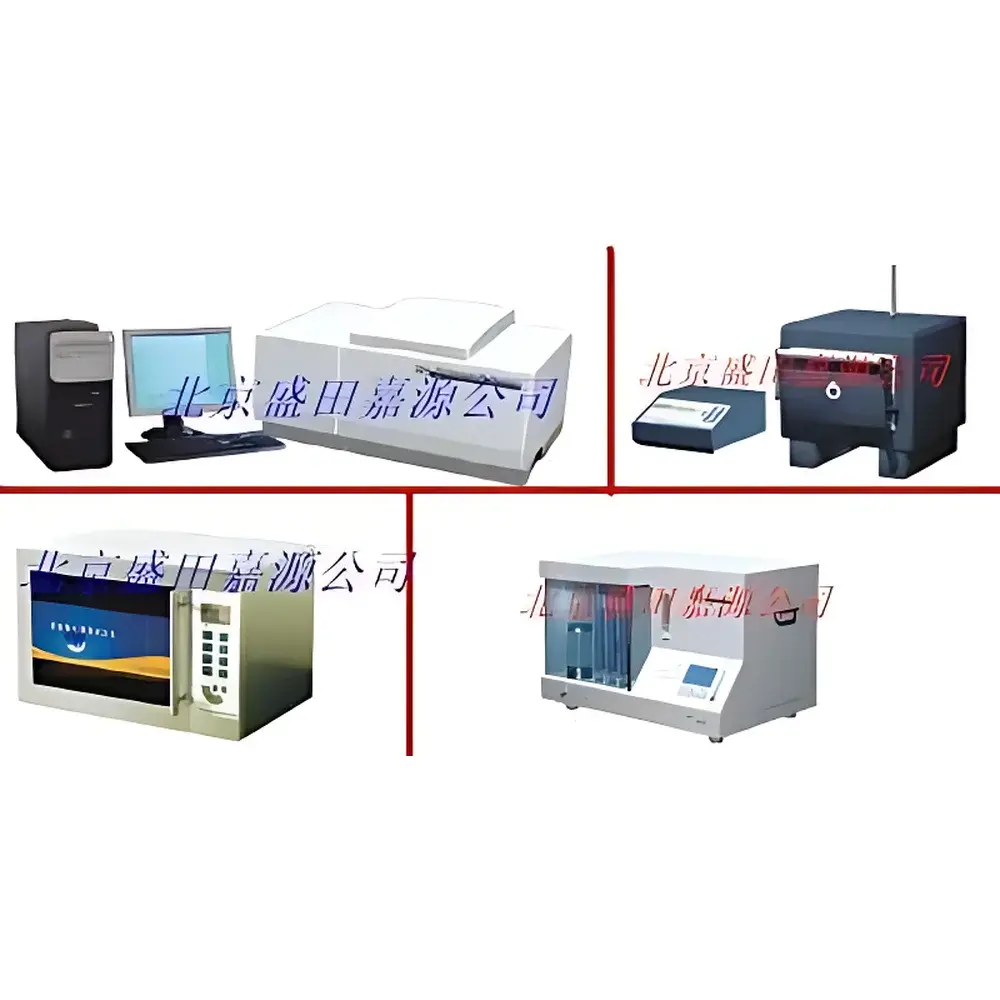
Shengtianjiayuan CT7000 Multi-Function Calorimeter | CTS3000 Precision Fast Sulfur Analyzer | CTD100 Microwave-Mediated Moisture Analyzer | CTM100 Ash & Volatiles Determinator
| Origin | China |
|---|---|
| Manufacturer Type | Authorized Distributor |
| Model Range | CT7000 / CTS3000 / CTD100 / CTM100 |
| Pricing | Available Upon Request |
Overview
The Shengtianjiayuan CT Series comprises four complementary, industry-optimized analytical instruments engineered specifically for quality control and raw material evaluation in modern dry-process cement manufacturing. Each unit addresses a distinct but interdependent parameter critical to thermal process stability, kiln reliability, and clinker quality: calorific value and combustion behavior (CT7000), total sulfur content (CTS3000), moisture content (CTD100), and ash/volatiles yield (CTM100). Collectively, they implement standardized test methods mandated by GB/T 213–2008 (calorimetry), GB/T 214–2017 (coulometric sulfur determination), GB/T 211–2017 (moisture), and GB/T 212–2008 (proximate analysis), ensuring regulatory traceability and data comparability across laboratories. The CT7000 operates on the oxygen bomb calorimetry principle, delivering direct measurement of gross calorific value (Qgr,m) and proprietary kinetic combustion profiling via controlled isothermal oxidation. The CTS3000 employs coulometric titration following high-temperature pyrolysis at 1150 °C ±5 °C in a quartz tube under controlled oxygen flow, enabling precise quantification of total sulfur as SO2. The CTD100 integrates dual-mode microwave and infrared irradiation to achieve rapid, uniform volumetric heating—minimizing thermal gradients and eliminating sample charring or splattering, particularly for low-reactivity anthracite. The CTM100 implements programmable temperature ramping per ASTM D3172 and ISO 562, with automated dwell timing and cold-junction compensation for thermocouple accuracy. All units are designed for integration into GLP-compliant cement QC workflows and support audit-ready data integrity requirements.
Key Features
- CT7000: Integrated refrigerated water jacket maintains constant inner-bomb temperature across consecutive runs; auto-fill/drain cycle eliminates manual water handling; combustion kinetics module generates ignition index (Ii) and burnout index (Bo) from real-time temperature rise profiles.
- CTS3000: Dynamic endpoint detection algorithm compensates for tailing effects in high-sulfur (>5%) and cement matrix samples; PID-controlled furnace with lightweight ceramic insulation achieves 1150 °C in <8 min; electrolyte anti-backflow design prevents electrolytic cell damage during power interruption.
- CTD100: Dual-frequency microwave (2450 MHz) + near-infrared (1.2 µm) irradiation ensures homogeneous energy coupling across bituminous, anthracite, and lignite matrices; explosion-resistant sample chamber with pressure-relief venting; programmable drying protocols for Mad and Mt per ISO 589.
- CTM100: Motorized sliding door with safety interlock; pre-stored thermal programs for ash (815 °C, 60 min), volatiles (900 °C, 7 min), and Roasting Index (RI); self-diagnostic firmware reports heater status, thermocouple continuity, and ambient drift.
- All systems feature RS-232/USB interfaces for LIMS connectivity; optional Ethernet module supports remote calibration verification and firmware updates.
Sample Compatibility & Compliance
The CT Series accommodates heterogeneous solid fuels and intermediate cementitious materials including pulverized coal (particle size ≤6 mm for moisture, ≤0.2 mm for proximate analysis), petcoke, lignite, fly ash, raw meal, and clinker fines. Each instrument conforms to national and international standards governing method validation, precision, and reporting: GB/T 213–2008 (calorific value), GB/T 214–2017 (sulfur), GB/T 211–2017 (moisture), GB/T 212–2008 (ash/volatiles), ASTM D5142 (moisture), ASTM D3177 (sulfur), and ISO 19579 (microwave moisture). Instrument qualification includes repeatability testing per ISO 5725-2, with demonstrated RSD ≤0.2% for calorific value, ≤0.05% absolute for sulfur (0.1–10% range), ≤0.15% absolute for moisture (1–15%), and ≤0.3% absolute for ash (5–25%). Data records comply with FDA 21 CFR Part 11 requirements when paired with optional audit-trail software.
Software & Data Management
Embedded firmware provides intuitive touchscreen operation with multilingual UI (English, Chinese, Spanish). All instruments generate timestamped, digitally signed result files (.csv/.txt) containing sample ID, operator ID, method version, raw sensor outputs, intermediate calculations, and final reported values. Optional Shengtianjiayuan LabLink™ software enables centralized instrument monitoring, statistical process control (SPC) charting, trend analysis across shifts, and automatic report generation compliant with ISO/IEC 17025 clause 7.8. Calibration logs, maintenance history, and user access permissions are stored locally with encrypted backup. Data export supports direct ingestion into SAP QM, LabWare LIMS, and Oracle EBS Quality modules. Remote diagnostics allow authorized service engineers to assess system health without on-site visits.
Applications
These analyzers serve core functions across the cement production chain: incoming coal acceptance (moisture, sulfur, calorific value, ash), raw mix optimization (sulfur-alkali balance calculation using CTS3000 and CTM100 data), kiln feed homogeneity assessment (volatiles consistency), alternative fuel qualification (RDF, biomass co-firing), and clinker quality forecasting (SO3 content correlation with 28-day strength). In coal procurement, CT7000-derived combustion indices directly inform mill settings and burner adjustments to suppress precalciner afterburning and preheater blockages. CTS3000 data feeds real-time sulfur mass balance models, enabling predictive control of bypass bleed rates. CTD100 moisture results drive coal mill ventilation and classifier speed adjustments to maintain ≤1.0% out-of-mill moisture. CTM100 volatility profiles assist in diagnosing flame instability caused by excessive volatile release in the calciner zone.
FAQ
What sulfur measurement principle does the CTS3000 employ?
It uses coulometric titration following high-temperature oxidative pyrolysis at 1150 °C, per GB/T 214–2017 and ASTM D3177.
Can the CT7000 replace thermogravimetric analysis for combustion characterization?
Yes—it delivers empirically validated ignition and burnout indices without requiring TGA instrumentation, specifically calibrated for cement plant coal matrices.
Is the CTD100 suitable for anthracite with high density and low dielectric loss?
Yes—the combined microwave + IR excitation overcomes poor microwave coupling in anthracite, preventing bottle rupture and ensuring <±0.2% repeatability.
Does the CTM100 support Roasting Index (RI) determination per ISO 1171?
Yes—its programmable thermal profile includes the 900 °C/15-min hold required for RI, with automatic cooling and weight stabilization logic.
Are calibration standards and reference materials available for all four instruments?
Yes—NIST-traceable coal CRM (e.g., NIST 1632E), sulfur CRM (e.g., NIST 1632F), and moisture CRM (e.g., NIST 8490) are supplied with full CoA and uncertainty budgets.





