
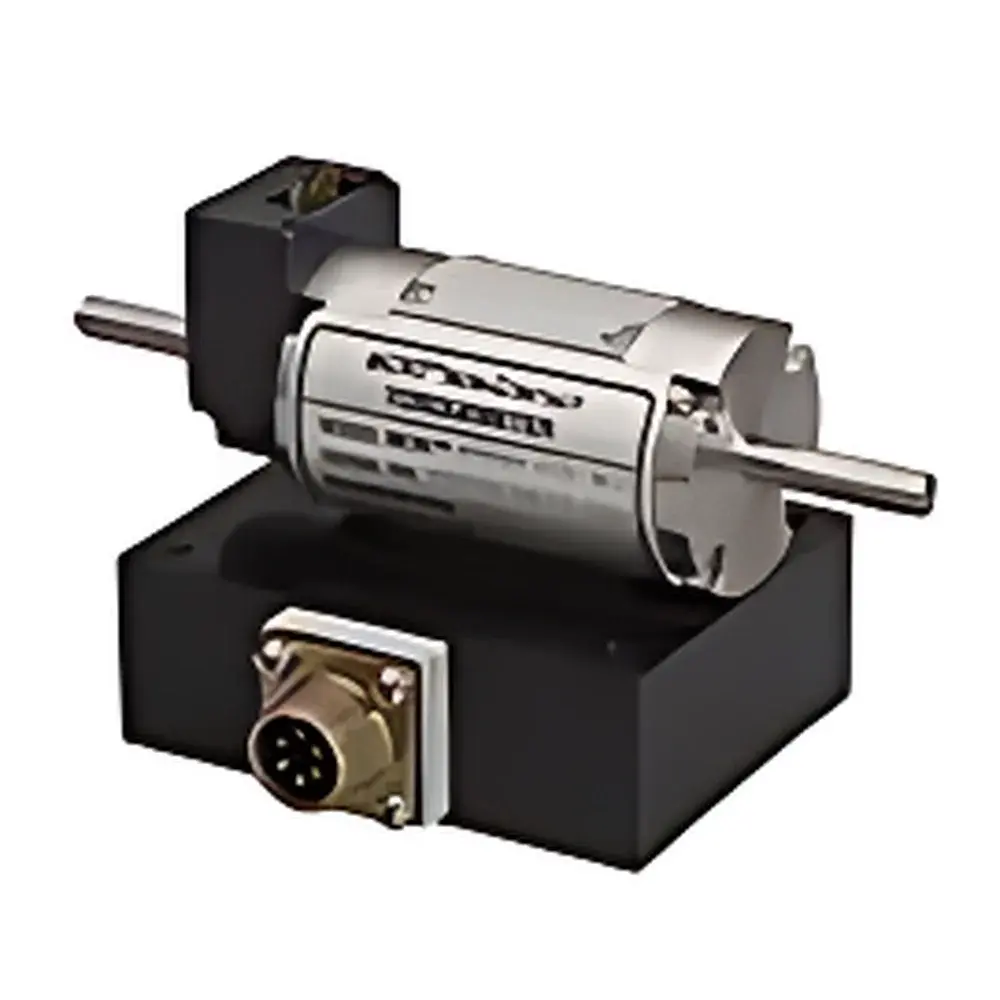
Futek 480 & 490V Non-Contact Low-Range DC Torque Sensor
| Origin | USA |
|---|---|
| Manufacturer Type | Authorized Distributor |
| Origin Category | Imported |
| Model | 480V & 490V |
| Torque Range | 0.071–1.412 N·m |
| Output | ±5 V DC (clockwise/counterclockwise) |
| Accuracy (combined) | ±0.15% FS |
| Nonlinearity | ±0.1% FS |
| Hysteresis | ±0.1% FS |
| Nonrepeatability | ±0.06% FS |
| Rotational Effect on Zero | ±0.05% FS |
| Remote Calibration Accuracy (75°F, NIST-traceable) | ±0.05% FS |
| Temperature Effect (Zero) | ±0.003% FS/°F |
| Temperature Effect (Span) | ±0.003% reading/°F |
| Compensated Temp Range | +75 to +175°F |
| Operating Temp Range | −25 to +185°F |
| Storage Temp Range | −65 to +225°F |
| Bandwidth (High-Freq Output) | DC–500 Hz |
| Bandwidth (Low-Freq Output) | DC–1 Hz |
| Input Power | 10.5–24 VDC @ 85 mA nominal |
| EMI Immunity | Enhanced against IGBT-based ASD noise |
| Max Speed Rating | 25,000 rpm |
| Optional Encoder | Dual-track 512 PPR with line driver |
Overview
The Futek 480 & 490V series represents a precision-engineered class of non-contact, low-range DC torque sensors designed for high-fidelity static and dynamic torque measurement in demanding industrial and laboratory environments. Based on strain-gaged titanium shaft technology, these sensors operate on the principle of shear-strain detection under torsional load—where applied torque induces measurable deformation in the calibrated sensing element. Critically, the design incorporates mechanical decoupling of bending and axial thrust loads, ensuring measurement integrity independent of misalignment or parallel offset forces. Unlike slip-ring–based systems, the 480/490V models utilize ferrite-free rotary transformers to transmit conditioned signals across the rotating interface—eliminating wear, electrical noise generation, and magnetic field sensitivity. This architecture delivers intrinsic immunity to electromagnetic interference (EMI), vibration, lubricants, and temperature-induced drift—making them suitable for integration into closed-loop motion control systems, motor test benches, and R&D validation platforms where signal fidelity and long-term stability are non-negotiable.
Key Features
- Non-contact signal transmission via robust, maintenance-free rotary transformers—zero wear, no brush degradation, and immunity to magnetic fields
- Integrated signal conditioning electronics enabling direct ±5 V DC analog outputs compatible with standard DAQ systems, PLCs, and industrial PCs
- Strain-gaged titanium sensing shaft engineered for high stiffness-to-inertia ratio—optimized for stepper motor characterization, servo tuning, and rapid transient torque profiling
- Enhanced EMI hardening specifically validated against noise from IGBT-based adjustable speed drives (ASDs), supporting reliable operation in modern variable-frequency drive environments
- NIST-traceable remote calibration at 75°F with ±0.05% FS accuracy; full thermal compensation across +75°F to +175°F operating range
- Maximum rotational speed rating of 25,000 rpm—enabling use in high-speed motor and gearbox testing applications
Sample Compatibility & Compliance
The 480 & 490V sensors are mechanically interfaced in-line between torque source and load—requiring no physical coupling modifications beyond standard shaft alignment practices. They accommodate both solid and hollow shaft configurations (per model variant) and support optional dual-track 512 pulses-per-revolution (PPR) encoders for concurrent speed and direction feedback. From a regulatory standpoint, the sensor’s analog output architecture and traceable calibration documentation support compliance with ISO/IEC 17025–accredited calibration workflows. While not intrinsically certified for hazardous locations, its robust enclosure and EMI resilience align with industrial requirements under IEC 61000-4-3 (radiated immunity) and IEC 61000-4-4 (electrical fast transient/burst immunity). The absence of moving contacts or lubrication dependencies ensures suitability for cleanroom-adjacent applications and GLP-compliant test setups where contamination risk must be minimized.
Software & Data Management
These sensors interface natively with industry-standard data acquisition platforms—including National Instruments DAQmx, Keysight PathWave, and MATLAB/Simulink via analog input modules. No proprietary drivers are required; the ±5 V DC output maps linearly to full-scale torque (e.g., +5 V = +1.412 N·m, −5 V = −1.412 N·m), enabling straightforward scaling in SCADA or custom LabVIEW applications. For auditability, users may log raw voltage timestamps alongside environmental metadata (e.g., ambient temperature, supply voltage) to reconstruct measurement uncertainty per ISO/IEC 17025 Clause 7.6. While the sensor itself does not embed firmware or digital communication protocols (e.g., EtherCAT, CANopen), optional encoder outputs can be synchronized with torque data using hardware-timed triggers—facilitating phase-resolved analysis of torque ripple, cogging, and commutation events in electric motor development.
Applications
- Dynamic torque characterization of stepper, BLDC, and servo motors during closed-loop position/speed control validation
- Motor test stands for EV traction motor subcomponents, including inverter-motor interaction studies under PWM excitation
- Robotics joint actuator calibration—particularly where low-end resolution (<0.01 N·m) and repeatability are critical
- Medical device R&D: precision torque verification for surgical tool actuators, infusion pump mechanisms, and haptic feedback systems
- Materials science: torsional fatigue testing of polymer composites and thin-walled metallic specimens under controlled angular displacement
- Industrial automation: real-time monitoring of gearmotor loading, conveyor drive torque margins, and clutch engagement dynamics
FAQ
What is the recommended mounting configuration for optimal accuracy?
Mount the sensor in-line between driver and load with proper shaft alignment (≤0.002″ TIR); avoid cantilevered or side-loaded configurations that introduce parasitic bending moments.
Can this sensor measure bidirectional torque without zero-shift drift?
Yes—the dual ±5 V output architecture and rotational-effect-on-zero specification (±0.05% FS) ensure stable null-point retention across continuous bidirectional rotation up to 25,000 rpm.
Is NIST-traceable calibration documentation provided with shipment?
Each unit ships with a certificate of conformance and a NIST-traceable calibration report valid at 75°F; extended-range calibration (e.g., at −25°F or +185°F) is available upon request.
Does the sensor require external excitation or signal conditioning?
No—integrated electronics condition the bridge output and provide regulated ±5 V DC analog signals; only 10.5–24 VDC power input is required.
How is thermal drift compensated over wide ambient ranges?
Temperature effects on zero and span are actively compensated within the +75°F to +175°F range using onboard thermistors and algorithmic correction—verified per ASTM E220 methodology.



