
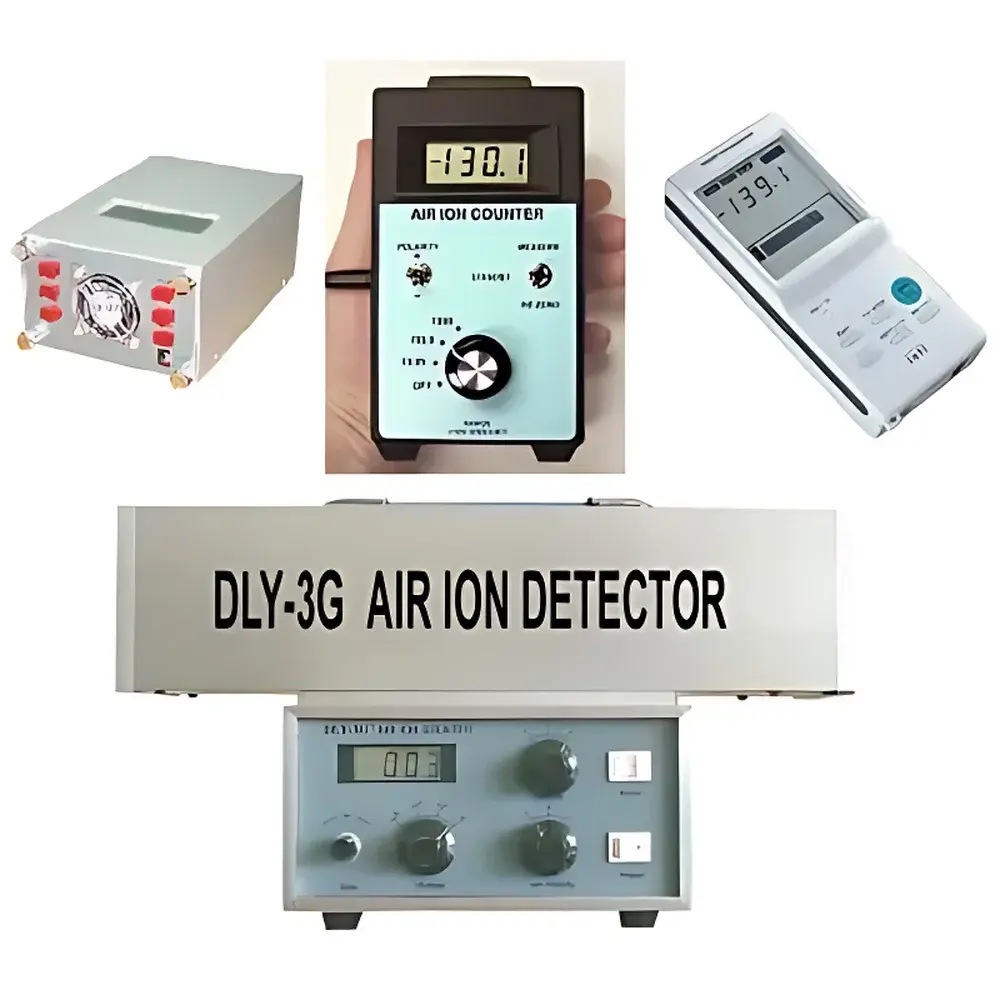
ZL1-DLY Series Air Negative Ion Concentration Analyzer
| Origin | Imported |
|---|---|
| Manufacturer Type | Authorized Distributor |
| Model Variants | 6 / 6B / 3G / 3G-232Y / 220 / 1000 |
| Detection Range | 10–1.999×10⁹ ions/cm³ |
| Resolution | 10 ions/cm³ |
| Ion Mobility Ranges | 1.0 / 0.4 / 0.15 cm²/V·s |
| Airflow Velocity | 180–200 cm/s |
| Response Time Constant | ~10–15 s |
| Accuracy | ±10% (ion concentration), ±10% (mobility), ±25% (broad-range models) |
| Operating Humidity | ≤90–99% RH (non-condensing) |
| Operating Temperature | –20 to +60 °C |
| Power Supply | DC 9 V / DC 12 V / AC 220 V |
| Output Impedance | 5×10¹⁰ Ω |
| Data Interface | RS-232 or USB (optional software support) |
Overview
The ZL1-DLY Series Air Negative Ion Concentration Analyzer is a precision electrostatic detection instrument engineered for quantitative measurement of unipolar and bipolar gaseous ion concentrations in ambient air. It operates on the principle of parallel-plate corona-assisted ion collection: sampled air is drawn through a defined 4-mm aperture into a polarization chamber where outer electrodes maintain fixed ±1000 V/m electric fields, while a central linear collector plate measures the resulting microcurrent generated by incident ions. This current-to-concentration conversion—calibrated against known ion mobility standards—enables direct readout of ion density in units of ions per cubic centimeter (ions/cm³). Unlike optical or mass-spectrometric methods, this design delivers real-time, field-deployable performance without requiring vacuum systems or consumable reagents. The analyzer is specifically optimized for environmental monitoring applications where long-term stability under variable atmospheric conditions—including elevated humidity—is critical. Its operational foundation aligns with the physical principles outlined in IEC 61000-4-xx electromagnetic compatibility standards and conforms to the measurement methodology specified in GB/T 18809–2002, China’s national standard for air ion concentration determination.
Key Features
- Triple-mode ion mobility selection (1.0, 0.4, and 0.15 cm²/V·s) enables discrimination between small, medium, and large cluster ions—essential for distinguishing biologically active light ions from less mobile heavy ions.
- Integrated anti-humidity architecture in the 3G variant includes a proprietary self-recovering desiccation system that actively dissipates surface moisture from collector plates and insulators, ensuring stable baseline operation at up to 99% RH without manual intervention.
- Dual-polarity capability (models D220 and 1000) supports simultaneous or selective measurement of both positive and negative ion populations—a requirement for comprehensive atmospheric electricity studies and indoor air quality audits.
- High-input-impedance electrometer circuitry (5×10¹⁰ Ω) minimizes signal loading error and preserves integrity of sub-picoampere currents generated by low-concentration ion fluxes.
- Real-time multi-parameter display (LCD) shows ion concentration, ambient temperature, relative humidity, timestamp, and polarity mode—enabling synchronized environmental correlation during field surveys.
- Modular power architecture accepts rechargeable 9 V batteries, 12 V DC adapters, or 220 V AC mains—ensuring uninterrupted operation across remote field stations, mobile laboratories, and fixed monitoring nodes.
Sample Compatibility & Compliance
The ZL1-DLY series is validated for continuous sampling of ambient outdoor air, forest canopy air, coastal marine air, and indoor environments including HVAC-ventilated spaces and sealed chambers. Its robust inlet geometry and low-pressure drop design accommodate particulate-laden airstreams without clogging, though use with optional 0.3 µm pre-filters is recommended for high-dust settings. All models comply with GB/T 18809–2002 for methodology, reporting resolution, and calibration traceability. While not certified to ISO/IEC 17025 for accredited testing, the instruments meet technical requirements for routine environmental surveillance per EPA Region 10 ambient air monitoring guidance and WHO indoor air quality assessment frameworks. For GLP-compliant deployments, optional audit-trail-enabled firmware (v3.2+) supports time-stamped data logging with operator ID tagging and tamper-evident file encryption.
Software & Data Management
Optional PC-based control software (ZL1-DataLink v4.1) provides full remote operation via RS-232 or USB virtual COM port. It captures time-synchronized streams of ion concentration (positive/negative), temperature (±0.5 °C), and humidity (±3% RH) at user-defined intervals down to 1 Hz. Raw data exports to CSV or Excel-compatible formats include metadata headers compliant with FAIR (Findable, Accessible, Interoperable, Reusable) data principles. Curve-fitting modules support exponential decay analysis for ion lifetime estimation, while batch processing tools enable comparative statistical analysis across multiple sensor deployments. Software logs include automatic calibration event records, battery voltage history, and sensor self-diagnostic flags—facilitating preventive maintenance scheduling in multi-unit networks.
Applications
- Environmental monitoring: Long-term trend analysis of negative ion dynamics in national parks, coastal zones, and urban green infrastructure—supporting ecological health assessments per ISO 14001 environmental management systems.
- Indoor air quality (IAQ) validation: Quantifying ion depletion effects of HVAC filtration, electronic equipment emissions, and synthetic material off-gassing in offices, schools, and healthcare facilities.
- Climatological research: Correlating ion concentration with solar irradiance, cosmic ray flux, and thunderstorm activity in mesoscale atmospheric electricity studies.
- Biomedical exposure studies: Measuring ion gradients near waterfalls, forest trails, and salt caves to inform dose–response modeling for therapeutic aerosol exposure protocols.
- Building commissioning: Verifying ion generation efficacy of commercial ionizers and plasma-based air purifiers under real-world boundary conditions.
FAQ
What is the minimum detectable ion concentration?
The instrument achieves a lower limit of detection (LOD) of 10 ions/cm³ under controlled laboratory conditions, verified using calibrated radioactive ²¹⁰Po ion sources per ASTM D8197–21 Annex A1.
Can the analyzer distinguish between ion types (e.g., O₂⁻ vs. CO₃⁻)?
No. The ZL1-DLY series measures total charge-carrying capacity within defined mobility ranges but does not perform mass spectrometry or chemical speciation. Identification requires coupling with differential mobility analyzers (DMA) or ion chromatography systems.
Is calibration traceable to national standards?
Yes. Primary calibration is performed against NIM (National Institute of Metrology, China) reference ion generators. Certificate of Calibration includes uncertainty budgets per GUM (Guide to the Expression of Uncertainty in Measurement) and is valid for 12 months.
How often should the collector plates be cleaned?
Under typical field use (≤70% RH), cleaning every 3 months with anhydrous ethanol and lint-free swabs is sufficient. In high-humidity or high-particulate environments, monthly inspection is advised.
Does the instrument meet FDA 21 CFR Part 11 requirements?
The base hardware does not include electronic signature or audit trail functionality. However, the optional ZL1-DataLink Pro software package (with password-protected user roles, electronic signatures, and immutable log archives) satisfies Part 11 criteria for regulated pharmaceutical and clinical trial environments.
Related Products







