
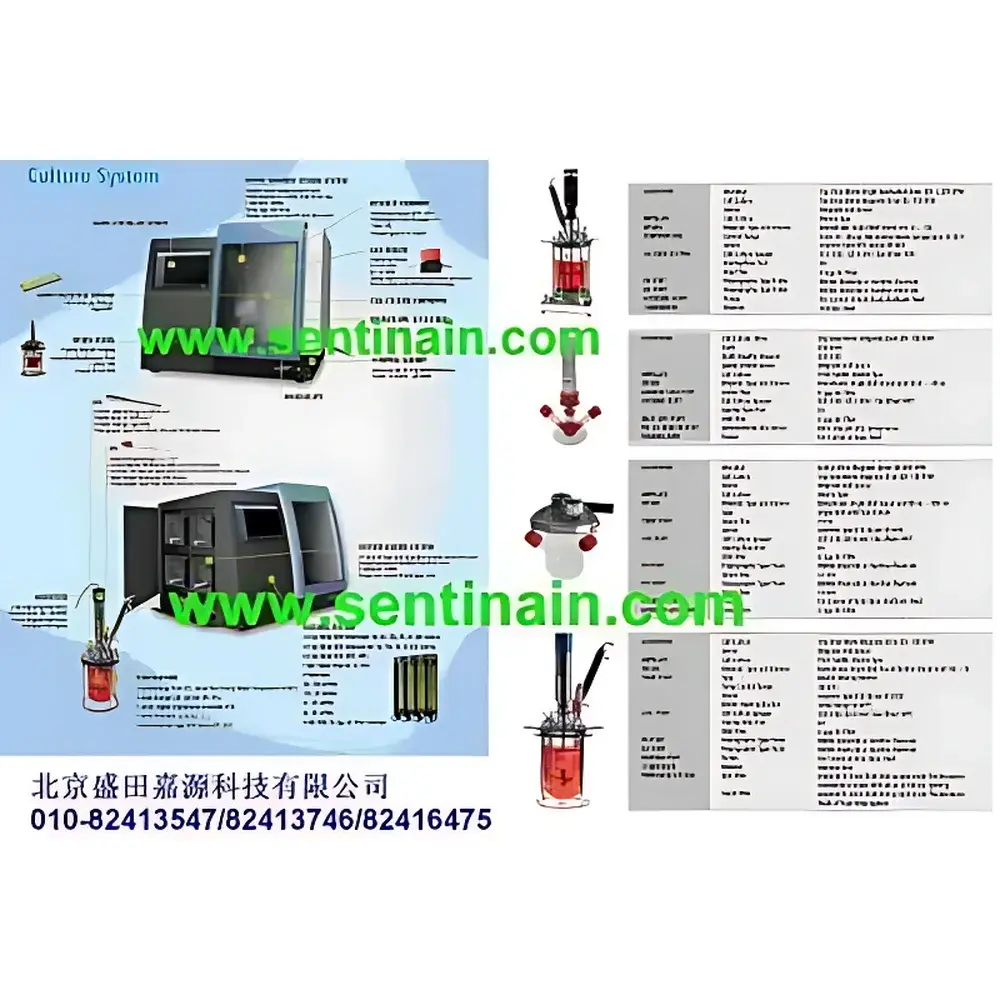
GL Bioreactor Plant Cell Culture Observation System
| Origin | South Korea |
|---|---|
| Manufacturer Type | Authorized Distributor |
| Origin Category | Imported |
| Model | GL Bioreactor |
| Pricing | Upon Request |
Overview
The GL Bioreactor Plant Cell Culture Observation System is an integrated, modular platform engineered for high-fidelity, real-time monitoring and controlled cultivation of plant and mammalian cells—particularly sensitive stem cell lines and 3D microtissue constructs. Unlike conventional stirred-tank bioreactors, this system employs a non-invasive, single-use bioreactor cartridge architecture combined with in-situ optical and semiconductor-based sensing to eliminate cross-contamination risks and minimize mechanical shear stress. Its core measurement principles include lateral/backside-isolated ISFET-based pH detection, thermistor- and galvanic-cell-derived dissolved oxygen (DO) quantification, and embedded micro-thermometry—all co-located within the culture chamber at sub-millimeter scale. The system operates on a closed-loop control paradigm compliant with ISO 20957 (bioreactor performance standards) and supports process analytical technology (PAT) frameworks aligned with FDA Guidance for Industry on PAT and ICH Q5D (characterization of cell substrates). Designed specifically for early-stage bioprocess development, it bridges the gap between benchtop flask culture and GMP-scale manufacturing by enabling scalable, reproducible, and data-rich cultivation from 10 mL to 100 mL working volumes.
Key Features
- Single-use, customizable bioreactor cartridges fabricated via Kyocera’s 3D ceramic platform—enabling user-defined geometry, surface chemistry, and porosity for adherent or suspension cultures.
- Integrated multifunctional semiconductor sensor array: simultaneous, real-time measurement of pH, DO, and temperature with <1 µm spatial resolution and lateral isolation (patent-pending).
- Magnetic coupling drive mechanism eliminates shaft seals and prevents microbial ingress—validated per ASTM E2994 for sterility assurance in closed bioprocessing.
- Multi-gas blending capability (O₂, CO₂, N₂, air) with precision mass flow controllers; up to 24 reactors operable in serial configuration.
- Modular controller architecture supporting up to 16 variable-speed and 24 fixed-speed peristaltic pumps for multi-component perfusion (e.g., glucose, glutamine, FBS, antibiotics).
- Dual-display interface options: LCD-integrated master module (1:16 cascade) or headless node modules—enabling centralized supervision of up to 256 independent bioreactor units via one host PC.
Sample Compatibility & Compliance
The system accommodates diverse culture modalities: suspension-adapted plant cells (e.g., Nicotiana tabacum BY-2), anchorage-dependent mammalian lines (CHO-K1, HEK293), mesenchymal and pluripotent stem cells, and 3D microcarriers (U-shaped carriers, alginate microcapsules, soft agar overlays). All disposable cartridges meet USP Class VI biological safety requirements and are certified endotoxin-free (<0.03 EU/mL). Hardware and firmware comply with IEC 61000-6-2/6-4 (EMC), UL 61010-1 (safety), and support 21 CFR Part 11-compliant audit trails when paired with optional GL BioSuite software. System validation documentation—including IQ/OQ protocols—is provided to facilitate GLP/GMP transition and regulatory submissions (e.g., IND/IMPD dossiers).
Software & Data Management
The embedded control software provides PID-tuned regulation of pH (via acid/base dosing or CO₂ sparging), DO (via gas blending or agitation modulation), temperature (±0.1°C stability), and perfusion rate. Data logging captures time-stamped sensor outputs, actuator states, and image metadata at user-configurable intervals (1 sec–60 min). Raw image files (TIFF, AVI, PNG) and sensor CSV logs are stored locally on onboard 128 MB flash memory or exported directly to external USB drives or network-attached storage. Image processing tools support ROI annotation, contrast enhancement, motion tracking, and fluorescence intensity profiling—compatible with third-party analysis platforms (e.g., Fiji/ImageJ, MATLAB). All calibration events (pH, DO, temperature) are timestamped, user-identified, and archived with pre-/post-calibration deviation reports.
Applications
- Stem cell expansion and directed differentiation under physiologically relevant biophysical stimuli (e.g., controlled shear, electrical pulsing, ultrasonic modulation, wavelength-specific photostimulation).
- Plant secondary metabolite production (e.g., paclitaxel, anthocyanins) in scalable, sterile, low-shear environments.
- 3D organoid and spheroid formation with integrated live imaging—supporting longitudinal morphometric analysis without harvesting.
- Process characterization studies for biosimilar development, including critical quality attribute (CQA) mapping against process parameters (CPPs).
- Regulatory-grade process validation for ATMPs (Advanced Therapy Medicinal Products), including comparability studies across scales and platforms.
FAQ
Does the system support FDA submission-ready data integrity?
Yes—when deployed with GL BioSuite software, the system enforces role-based access control, electronic signatures, and immutable audit trails meeting 21 CFR Part 11 requirements.
Can the bioreactor cartridge be sterilized in place (SIP)?
No—cartridges are supplied gamma-irradiated and single-use only; SIP is neither required nor supported per design philosophy.
What optical magnification ranges does the live-cell imaging subsystem support?
60× to 200× user-selectable magnification with 1 µm XY resolution stage, white LED illumination, and progressive-scan 1024×768 color CCD.
Is confocal imaging compatible with fluorescent nanoprobes?
Yes—the fiber-oscillation laser scanning module (1 frame/min) enables high-contrast 3D fluorescent reconstruction, especially when enhanced with magnetic nanoparticle labeling.
How is shear stress minimized during agitation?
Via smooth-profile impellers and magnetically coupled drive—validated to maintain turbulent kinetic energy below 0.05 m²/s², well within thresholds reported for sensitive hMSCs in literature (Biotechnology and Bioengineering, 2021).
Related Products



