
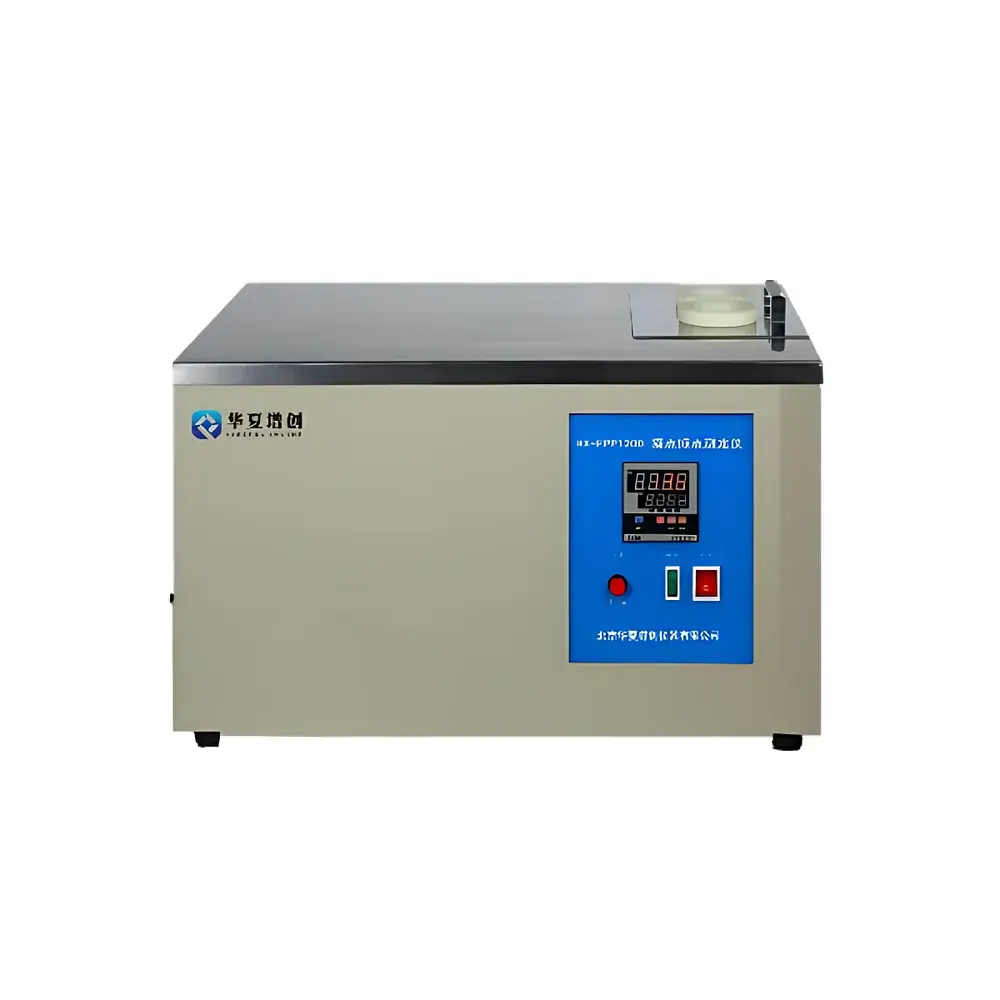
Spectra Invent HX-FPP1200 Cloud Point and Pour Point Analyzer
| Brand | Spectra Invent |
|---|---|
| Origin | Beijing, China |
| Manufacturer Type | Authorized Distributor |
| Country of Origin | China |
| Model | HX-FPP1200 |
| Price Range | USD 1,400 – 14,000 |
| Power Consumption | ≤1500 W |
| Temperature Resolution | 0.1 °C |
| Temperature Range | −70 °C to +15 °C |
| Cooling Method | Compressor-based refrigeration |
| Bath Configuration | Dual-bath single-chamber isothermal system |
| Timing Resolution | 0.1 s (max 60.0 s) |
| Temperature Sensor | PT100 platinum resistance thermometer |
| Ambient Operating Conditions | 5–40 °C, RH ≤85% |
| Power Supply | AC 220 V ±10%, 50 Hz |
| Dimensions | 600 × 450 × 450 mm |
| Net Weight | 50 kg |
Overview
The Spectra Invent HX-FPP1200 Cloud Point and Pour Point Analyzer is a fully automated, dual-function laboratory instrument engineered for precise determination of cloud point (CP) and pour point (PP) in petroleum products and related hydrocarbon-based fluids. It operates on the principle of controlled-rate cooling combined with optical detection (for cloud point) and mechanical flow assessment (for pour point), conforming to internationally recognized test methodologies including ASTM D2386 (cloud point), ASTM D97 (pour point), GB/T 510 (pour point), and GB/T 3535 (cloud point). The system employs a high-efficiency compressor-based refrigeration unit capable of sustaining stable thermal gradients down to −70 °C, enabling accurate endpoint detection across a broad spectrum of distillate fuels, lubricating oils, biodiesel blends, and crude fractions. Its single-chamber, dual-bath isothermal architecture ensures uniform thermal exposure between reference medium and sample vial—minimizing thermal lag and enhancing measurement reproducibility across repeated runs.
Key Features
- Compressor-driven refrigeration system delivering consistent cooling performance to −70 °C without reliance on external coolant or dry ice.
- Integrated high-airflow forced-convection cooling fan eliminates need for recirculating water chillers—reducing infrastructure dependencies and operational complexity.
- Intelligent temperature differential control algorithm maintains constant ΔT between cooling bath and sample, ensuring linear, repeatable cooling rates per ASTM and ISO protocols.
- Microprocessor-based timing module with 0.1-second resolution supports precise endpoint validation during both cloud formation observation and pourability assessment.
- PT100-class precision temperature sensing provides traceable, NIST-compatible thermal measurement with 0.1 °C resolution across the full operating range.
- Robust mechanical design (50 kg mass, steel-reinforced chassis) ensures vibration damping and thermal stability during extended testing cycles.
Sample Compatibility & Compliance
The HX-FPP1200 accommodates standard ASTM D2386 and D97 sample volumes (typically 45 mL in calibrated glass test jars) and supports transparent to semi-opaque hydrocarbon liquids—including diesel fuel, jet fuel (Jet A-1), heating oil, base oils, and paraffinic solvents. It complies with regulatory and quality assurance frameworks requiring documented thermal testing procedures, including ISO/IEC 17025-accredited laboratories, refinery QC workflows, and contract testing facilities serving API, ASTM, and CNPC specifications. While the instrument itself does not embed 21 CFR Part 11 compliance features (e.g., electronic signatures or audit trails), its hardware architecture and deterministic thermal control support integration into validated LIMS environments where procedural controls and manual record retention meet GLP/GMP documentation requirements.
Software & Data Management
The HX-FPP1200 operates via embedded firmware with a front-panel LCD interface and tactile keypad navigation—designed for standalone use in regulated environments where network connectivity is restricted. All test parameters (setpoint temperature, cooling rate profile, hold times, pass/fail thresholds) are configurable and retained in non-volatile memory. Real-time temperature logging is displayed during analysis, and final results—including observed cloud/pour endpoints, time-to-event, and ambient condition metadata—are printed via integrated thermal printer or exported manually via USB storage. For laboratories requiring digital data capture, optional RS-232 or USB-to-serial adapters enable ASCII-formatted output compatible with third-party data acquisition platforms compliant with ASTM E1382 and ISO 17025 data integrity guidelines.
Applications
- Refinery process control: Monitoring cold flow properties of finished distillates prior to blending or shipment.
- Fuel specification verification: Confirming conformance to EN 590, ASTM D975, and GB 19147 limits for low-temperature operability.
- Biodiesel quality assurance: Assessing cloud point elevation due to saturated methyl ester content in FAME blends.
- Lubricant formulation development: Evaluating wax inhibition efficacy of pour point depressants (PPDs) under standardized cooling profiles.
- Research & development: Correlating molecular composition (e.g., n-paraffin distribution via GC) with macroscopic low-temperature behavior.
- Contract testing laboratories: Supporting accredited testing services under ISO/IEC 17025 scope for petroleum product certification.
FAQ
What standards does the HX-FPP1200 support for cloud point and pour point testing?
It fully implements ASTM D2386, ASTM D97, GB/T 510, and GB/T 3535 test procedures—including required cooling rate specifications, sample preparation guidance, and endpoint interpretation rules.
Is external cooling water required for operation?
No—the unit uses an internal compressor refrigeration system and forced-air heat dissipation; no recirculating chiller or tap-water connection is needed.
Can the instrument store test results internally?
It retains configuration settings and displays real-time data during analysis but does not feature onboard long-term data storage; results are output via thermal printout or serial export.
What is the minimum detectable temperature difference between cloud and pour points?
The system resolves temperature to 0.1 °C, and typical method-defined separation between CP and PP endpoints ranges from 3 °C to >25 °C depending on sample composition.
Does the HX-FPP1200 require calibration traceable to national standards?
Yes—PT100 sensor calibration should be verified annually using certified reference thermometers traceable to NIST or equivalent national metrology institutes per ISO/IEC 17025 Clause 6.5.





