
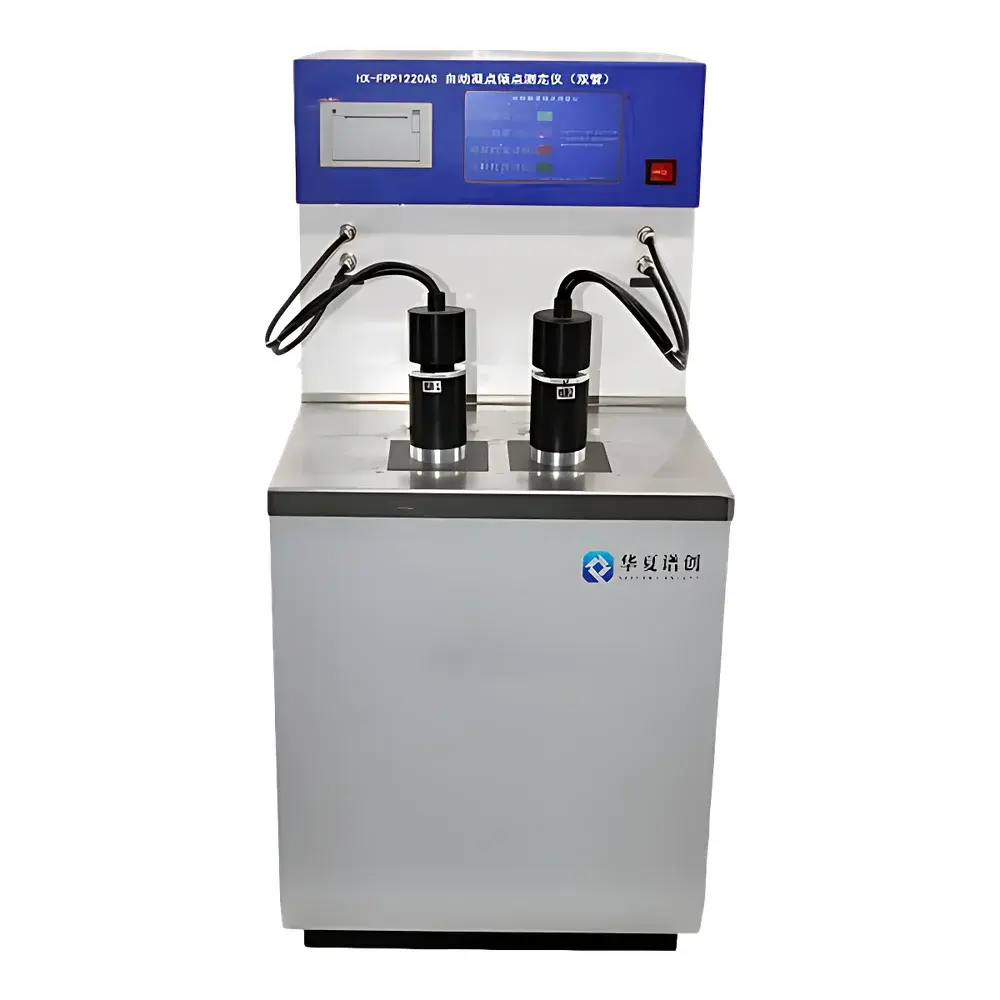
Spectra Invent HX-FPP1220AS Dual-Tube Automatic Cloud Point and Pour Point Tester
| Brand | Spectra Invent |
|---|---|
| Origin | Beijing, China |
| Manufacturer Type | Authorized Distributor |
| Country of Origin | China |
| Model | HX-FPP1220AS |
| Power Consumption | <300 W |
| Temperature Control Range | Ambient to –70 °C |
| Measurement Range | Ambient to –60 °C |
| Accuracy | ±1 °C |
| Cooling Rate | ΔT >15 °C in 10 min |
| Sample Capacity | 2 tubes simultaneously |
| Resolution | 0.1 °C |
| Display | LCD touchscreen |
| Printer | Thermal printer, 36-character Chinese/English output |
| Ambient Operating Conditions | 5–40 °C, ≤85% RH |
| Power Supply | AC 220 V ±10%, 50 Hz |
| Dimensions (W×D×H) | 600 × 580 × 825 mm |
| Net Weight | 50 kg |
Overview
The Spectra Invent HX-FPP1220AS Dual-Tube Automatic Cloud Point and Pour Point Tester is a precision-engineered analytical instrument designed for the standardized determination of cloud point (CP) and pour point (PP) in petroleum-based liquids—including lubricating oils, diesel fuels, residual fuels, and dark-colored hydrocarbon products—without viscosity limitations. It operates on the principle of controlled thermal ramping combined with optical detection (for cloud point) and mechanical tilt-based flow assessment (for pour point), fully compliant with internationally recognized test methodologies. The dual-tube architecture enables parallel, independent analysis of two samples under identical environmental conditions, significantly improving laboratory throughput while maintaining strict adherence to ASTM D2386 (cloud point), ASTM D97 (pour point), GB/T 510, and GB/T 3535 protocols. Its integrated Peltier-assisted cooling system—augmented by high-efficiency compressors—ensures stable, reproducible sub-ambient temperature control down to –70 °C, essential for low-temperature characterization of modern synthetic lubricants and biofuels.
Key Features
- Dual-channel testing capability: Simultaneous, independent CP and PP determination on two samples, reducing inter-run variability and increasing daily assay capacity.
- Wide thermal operating envelope: Precise temperature regulation from ambient to –70 °C, with resolution of 0.1 °C and accuracy of ±1 °C across the full measurement range (ambient to –60 °C).
- Automated tilt mechanism: Motor-driven sample tube inclination at defined angular increments and dwell times, replicating manual ASTM D97 procedures with metrological fidelity.
- Optical cloud detection module: High-sensitivity photometric sensor array detects subtle light-scattering changes during wax crystal formation, eliminating subjective visual interpretation.
- Programmable thermal profiles: Users may define custom cooling rates, hold durations, and detection thresholds—enabling method adaptation for non-standard or proprietary specifications.
- Intuitive human-machine interface: 7-inch capacitive touchscreen LCD with multilingual menu navigation (English/Chinese), real-time curve plotting, and on-screen parameter validation.
- Integrated thermal printer: Built-in 36-character thermal printer supports direct hardcopy output of test ID, timestamps, final values, and pass/fail status—all in native Unicode for bilingual reporting.
Sample Compatibility & Compliance
The HX-FPP1220AS accommodates standard ASTM/ISO glass test tubes (16 mm OD × 125 mm L) and accepts viscous, opaque, or heavily dyed petroleum distillates and residuals without pre-dilution or filtration. It meets functional and performance requirements outlined in ASTM D2386 (Standard Test Method for Cloud Point of Petroleum Products), ASTM D97 (Standard Test Method for Pour Point of Petroleum Products), GB/T 510–2010 (Petroleum Products—Determination of Cloud Point), and GB/T 3535–2006 (Petroleum Products—Determination of Pour Point). All firmware logic, calibration routines, and data logging pathways are structured to support GLP-compliant workflows, including user-access-level controls, audit-trail-enabled operation logs, and timestamped result archives. While not FDA 21 CFR Part 11-certified out-of-the-box, the system’s deterministic behavior, non-volatile memory storage, and traceable calibration certificate (supplied with each unit) facilitate qualification for regulated QC environments under internal SOPs.
Software & Data Management
The embedded firmware implements a deterministic state-machine architecture with no external OS dependencies, ensuring long-term operational stability and immunity to software corruption. Test parameters, raw thermal curves, and endpoint determinations are stored locally in binary format with CRC-32 integrity verification. Data export is supported via USB 2.0 port in CSV format—structured with column headers conforming to ISO/IEC 17025 documentation requirements (e.g., “Sample_ID”, “Test_Date”, “CP_°C”, “PP_°C”, “Operator_ID”, “Instrument_SN”). Optional PC-based companion software (SpectraView™ v3.2, sold separately) provides advanced statistical trending, multi-instrument fleet monitoring, and automated report generation aligned with ISO 8217 or API RP 9902 templates.
Applications
This instrument serves critical quality assurance functions across multiple sectors: In power generation, it verifies cold-flow properties of turbine oils and insulating fluids prior to winter commissioning; in refining and petrochemical manufacturing, it supports batch release testing of jet fuel (Jet A-1), marine diesel (DMA/DMB), and base oil fractions; in third-party inspection agencies (e.g., SGS, Bureau Veritas), it delivers auditable results for customs clearance and contract compliance; and in academic and industrial R&D labs, its programmable thermal profiles enable structure–property correlation studies of wax inhibitors and cold-flow improvers. Its robust mechanical design and sealed refrigeration loop also make it suitable for continuous operation in field laboratories aboard offshore platforms or remote pipeline terminals.
FAQ
What standards does the HX-FPP1220AS natively support?
It executes ASTM D2386, ASTM D97, GB/T 510, and GB/T 3535 test sequences by default, with all timing, tilt angles, and detection logic pre-configured per clause requirements.
Can the instrument be validated for ISO/IEC 17025 accreditation?
Yes—its traceable temperature calibration (NIST-traceable reference thermometer included), deterministic endpoint algorithms, and secure data logging provide foundational evidence for method validation and scope extension.
Is external chiller or coolant required?
No—the system uses an integrated compressor-based refrigeration circuit with self-contained heat dissipation; only standard AC mains power and ambient ventilation are needed.
How is measurement repeatability ensured between dual channels?
Each tube has independent temperature sensors, tilt actuators, and optical detectors, with cross-channel synchronization enforced at firmware level to eliminate thermal crosstalk and timing skew.
What maintenance intervals are recommended?
Compressor oil level and condenser coil cleaning every 12 months; optical window cleaning after every 50 tests; annual recalibration using certified reference oils (available from Spectra Invent Calibration Services).





