
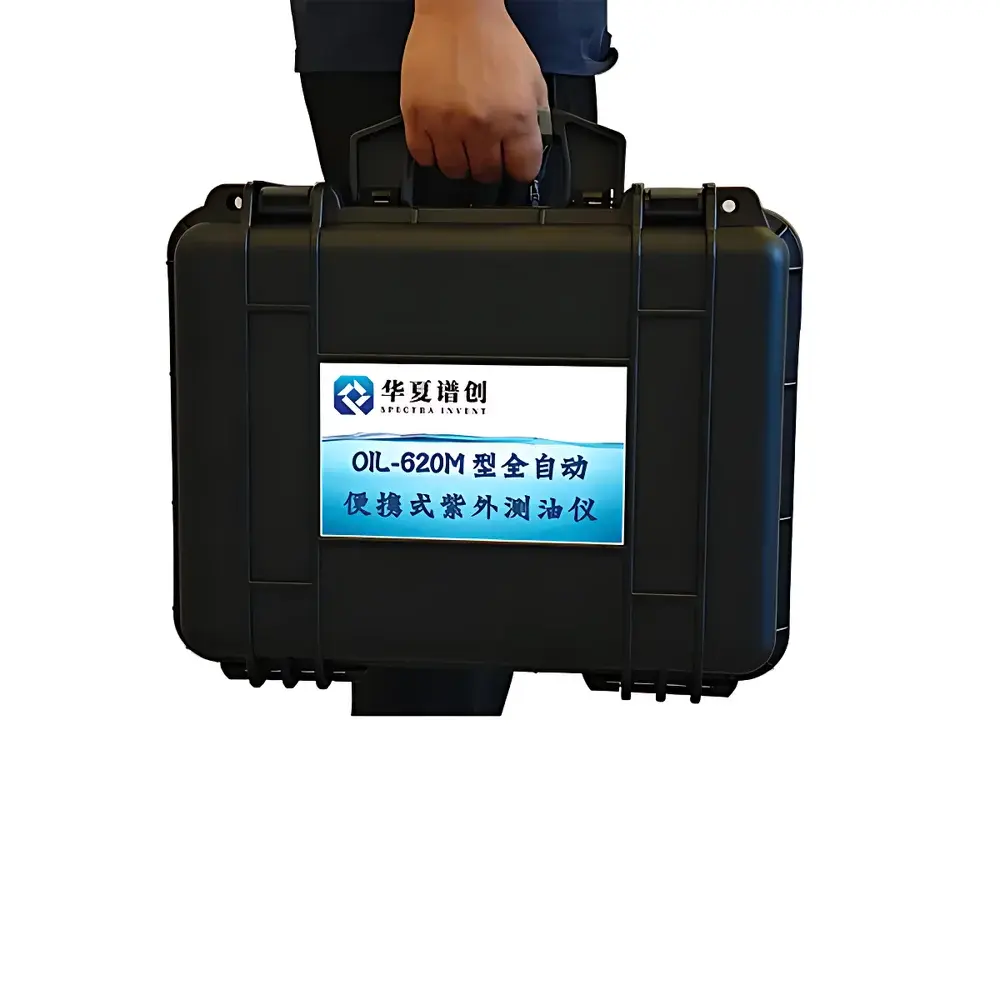
Spectra Invent OIL-620M Portable Automated UV Oil Content Analyzer
| Brand | Spectra Invent |
|---|---|
| Origin | Zhejiang, China |
| Model | OIL-620M |
| Instrument Type | Portable |
| Measurement Principle | Ultraviolet Spectrophotometry (UV-Vis) |
| Measurement Range | 0–60 mg/L |
| Detection Limit | ≤0.005 mg/L |
| Accuracy | ±2% of reading |
| Resolution | ≤0.001 mg/L |
| Compliance | HJ 970–2018, GB 5084–2021 |
| Dimensions | 428 × 350 × 230 mm |
| Weight | <15 kg |
Overview
The Spectra Invent OIL-620M Portable Automated UV Oil Content Analyzer is an integrated, field-deployable instrument engineered for the quantitative determination of petroleum hydrocarbons in aqueous matrices using ultraviolet spectrophotometry. It operates in full compliance with the Chinese environmental standard HJ 970–2018 (“Determination of Petroleum Hydrocarbons in Water by Ultraviolet Spectrophotometry”) and agricultural water quality specification GB 5084–2021. The system implements a fully automated extraction and purification workflow based on liquid–liquid partitioning: water samples are acidified to pH ≤2, followed by precise addition of n-hexane as extraction solvent; high-speed vortex mixing ensures efficient phase transfer of non-polar petroleum compounds; subsequent dehydration is achieved via a proprietary oil–water separation membrane; final cleanup employs magnesium silicate adsorption to eliminate interfering polar substances—including animal and vegetable oils—thereby isolating the target petroleum fraction. Quantification occurs at 225 nm, where absorbance follows the Lambert–Beer law, enabling direct correlation between optical density and petroleum concentration (mg/L).
Key Features
- Fully automated sample preparation: integrated reagent dispensing, volumetric sampling, vortex-assisted extraction, membrane-based phase separation, and magnesium silicate column cleanup—all executed without manual intervention.
- Compact, battery-compatible portable architecture: total mass <15 kg and footprint under 0.15 m², optimized for field deployment in remote monitoring stations, emergency response vehicles, or mobile laboratories.
- Optical system calibrated for 225 nm UV measurement with temperature-stabilized deuterium lamp source and low-stray-light monochromator, ensuring high photometric reproducibility across ambient operating conditions (10–35 °C).
- Digital resolution of ≤0.001 mg/L and method detection limit of ≤0.005 mg/L, validated per HJ 970–2018 protocol using certified reference materials traceable to NIM (National Institute of Metrology, China).
- Robust mechanical design featuring corrosion-resistant housing, sealed fluidic pathways, and vibration-damped optical bench—suitable for transport over unpaved terrain and operation on uneven surfaces.
Sample Compatibility & Compliance
The OIL-620M is validated for analysis of surface water, groundwater, seawater, and wastewater effluents. Sample matrix tolerance has been verified across salinity ranges up to 35 g/L (seawater-equivalent) and turbidity levels ≤100 NTU, with no significant interference from common co-solutes including humic acids (≤10 mg/L), chloride (≤10,000 mg/L), and suspended solids (<50 mg/L). All operational protocols and calibration procedures align with HJ 970–2018 requirements for method validation, including linearity assessment (r² ≥0.999 over 0–60 mg/L), spike recovery (85–115%), and inter-laboratory precision (RSD ≤5%). While not explicitly designed for GLP or 21 CFR Part 11 environments, audit-ready data logs—including timestamps, operator ID, reagent lot numbers, and raw absorbance spectra—are stored internally and exportable in CSV format.
Software & Data Management
The embedded Linux-based control software provides guided method execution, real-time spectral visualization, automatic baseline correction, and multi-point calibration curve generation. All measurements are tagged with metadata (date/time, operator, sample ID, instrument serial number) and archived in a tamper-evident local database. Data export supports USB flash drive transfer and optional Wi-Fi upload to secure cloud repositories. Firmware updates are delivered via signed binary packages to ensure integrity; no third-party drivers or Windows dependencies are required. Raw absorbance spectra (190–350 nm, 1 nm step) are retained for retrospective review and secondary peak evaluation.
Applications
- Regulatory monitoring of petroleum hydrocarbon discharge limits in municipal and industrial wastewater outfalls.
- Rapid assessment of oil contamination following pipeline ruptures, tanker spills, or offshore platform incidents.
- Long-term trend analysis in drinking water source protection zones and aquifer recharge areas.
- Field verification of remediation efficacy at brownfield sites undergoing bioremediation or soil washing.
- Quality assurance testing of treated ballast water prior to oceanic discharge (in accordance with IMO D-2 standards).
FAQ
Does the OIL-620M require external laboratory infrastructure to operate?
No—it is self-contained, requiring only AC power (100–240 V, 50/60 Hz) or optional external DC battery pack (12 V, ≥20 Ah); all reagents, solvents, and consumables are housed internally or in standardized cartridges.
Can the instrument be used for measuring diesel or lubricating oil separately from crude oil?
The method targets total petroleum hydrocarbons (TPH) as defined in HJ 970–2018; it does not speciate individual hydrocarbon classes. For compound-specific identification, GC–FID or GC–MS analysis is recommended.
Is user calibration required before each analysis?
A single daily calibration using two certified standards (e.g., 5 mg/L and 30 mg/L) satisfies HJ 970–2018 requirements; the system performs automatic zero-checks and wavelength verification prior to each run.
How is data integrity ensured during field use?
All measurement events are cryptographically timestamped and linked to hardware-locked session IDs; raw spectral files cannot be edited post-acquisition, and deletion requires administrative authentication.
What maintenance intervals are recommended?
Fluidic pathway cleaning every 50 analyses; magnesium silicate cartridge replacement every 200 tests; annual optical alignment verification by authorized service technician.
Related Products







