
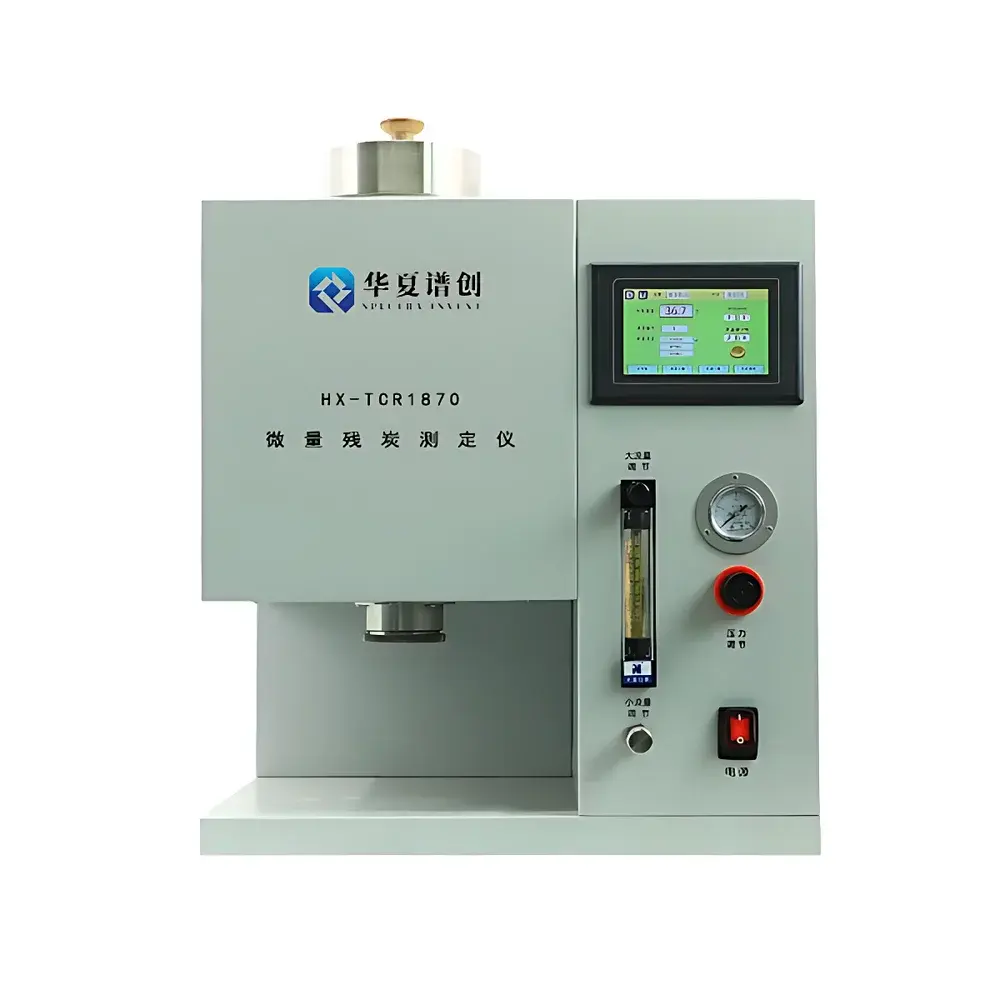
Spectra Invent HX-TCR1870 Micro Carbon Residue Analyzer
| Brand | Spectra Invent |
|---|---|
| Origin | Beijing, China |
| Manufacturer Type | Authorized Distributor |
| Country of Origin | China |
| Model | HX-TCR1870 |
| Measurement Range | 0.10–30.0 % (m/m) |
| Temperature Control | Ambient to 500 °C |
| Heating Rate | 10–15 °C/min |
| Sample Mass | 0.5 ± 0.1 g (black opaque liquids), 1.5 ± 0.5 g or 3.0 ± 0.5 g (transparent or translucent samples) |
| Display | 5.6-inch color touchscreen |
| Data Storage | 1000 test records with date-based retrieval |
| Weight | 15 kg |
Overview
The Spectra Invent HX-TCR1870 Micro Carbon Residue Analyzer is a precision thermal decomposition instrument engineered for the quantitative determination of micro carbon residue (MCR) in petroleum products, including residual fuel oils, lubricants, and cracked stocks. It operates on the principle of controlled inert-atmosphere pyrolysis—where a precisely weighed sample is heated under nitrogen flow to 500 °C following a defined temperature ramp, volatilizing hydrocarbons while leaving behind non-volatile carbonaceous residue. The mass fraction of this residue, expressed as percent by mass (% m/m), serves as a critical indicator of coke-forming tendency during refining, combustion, or catalytic processing. Designed to meet the rigorous procedural requirements of both GB/T 17144 and ASTM D4530, the HX-TCR1870 delivers high reproducibility in laboratory environments where trace-level residue quantification directly informs feedstock selection, catalyst life prediction, and boiler/furnace fouling risk assessment.
Key Features
- 5.6-inch high-resolution color touchscreen interface with intuitive navigation, real-time graphical display of temperature profile, nitrogen flow rate, and experimental timeline
- Automated thermal program execution: independent control of heating ramp (10–15 °C/min), hold duration at 500 °C, and post-pyrolysis purge cycle
- Embedded real-time operating system ensuring deterministic response, minimal latency, and uninterrupted operation during extended batch testing
- Dual-zone high-temperature chamber with ceramic-insulated furnace core and redundant overtemperature protection circuits compliant with IEC 61010-1 safety standards
- Integrated analytical balance interface support (via RS-232 or USB) for direct sample mass input; manual entry option with alphanumeric validation
- Onboard residue calculation engine applying ASTM D4530 correction factors for sample mass, crucible tare, and final char mass—outputting MCR (%) with four-digit precision
- Persistent internal flash memory storing up to 1000 complete test records, each timestamped with start time, operator ID (optional), and full thermal log
Sample Compatibility & Compliance
The HX-TCR1870 accommodates a broad range of petroleum-derived samples per ASTM D4530 scope: black opaque liquids (e.g., vacuum residua, heavy fuel oils) requiring 0.5 ± 0.1 g loading; and transparent or semi-transparent materials (e.g., distillate fuels, lubricant base oils) tested at either 1.5 ± 0.5 g or 3.0 ± 0.5 g—enabling method flexibility without hardware modification. All thermal profiles, gas flow calibration, and data handling protocols are fully aligned with the normative annexes of ASTM D4530-22 and GB/T 17144-2019. Instrument qualification documentation supports IQ/OQ protocols required under GLP-compliant laboratories, and audit trails (including parameter changes and result overrides) satisfy traceability expectations under ISO/IEC 17025:2017 Clause 7.7.
Software & Data Management
Data export is supported via USB 2.0 port in CSV format, compatible with LIMS integration and statistical process control (SPC) platforms. Each record includes raw thermocouple readings (every 5 seconds), nitrogen flow verification logs, user-entered metadata (sample ID, batch number, analyst initials), and final MCR value with uncertainty estimate derived from balance repeatability and thermal stability metrics. Optional PC-based SpectraSoft™ TCR Suite provides advanced reporting—including trend charts across multiple batches, compliance flagging for out-of-spec heating rates, and automated generation of ASTM-certified test reports with digital signature fields. All software modules adhere to FDA 21 CFR Part 11 requirements for electronic records and signatures when configured with user authentication and audit trail activation.
Applications
- Refinery QC labs monitoring residual fuel oil stability and predicting coking behavior in delayed cokers and fluid catalytic cracking (FCC) units
- Power generation facilities evaluating heavy fuel oil compatibility with combustion chamber design and ash deposition models
- Railway maintenance depots assessing lubricant degradation in diesel engine oils subjected to extended drain intervals
- Independent testing laboratories performing contract analysis for ISO 8217 marine fuel certification
- Research institutions studying thermal cracking mechanisms of bio-blended fuels and synthetic crude fractions
FAQ
What standards does the HX-TCR1870 fully comply with?
It is validated for ASTM D4530-22 and GB/T 17144-2019, including all specified heating ramps, nitrogen purity requirements (≥99.995%), and crucible geometry tolerances.
Can the instrument be integrated into an existing LIMS environment?
Yes—via standardized CSV export or optional SpectraSoft™ TCR Suite with configurable ODBC drivers and HL7-compatible metadata tagging.
Is operator training included with purchase?
Standard delivery includes on-site installation, operational qualification, and a two-day hands-on workshop covering method setup, troubleshooting common pyrolysis anomalies, and report generation.
What maintenance schedule is recommended for long-term accuracy?
Annual recalibration of thermocouple sensors and mass flow controller against NIST-traceable references is advised; furnace insulation integrity checks every 500 cycles.
Does the system support multi-user access with role-based permissions?
When deployed with SpectraSoft™ TCR Suite, it supports hierarchical user accounts (analyst, supervisor, administrator) with configurable access to data editing, method modification, and audit log review functions.





