
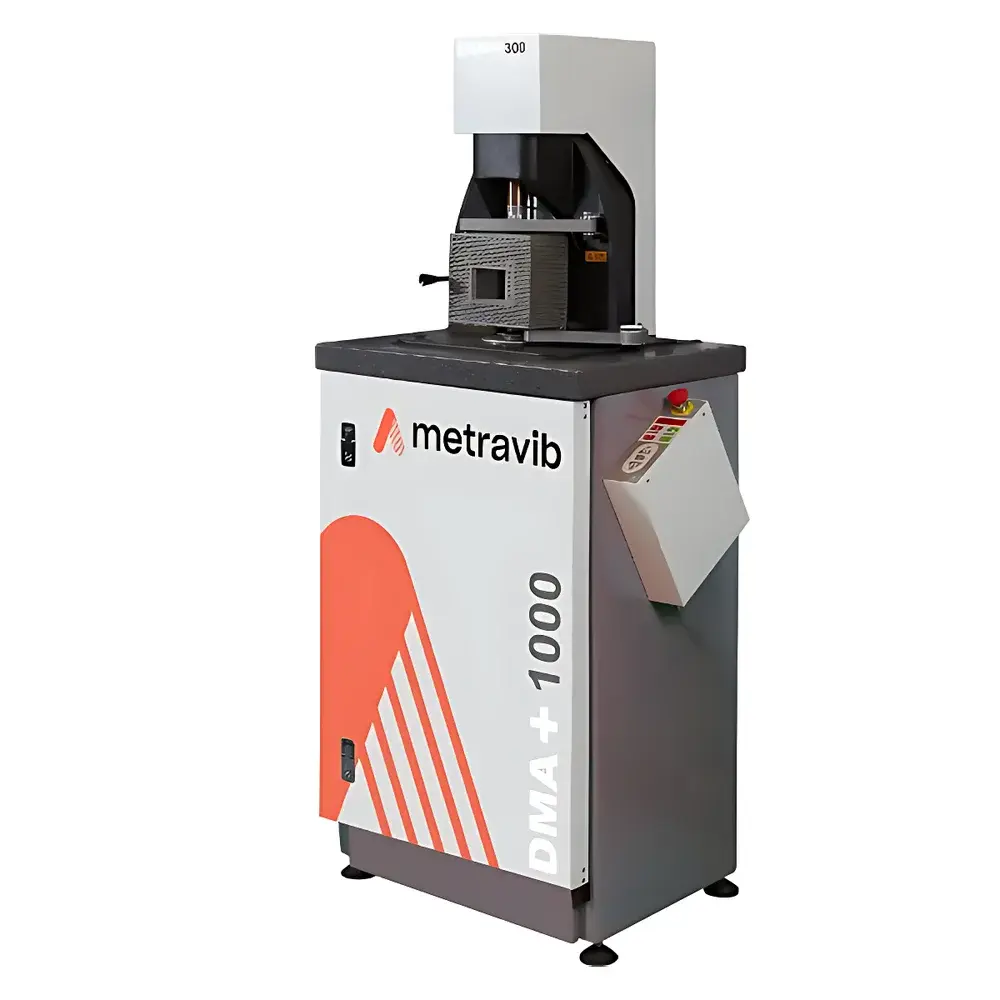
Metravib DMA+1000 Dynamic Mechanical Analyzer
| Brand | Metravib |
|---|---|
| Origin | France |
| Model | DMA+1000 |
| Instrument Type | Dynamic Mechanical Analyzer (DMA/DMTA) |
| Temperature Range | −150 °C to 500 °C |
| Temperature Accuracy | ±0.1 °C |
| Force Range | −500 N to +500 N (peak-to-peak: 1000 N) |
| Displacement Range | ±6 mm (peak-to-peak: 12 mm) |
| Frequency Range | 1×10⁻⁵ Hz to 200 Hz (optional up to 1000 Hz) |
| Minimum Detectable Force | 0.01 N |
| Minimum Detectable Displacement | 0.1 µm |
| Maximum Measurable Modulus | 3×10¹² Pa |
| Dynamic Modulus Range | 6 decades |
| Environmental Control Options | O₂ concentration control (10 ppm–20% O₂), forced-air cooling (−70 °C), liquid nitrogen cooling (−150 °C) |
Overview
The Metravib DMA+1000 Dynamic Mechanical Analyzer is a high-performance, research-grade instrument engineered for the precise characterization of viscoelastic behavior across broad thermal, mechanical, and temporal domains. Based on over four decades of expertise in dynamic mechanical testing, the DMA+1000 implements a monolithic mechanical architecture—integrating load frame, actuator, and sensor subsystems into a single rigid structure—to eliminate parasitic compliance and ensure exceptional signal fidelity. It operates on the principle of forced oscillatory deformation under controlled temperature and frequency conditions, enabling quantitative determination of storage modulus (E′), loss modulus (E″), and tan δ as functions of temperature, frequency, time, or strain amplitude. Designed for both fundamental polymer physics and industrial R&D applications, the system supports ISO 6721, ASTM D4065, ASTM D7028, and ISO 11357-4 compliant testing protocols. Its extended low-frequency capability (down to 10⁻⁵ Hz) facilitates time–temperature superposition (TTS) modeling and long-term creep prediction, while its high-force capacity (±500 N, 1000 N peak-to-peak) accommodates stiff composites, ceramics, and structural components.
Key Features
- Monolithic load frame with ultra-high mechanical stiffness (>10⁶ N/m), minimizing frame resonance and ensuring measurement integrity at high frequencies and large deformations.
- High-power electromagnetic actuator delivering ±500 N dynamic force (1000 N peak-to-peak), enabling reliable testing of rigid thermosets, fiber-reinforced laminates, and metal-matrix composites.
- Extended displacement range of ±6 mm (12 mm peak-to-peak) with sub-micron resolution (0.1 µm), supporting large-strain nonlinear analysis including Payne and Mullins effects in elastomers.
- Ultra-broad frequency spectrum: 10⁻⁵ Hz to 200 Hz standard; optional extension to 1000 Hz for high-rate relaxation studies and acoustic damping characterization.
- Wide thermal operating range: −150 °C (with LN₂ cooling) to +500 °C (convection-heated chamber), with temperature stability ≤ ±0.1 °C and ramp rates up to 20 °C/min.
- Modular environmental control: optional inert atmosphere (O₂ down to 10 ppm), humidity regulation, and vacuum compatibility for oxidation-sensitive or moisture-dependent materials.
- Integrated dual-sensor architecture: simultaneous high-fidelity force and displacement transduction with active thermal drift compensation.
Sample Compatibility & Compliance
The DMA+1000 accommodates diverse sample geometries—including tension, compression, bending, shear, and torsion configurations—via interchangeable fixtures certified to ASTM D4065 Annex A3 and ISO 6721-1. It supports specimens ranging from thin films (<10 µm) to bulk components (up to 100 mm length, 25 mm width). Materials routinely characterized include thermoplastics, thermosets, elastomers, hydrogels, biopolymers, carbon-fiber composites, and shape-memory alloys. The system complies with GLP and GMP documentation requirements through audit-trail-enabled software, full electronic signatures (21 CFR Part 11 ready), and traceable calibration certificates per ISO/IEC 17025. All thermal and mechanical calibrations are traceable to NIST and LNE standards.
Software & Data Management
Controlled by Metravib’s DYNATEST and MULTITEST software suites, the DMA+1000 provides synchronized multi-modal operation—including concurrent DMA/TMA, controlled-strain fatigue, arbitrary waveform generation (sine, triangle, square, custom waveforms), and real-time derivative analysis (dE′/dT, d(tan δ)/dT). Data acquisition supports 24-bit resolution at up to 10 kHz sampling, with automatic baseline correction, harmonic distortion monitoring, and adaptive gain control. Export formats include ASCII, CSV, HDF5, and universal .qdx (for TA Instruments compatibility). Raw data and metadata (including instrument configuration, calibration history, and environmental logs) are stored in encrypted SQLite databases with versioned backups and user-access controls aligned with ISO 27001 practices.
Applications
- Quantification of glass transition (Tg) and secondary relaxations (β, γ) in amorphous and semi-crystalline polymers.
- Nonlinear viscoelasticity mapping: strain sweeps for Payne effect (filler networks), Mullins softening (filled rubbers), and cyclic hysteresis.
- Thermo-oxidative aging studies via isothermal DMA under controlled O₂ partial pressure.
- Cure kinetics analysis of thermosetting resins using dynamic temperature ramps coupled with real-time modulus evolution.
- Fatigue life prediction under variable amplitude loading, with crack initiation detection via modulus degradation tracking.
- Time–temperature superposition (TTS) master curve construction for long-term creep and stress relaxation modeling.
- Synchronous viscoelastic–calorimetric analysis using optional heat-flow chamber for correlating modulus changes with exothermic events (e.g., post-cure, crystallization).
FAQ
What is the difference between the standard and optional 1000 Hz frequency capability?
The 1000 Hz option employs a high-bandwidth actuator and optimized digital control loop, enabling characterization of fast relaxation modes in highly crosslinked systems and damping behavior in acoustic metamaterials.
Can the DMA+1000 perform static mechanical tests such as tensile or compression?
Yes—via MULTITEST’s quasi-static module, it supports creep, stress relaxation, monotonic tension/compression, and step-strain recovery, all with full force/displacement feedback control and ISO 527/ISO 6892-1 alignment.
Is liquid nitrogen handling automated or manual?
LN₂ delivery is fully automated via integrated level-sensing dewar and solenoid-controlled flow regulation, with safety interlocks preventing thermal shock and condensation-induced electrical faults.
How is calibration traceability maintained across temperature and force domains?
Force calibration uses NIST-traceable dead-weight standards; temperature calibration employs ITS-90-certified PRTs and reference materials (e.g., indium, zinc) verified per ISO 11357-5; all calibrations are logged with timestamps, operator IDs, and uncertainty budgets.
Does the system support remote operation and data monitoring?
Yes—DYNATEST includes secure HTTPS-based remote access, live dashboard streaming, and scheduled report generation with configurable email/SFTP export to LIMS or ELN platforms.



