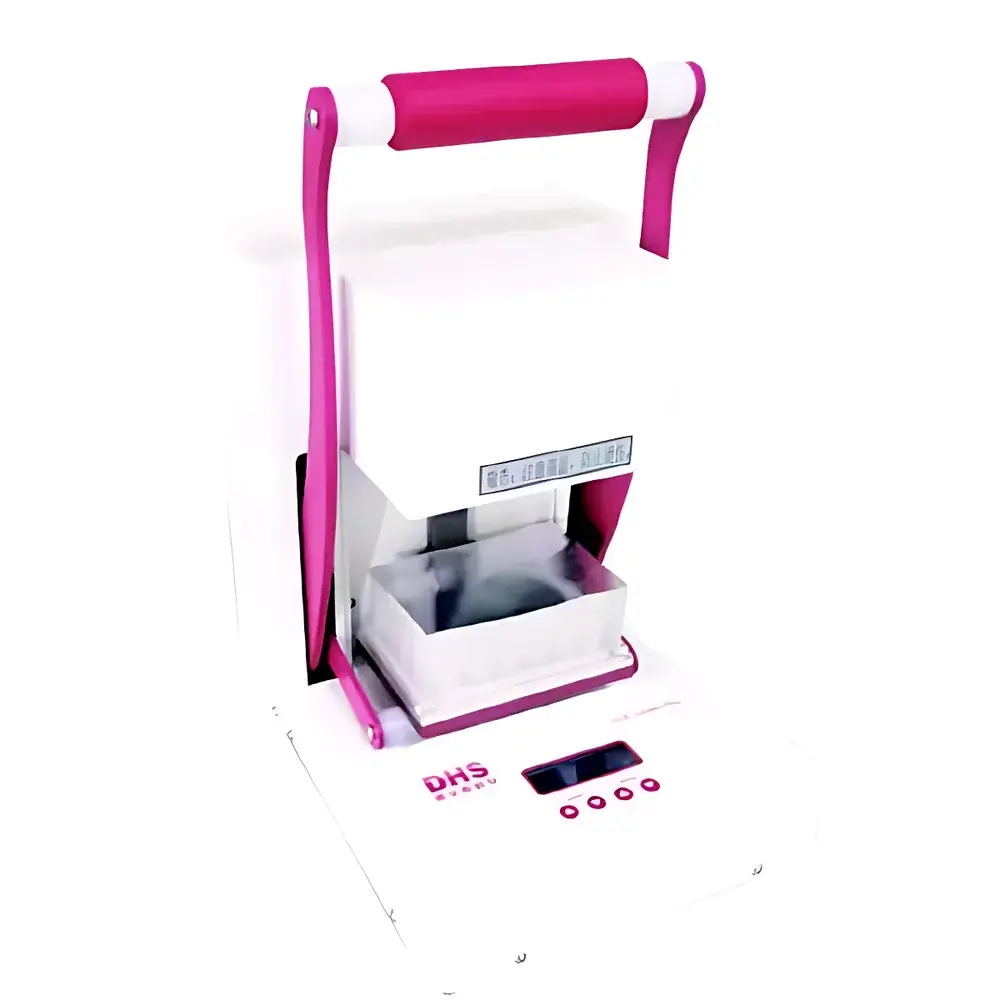
DHS PCR-Sealer Plus 96-Well Microplate Heat Sealer
| Brand | DHS |
|---|---|
| Origin | Tianjin, China |
| Model | PCR-Sealer Plus |
| Automation Level | Manual |
| Sealing Temperature Range | 5–200 °C |
| Sealing Time | 1–9 s |
| Input Power | 220 V / 50 Hz |
| Dimensions (W×D×H) | 230 × 395 × 310 mm |
| Weight | 9.5 kg |
| Compatible Plate Types | Standard 96-well PCR plates, 384-well amplification plates, microtiter plates (ELISA), deep-well plates |
| Sealant Compatibility | Universal thermal sealing films including standard heat-seal films, pierceable films, optical films (for qPCR), and permanent adhesive films |
Overview
The DHS PCR-Sealer Plus is a manually operated, precision-engineered microplate heat sealer designed for reliable, uniform thermal sealing of nucleic acid and protein assay plates in molecular biology, clinical diagnostics, and biobanking workflows. Utilizing a mechanical lever-based actuation system, the instrument delivers consistent downward force across the entire sealing surface—eliminating operator-dependent variability while minimizing physical strain. Its core function relies on controlled conductive heating: a temperature-regulated aluminum sealing head transfers thermal energy to thermoplastic or adhesive-based sealants, inducing localized melting and fusion at the plate rim. This process creates hermetic, low-permeability seals essential for preventing sample evaporation, cross-contamination, and degradation during thermal cycling (e.g., PCR/qPCR), long-term cryogenic storage (−80 °C or liquid nitrogen), and automated liquid handling integration. Unlike adhesive tape-based methods, thermal sealing ensures compatibility with downstream robotic pipetting, centrifugation, and high-throughput scanning—making it a foundational tool in GLP-compliant assay development and ISO 15189-accredited diagnostic laboratories.
Key Features
- Lever-assisted mechanical design ensures uniform pressure distribution across all 96 or 384 wells—critical for reproducible seal integrity and elimination of edge-effect failures.
- Precisely calibrated digital temperature control (5–200 °C in 1 °C increments) enables optimization for diverse film chemistries: from low-melt polymer films (e.g., for fragile RNA samples) to high-adhesion permanent films used in archival biobanking.
- Adjustable dwell time (1–9 seconds) allows fine-tuning for plate material thickness (e.g., thin-wall PCR plates vs. rigid deep-well polypropylene) and ambient humidity conditions.
- Compact footprint (230 × 395 × 310 mm) and lightweight construction (9.5 kg) support benchtop deployment in space-constrained cleanrooms, biosafety cabinets, or mobile lab environments.
- Universal plate compatibility—validated for ANSI/SLAS-standard 96-well and 384-well PCR plates, flat-bottom and U/V-bottom microtiter plates (ELISA), and 96-well deep-well storage plates (1.1–2.2 mL capacity); optional custom adapters accommodate non-standard geometries.
- No consumable heating elements or replaceable cartridges—reducing total cost of ownership and eliminating calibration drift associated with resistive coil aging.
Sample Compatibility & Compliance
The PCR-Sealer Plus accommodates a broad spectrum of commercially available thermal sealants certified for life science applications, including: standard polyolefin films (for routine PCR), UV-transparent optical films (optimized for real-time fluorescence detection in qPCR), pierceable silicone-coated films (enabling direct probe access without manual film removal), and solvent-resistant permanent adhesive films (validated for long-term −80 °C storage and repeated freeze-thaw cycles). All sealing parameters are documented and repeatable per ISO/IEC 17025 requirements for method validation. The device supports audit-ready operation when integrated into quality systems adhering to FDA 21 CFR Part 11 (with external electronic logbook), CLIA, and CAP guidelines—particularly where seal integrity directly impacts result validity (e.g., viral load quantification, NGS library preparation).
Software & Data Management
As a manually actuated instrument, the PCR-Sealer Plus operates without embedded firmware or proprietary software—ensuring deterministic behavior, zero cybersecurity attack surface, and full compatibility with existing LIMS or ELN platforms. All sealing protocols (temperature setpoint, dwell time, plate type) are recorded externally by laboratory personnel using standardized SOP templates. Optional integration with barcode-scanned plate tracking systems allows correlation of seal parameters with sample IDs for retrospective analysis. For labs requiring electronic records, the device is compatible with third-party digital loggers that capture timestamped operator inputs and environmental metadata (e.g., room temperature, humidity), satisfying ALCOA+ data integrity principles.
Applications
- Pre-PCR/qPCR plate sealing to prevent evaporation-induced concentration shifts and condensation artifacts during thermal cycling.
- Sealing of extracted DNA/RNA plates prior to sequencing library prep or multiplexed genotyping assays.
- Long-term biobank storage of clinical specimens (plasma, PBMCs, tissue lysates) under cryogenic conditions.
- High-throughput ELISA and immunoassay plate sealing prior to incubation and wash steps—reducing reagent loss and edge-well drying effects.
- Stabilization of enzymatic reaction plates for kinetic assays requiring extended incubation at 37 °C or ambient temperatures.
- Secure transport of hazardous or regulated biological materials compliant with IATA Packing Instruction 650.
FAQ
What types of microplates can be sealed with the PCR-Sealer Plus?
Standard ANSI/SLAS-format 96-well PCR plates (full-skirted, semi-skirted, unskirted), 384-well amplification plates, flat-bottom and round-bottom microtiter plates (ELISA), and 96-well deep-well plates (1.1–2.2 mL). Custom adapter fixtures are available for non-standard or proprietary plate formats.
Is the sealing temperature adjustable in precise increments?
Yes—digital temperature control offers 1 °C resolution across the full 5–200 °C range, enabling method-specific optimization for different film chemistries and plate materials.
Does the instrument require routine calibration or maintenance?
No scheduled calibration is required. Periodic verification of temperature accuracy using a traceable NIST-calibrated infrared thermometer or contact probe is recommended annually as part of laboratory quality assurance procedures.
Can the PCR-Sealer Plus be used in a biosafety cabinet?
Yes—the compact size, absence of exhaust vents or moving parts generating aerosols, and low electromagnetic emissions make it suitable for Class II A2 and B2 biosafety cabinets.
How does lever-based actuation improve seal consistency compared to spring-loaded or manual clamp designs?
The first-class lever mechanism multiplies user input force while ensuring geometrically fixed travel distance and parallel plate-to-head alignment—minimizing tilt-induced seal gaps and delivering ±2% force uniformity across all 96 wells, as verified by pressure-sensitive film analysis.