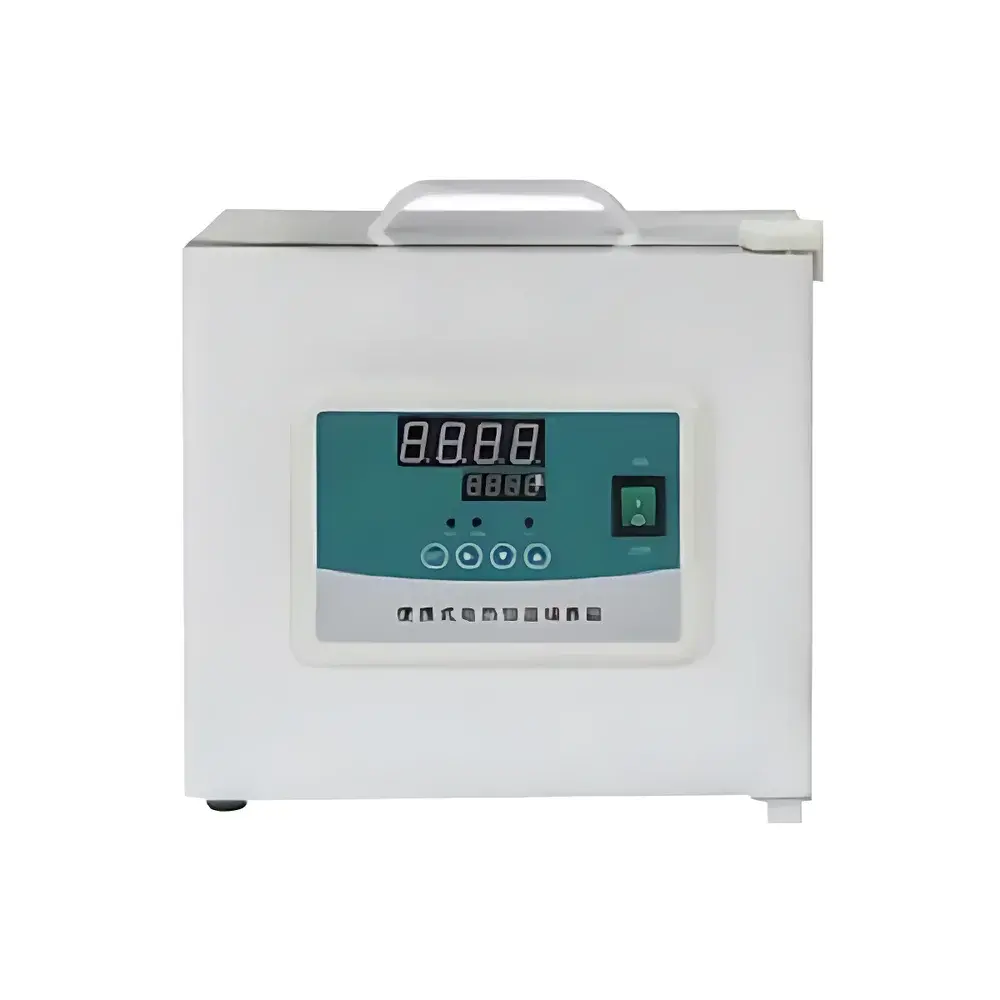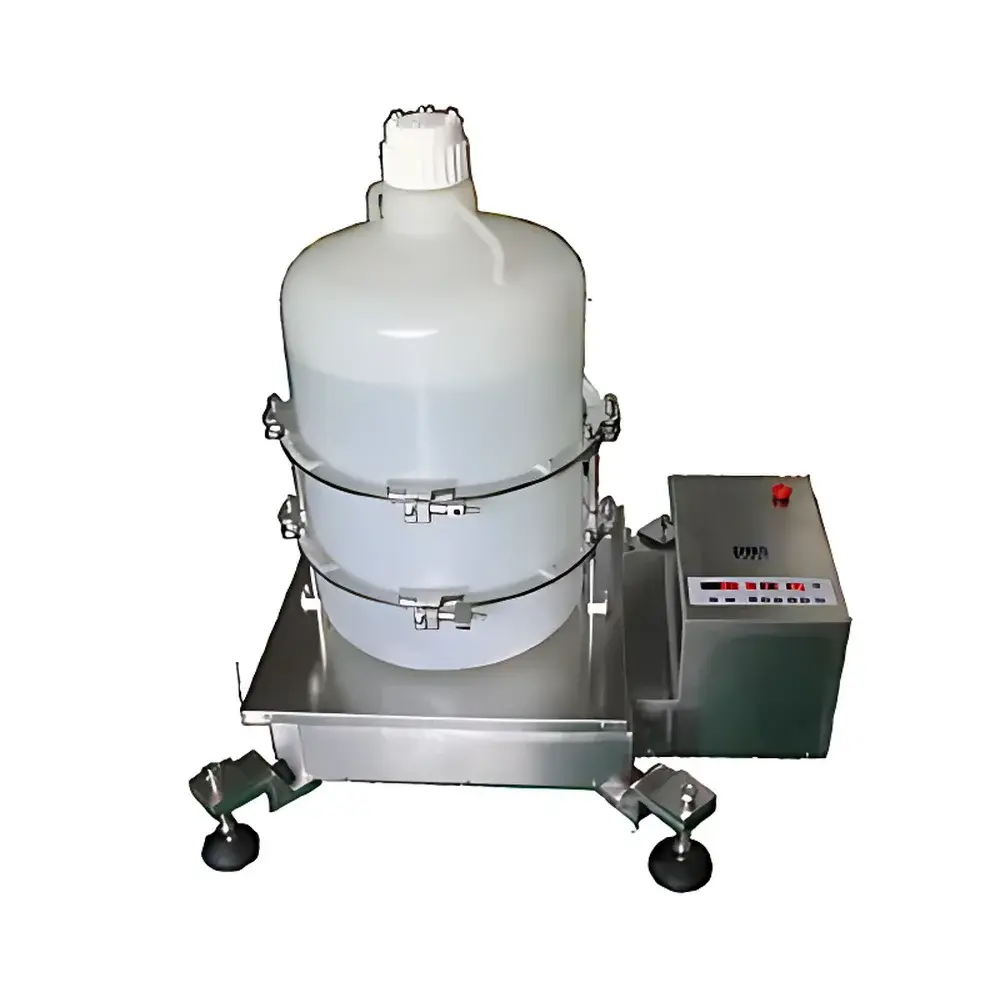
DHS MaxMixer-100 High-Capacity Vortex Mixer
| Brand | DHS |
|---|---|
| Origin | Tianjin, China |
| Model | MaxMixer-100 |
| Timing Range | Mixing Time 1–99 min, Pause Time 0–9 s, Cycles 1–9 |
| Oscillation Frequency | 50–100 rpm |
| Amplitude | 50 mm |
| Tray Quantity | 1 |
| Power Supply | 220 V / 50 Hz, 800 W |
| Dimensions (L×W×H) | 840 × 670 × 490 mm |
| Net Weight | 52 kg |
| Construction | Full stainless steel chassis |
| Compliance | Designed for GMP-compliant environments |
Overview
The DHS MaxMixer-100 is a high-capacity industrial vortex mixer engineered for reproducible, contamination-free homogenization of large-volume liquid samples in regulated and research-intensive laboratory settings. Unlike magnetic stirrers or overhead agitators, the MaxMixer-100 employs eccentric orbital oscillation—driven by a precision-balanced motor and cam mechanism—to induce controlled vortex motion within containers placed on its single stainless-steel platform. This mechanical principle generates radial shear forces and axial convection currents that effectively suspend particulates, re-suspend precipitates, and accelerate dissolution without introducing external magnetic fields, electrical interference, or mechanical shafts into the sample. Its design targets applications where sterility, material compatibility, and process traceability are critical—including upstream bioprocessing, QC release testing, environmental sample preparation, and formulation development in pharmaceutical manufacturing.
Key Features
- High-Capacity Mixing Platform: Supports containers up to 100 L volume—ideal for batch-scale buffer preparation, cell culture media conditioning, and bulk reagent homogenization.
- Precision-Controlled Oscillation: Adjustable frequency range of 50–100 rpm ensures optimal energy input across viscosities—from low-viscosity aqueous solutions to moderately viscous suspensions.
- Large-Amplitude Motion: 50 mm amplitude delivers deep fluid displacement, minimizing wall adhesion and promoting uniform mixing even for challenging solutes (e.g., erythromycin powder, histological dyes, polymer dispersions).
- GMP-Ready Construction: Entire frame, tray, and clamping system fabricated from electropolished 316 stainless steel; surface finish compliant with ISO 14644-1 Class 7 cleanroom requirements.
- Digital Programmable Interface: Independent control of mixing duration (1–99 min), inter-cycle pause (0–9 s), and repeat cycles (1–9); all parameters stored with timestamped execution logs.
- Operational Safety Architecture: Integrated emergency stop button, fail-safe clamp locking mechanism, overload current protection, and acoustic noise level <62 dB(A) at 1 m distance.
Sample Compatibility & Compliance
The MaxMixer-100 accommodates standard laboratory vessels—including polypropylene carboys, stainless-steel drums, glass carboys, and HDPE IBC totes—via its adjustable universal clamp system. No consumables or disposable parts are required. The instrument meets structural and operational criteria referenced in ISO 13485:2016 (medical device quality management), FDA 21 CFR Part 11 (electronic records/electronic signatures), and EU Annex 11 (computerized systems). Its stainless-steel build supports routine cleaning validation per ASTM E3011-16 and supports audit-ready documentation when integrated with LIMS or MES platforms.
Software & Data Management
While the MaxMixer-100 operates via embedded microcontroller-based firmware (no PC dependency), its digital timer module records full execution history—including start time, total runtime, cycle count, and fault codes—in non-volatile memory. Optional RS-485 serial interface enables integration with SCADA or laboratory automation systems for centralized monitoring and electronic batch record (EBR) generation. Audit trails comply with ALCOA+ principles (Attributable, Legible, Contemporaneous, Original, Accurate, Complete, Consistent, Enduring, Available) under GLP and GMP frameworks.
Applications
- Biopharmaceutical: Homogenization of fermentation broth, harvest clarification buffers, and chromatography column equilibration solutions.
- Clinical Diagnostics: Uniform dispersion of whole-blood controls, serum matrix standards, and calibrator diluents prior to ELISA or PCR workflows.
- Environmental Testing: Extraction of heavy metals from soil leachates and homogenization of wastewater composite samples per EPA Method 1311.
- Food & Beverage QA: Reconstitution of powdered nutritional supplements, suspension of microbial challenge cultures, and blending of viscosity-modified sauces.
- Academic Research: Scalable mixing for synthetic biology reaction setups, nanoparticle dispersion studies, and polymer solution rheology pre-conditioning.
FAQ
What container sizes and materials are compatible with the MaxMixer-100?
Standard configurations support cylindrical vessels from 5 L to 100 L, including PP, HDPE, 316 SS, borosilicate glass, and PETG. Custom clamp inserts are available for irregular geometries.
Does the instrument require calibration or periodic verification?
Yes—frequency accuracy (±2 rpm) and timing fidelity (±0.5 s) should be verified annually using NIST-traceable tachometer and stopwatch. A calibration certificate is provided with initial commissioning.
Can the MaxMixer-100 operate continuously beyond 99 minutes?
No—the maximum single-run duration is 99 minutes. For extended protocols, users must program multi-cycle sequences with defined pauses.
Is the unit suitable for use in cold rooms or humid environments?
It is rated for operation between 5–40 °C and ≤80% RH (non-condensing). IP54-rated enclosure protects against dust ingress and water splashing.
How is maintenance performed?
Routine maintenance includes lubrication of cam bearings every 12 months and inspection of clamp tension springs. No user-serviceable electronics are present; firmware updates are performed by authorized DHS field engineers only.