
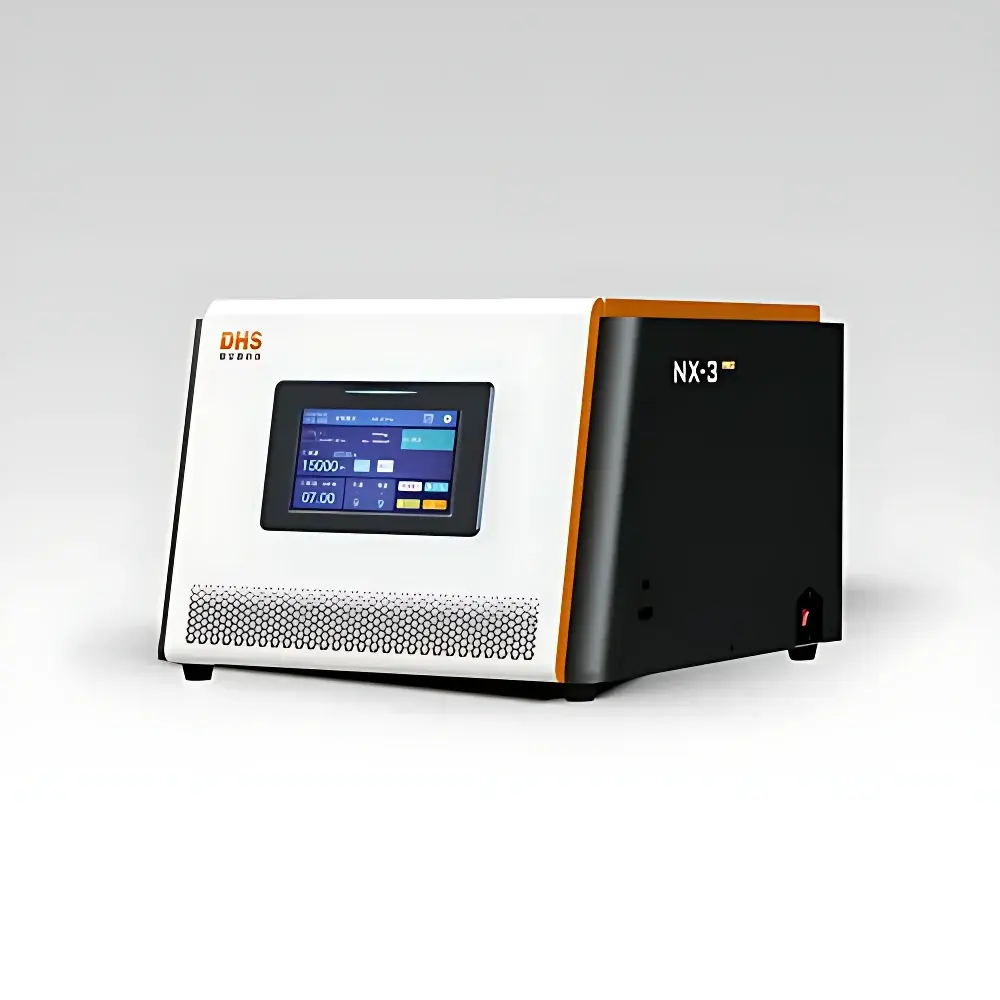
DHS NX-3 Pro High-Speed Benchtop Centrifuge
| Brand | DHS |
|---|---|
| Origin | Tianjin, China |
| Model No. | 0401321 |
| Type | Benchtop Centrifuge |
| Speed Range | 300–21,000 rpm |
| Max RCF | 33,500 × g |
| Max Capacity | 6 × 250 mL |
| Temperature Range (NX-3R Pro only) | −20 °C to 40 °C |
| Acceleration/Deceleration | 9-step acceleration, 10-step deceleration |
| Rotor Recognition | Automatic |
| Program Storage | 100 user-defined protocols (up to 10 segments per program) |
| Display | 7-inch HD color touchscreen |
| Drive System | Inverter-controlled brushless motor |
| Safety Features | Electronic imbalance detection, lid interlock, overspeed/overtemperature protection |
| Dimensions (NX-3 Pro) | 435 × 330 × 545 mm |
| Weight (NX-3 Pro) | 36 kg |
| Power Supply | 220 V / 50 Hz |
| Rated Power (NX-3 Pro/NX-3R Pro) | 800 W / 1500 W |
Overview
The DHS NX-3 Pro is a high-performance benchtop centrifuge engineered for precision separation of biological and chemical samples in demanding laboratory environments. Operating on the principle of sedimentation under controlled rotational force, it delivers reproducible separation outcomes by generating centrifugal forces up to 33,500 × g at a maximum speed of 21,000 rpm. Designed for routine and advanced applications—including bacterial pelleting, subcellular fractionation, nucleic acid purification, and protein precipitation—the NX-3 Pro supports both high-speed and high-capacity workflows without compromising thermal stability or mechanical integrity. Its robust all-metal chassis, powder-coated corrosion-resistant surface, and direct-drive inverter motor ensure long-term reliability, low acoustic emission (<65 dB(A) at maximum speed), and minimal maintenance requirements. The NX-3R Pro variant integrates an eco-friendly, fluorine-free refrigeration system with rapid cooling capability down to −20 °C—critical for preserving thermolabile analytes such as enzymes, antibodies, and RNA during extended high-speed runs.
Key Features
- Automatic rotor identification system prevents mismatched rotor operation and enforces safety-critical speed limits based on physical load configuration.
- Programmable multi-segment centrifugation: each stored protocol supports up to 10 independent time/speed/temperature/braking steps, enabling complex workflows such as density gradient centrifugation or sequential pelleting-wash-resuspension cycles.
- High-resolution 7-inch color touchscreen interface displays real-time parameters—including actual speed, RCF, elapsed time, remaining time, temperature (NX-3R Pro), and imbalance status—alongside editable setpoints on a single screen.
- PWM-based speed control ensures ±10 rpm accuracy across the full operating range (300–21,000 rpm), with precisely graded acceleration and deceleration profiles (9 levels up, 10 levels down) to minimize sample resuspension and improve pellet integrity.
- Electronic imbalance detection continuously monitors vibration signatures during spin-up and operation; automatic shutdown occurs if threshold deviation exceeds ISO 19438-compliant tolerance limits.
- Carbon-fiber composite angle rotor (6 × 250 mL) rated for 18,530 × g—optimized for rapid harvesting of bacterial and yeast cultures while maintaining structural rigidity and thermal inertia.
Sample Compatibility & Compliance
The NX-3 Pro accommodates tubes from 0.2 mL microcentrifuge tubes to 250 mL conical centrifuge bottles via interchangeable rotors and universal adapters. It supports standard tube materials including polypropylene, polycarbonate, and borosilicate glass. All rotors comply with ISO 15512:2018 (centrifuge rotor safety) and are certified for use under GLP and GMP-aligned quality systems. The NX-3R Pro’s refrigeration module meets IEC 61010-2-020 (safety requirements for laboratory equipment) and incorporates energy-saving auto-idle mode upon lid opening. Data logging functionality supports audit-ready traceability required for FDA 21 CFR Part 11 compliance when paired with validated LIMS integration.
Software & Data Management
While the NX-3 Pro operates as a standalone instrument, its embedded firmware enables timestamped event logging—including start/stop times, rotor ID, speed/RCF history, temperature logs (NX-3R Pro), error codes, and user login identifiers. All 100 programmable methods can be exported via USB port in CSV format for documentation archiving or SOP alignment. Optional PC-based configuration software (available separately) allows remote parameter validation, batch protocol deployment, and export of calibration certificates traceable to national metrology institutes.
Applications
- Biochemistry: Isolation of mitochondria, lysosomes, and membrane vesicles using differential centrifugation protocols.
- Clinical Diagnostics: Serum/plasma separation from whole blood, viral pellet concentration prior to qPCR analysis.
- Pharmaceutical QA/QC: Clarification of fermentation broths, removal of particulates from injectable formulations.
- Environmental Testing: Concentration of waterborne pathogens (e.g., E. coli, Legionella) for downstream culture or molecular detection.
- Food Science: Fat separation in dairy emulsions, starch granule isolation from cereal extracts.
FAQ
What is the difference between the NX-3 Pro and NX-3R Pro models?
The NX-3R Pro includes a built-in fluorine-free compressor-based cooling system capable of reaching −20 °C, whereas the NX-3 Pro is a non-refrigerated version optimized for ambient-temperature applications.
Can the NX-3 Pro be used for regulatory submissions under GLP or GMP guidelines?
Yes—when operated with documented procedures, calibrated rotors, and enabled event logging, the system supports data integrity requirements aligned with OECD GLP Principles and Annex 11 of EU GMP.
Does the centrifuge support third-party rotor compatibility?
No—only DHS-certified rotors with integrated RFID tags are recognized and permitted for operation to ensure mechanical safety and performance consistency.
How is rotor lifetime managed and tracked?
Each rotor stores cumulative run hours and maximum speed history internally; this information is read automatically upon insertion and displayed on the touchscreen for preventive maintenance planning.
Is network connectivity available for centralized lab management?
Standard configuration does not include Ethernet or Wi-Fi; however, optional RS-232/USB-to-Ethernet gateways enable integration into enterprise lab infrastructure via MODBUS or custom API endpoints.
Related Products



