
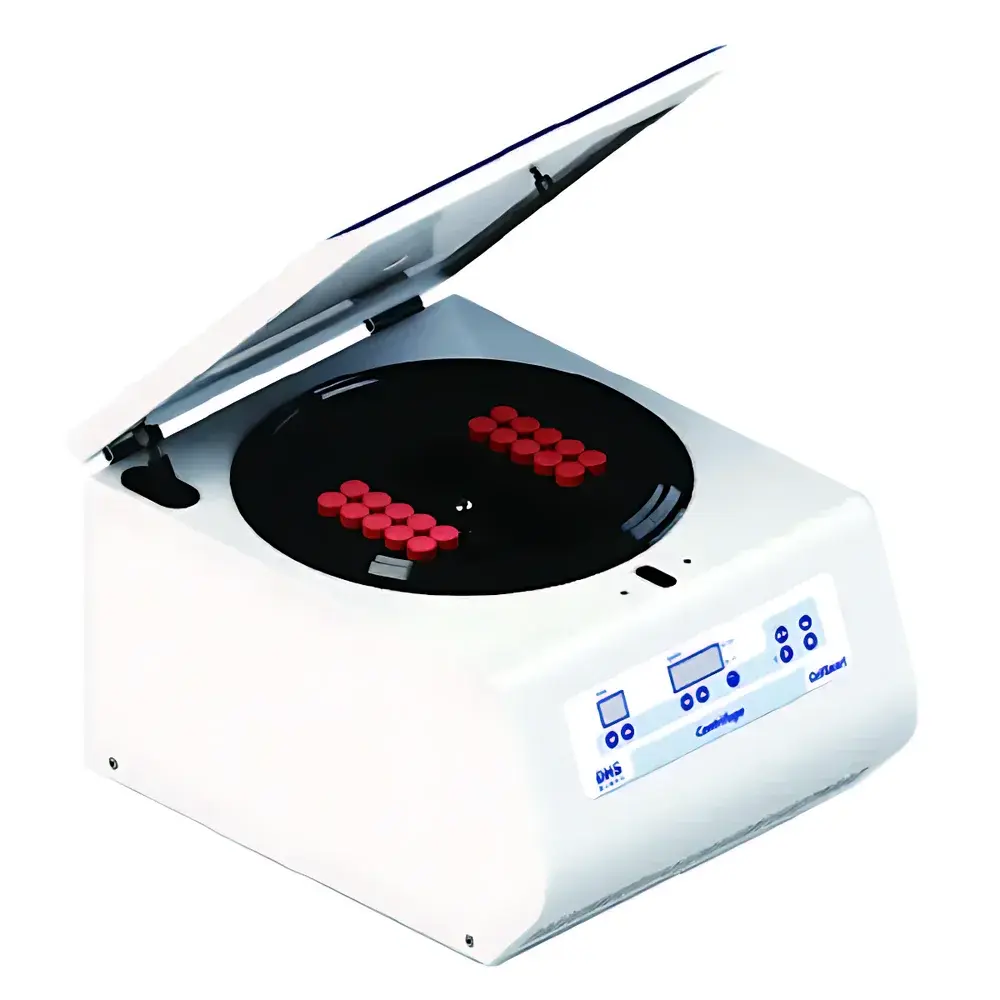
DHS CellSmart Benchtop Centrifuge
| Brand | DHS |
|---|---|
| Origin | Tianjin, China |
| Model | CellSmart |
| Instrument Type | Benchtop Centrifuge |
| Speed Range | 0–4000 rpm |
| Max RCF | 2770 × g |
| Max Capacity | 2×10×15 mL, 2×3×50 mL, 2×12×5 mL, 2×21×2 mL, 2×15×10 mL |
| Dimensions (W×D×H) | 384 × 288 × 480 mm |
| Rotor Configuration | Horizontal swing-out rotor |
| Application Scope | Cell & bacterial pelleting |
| Drive System | Brushless DC motor |
| Chamber Material | Stainless steel interior |
| Control Interface | Microprocessor-based with high-brightness LED display |
| Features | Instant spin button, rpm/RCF toggle key, low-noise airflow ducting, ambient temperature stability during operation |
| Compliance | Designed for GLP-compliant laboratories |
Overview
The DHS CellSmart Benchtop Centrifuge is an engineered solution for routine cell and bacterial pelleting in life science, clinical, and academic laboratories. Based on horizontal swing-out rotor architecture and optimized for low-speed, high-capacity sedimentation, it operates within a precisely controlled mechanical and thermal envelope—delivering reproducible separation performance without compromising bench space or operational comfort. Its core principle relies on centrifugal force generation via brushless DC motor-driven rotation, converting rotational speed (rpm) into relative centrifugal force (RCF, ×g) to accelerate density-based particle migration in suspension. With a maximum speed of 4000 rpm and peak RCF of 2770 × g, the CellSmart aligns with standard protocols for mammalian cell harvesting, peripheral blood mononuclear cell (PBMC) isolation, bacterial culture concentration, and soft-tissue homogenate clarification—where excessive shear stress must be avoided.
Key Features
- Compact footprint (384 × 288 × 480 mm) enables seamless integration into crowded biosafety cabinets, laminar flow hoods, or shared benchtop workspaces.
- Horizontal swing-out rotor accommodates multiple tube formats simultaneously—including 50 mL conical tubes (up to 6), 15 mL Falcon tubes (up to 20), 10 mL tubes (up to 30), 5 mL vacutainers or RIA tubes (up to 24), and 2 mL microcentrifuge tubes (up to 42).
- Brushless DC motor eliminates carbon brush wear, ensuring zero particulate contamination, silent operation (<55 dB(A) at 4000 rpm), and maintenance-free longevity.
- Microprocessor-controlled system with dual-parameter LED display supports real-time monitoring of rpm and RCF; dedicated toggle key allows instant unit conversion without menu navigation.
- Instant spin function enables rapid 10-second centrifugation cycles for quick pellet re-suspension checks or supernatant removal—critical during time-sensitive cell processing workflows.
- Stainless steel chamber and full-metal housing resist corrosion from common disinfectants (e.g., 70% ethanol, 0.5% sodium hypochlorite) and ensure long-term structural integrity under daily decontamination protocols.
Sample Compatibility & Compliance
The CellSmart is validated for use with standard polypropylene and polycarbonate centrifuge tubes meeting ISO 13485 material specifications. Its rotor geometry maintains balanced load distribution across asymmetric configurations (e.g., single-side loading up to 50% capacity), minimizing vibration-induced sample disturbance. The instrument conforms to IEC 61010-1:2010 for electrical safety in laboratory environments and incorporates over-speed protection, imbalance detection, and automatic rotor recognition logic. While not certified for Class II biological containment, its sealed stainless-steel cavity and absence of lubricant pathways support compliance with GLP documentation requirements when paired with lab-specific SOPs and calibration logs traceable to NIST standards.
Software & Data Management
The CellSmart operates as a standalone instrument with no embedded software or network interface. All parameters are set and verified locally via tactile keypad input and LED feedback—eliminating cybersecurity risks associated with connected devices and simplifying audit readiness. For regulated environments requiring electronic record retention, users may integrate the centrifuge into broader LIMS or ELN systems via manual entry of run metadata (time, speed, duration, rotor ID, operator ID). Its deterministic behavior—repeatable acceleration/deceleration profiles and fixed RCF calculation algorithm—ensures data integrity across shifts and operators, satisfying foundational elements of FDA 21 CFR Part 11 for non-electronic record generation.
Applications
- Mammalian cell culture harvest (adherent and suspension lines) prior to lysis or cryopreservation.
- Isolation of PBMCs from whole blood using Ficoll-Paque™ density gradients.
- Bacterial pellet collection for plasmid extraction, protein expression analysis, or antibiotic susceptibility testing.
- Serum/plasma separation from clotted blood samples in diagnostic support labs.
- Precipitation of extracellular vesicles (EVs) at low-force conditions to preserve membrane integrity.
- Clarification of crude tissue lysates before chromatographic or electrophoretic analysis.
FAQ
What is the maximum allowable imbalance tolerance for safe operation?
The CellSmart detects imbalances exceeding ±5 g per rotor bucket and halts acceleration automatically. Symmetric loading is recommended, but single-side operation at ≤50% total capacity is permissible with verified rotor balance.
Can the centrifuge be used with sealed tubes containing volatile solvents?
Yes—provided tubes meet ASTM D2593 burst pressure ratings and are rated for ≥3000 rpm operation. The stainless steel chamber provides passive containment for minor vapor leakage.
Is rotor calibration required before first use?
No factory calibration is needed; however, users should verify rotor identification markings against the included specification sheet and perform initial no-load run-in at 2000 rpm for 5 minutes to confirm mechanical stability.
Does the instrument support timed runs with auto-brake?
Yes—run duration is programmable from 1 second to 99 minutes and 59 seconds; deceleration follows a standard ramp-down profile without adjustable brake intensity.
How often should the centrifuge undergo preventive maintenance?
Annual visual inspection of rotor threads, chamber seal integrity, and motor ventilation ducts is recommended. No scheduled lubrication or internal servicing is required due to brushless motor design.



