
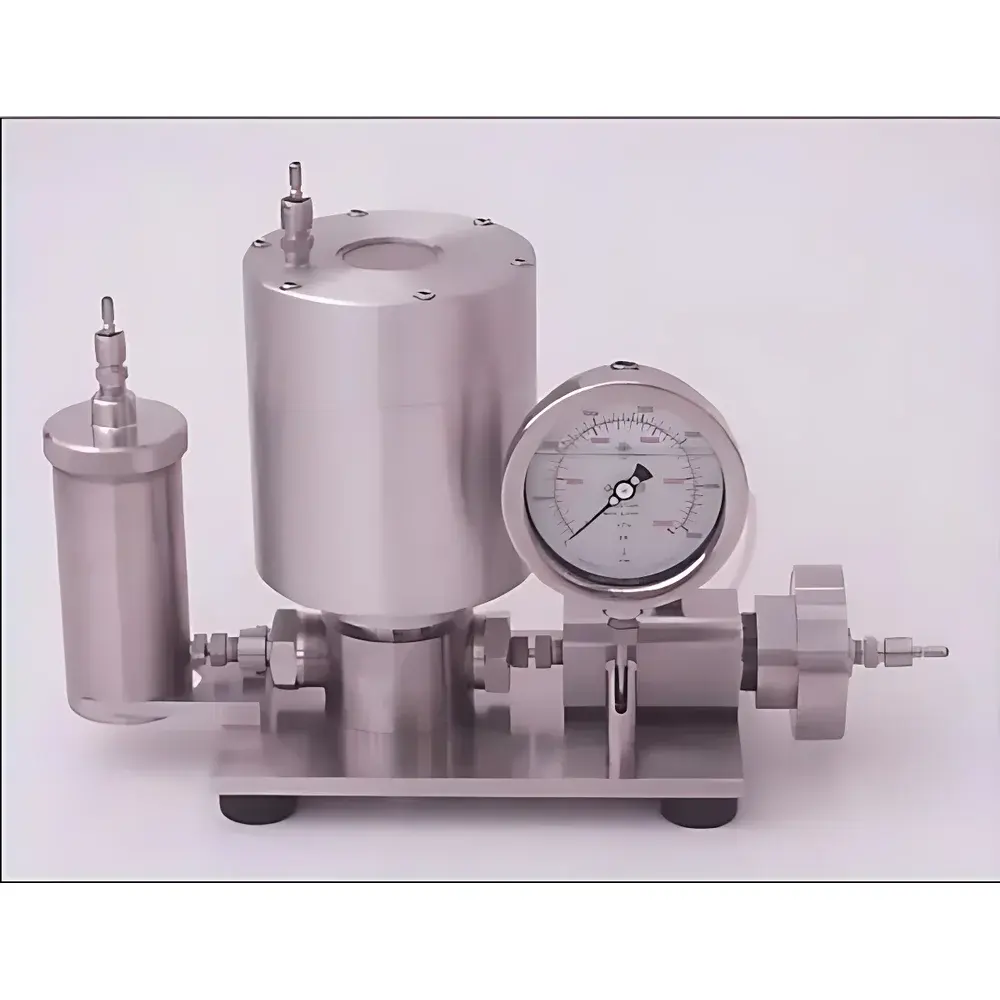
Avestin EmulsiFlex-C5 High-Pressure Homogenizer
| Brand | Avestin |
|---|---|
| Origin | Canada |
| Model | EF-C5 |
| Instrument Type | High-Pressure Homogenizer |
| Dimensions (W×D×H) | 430 × 160 × 320 mm |
| Processing Capacity | 7 mL – 5 L/h |
| Maximum Pressure | 30,000 psi |
| Sterilization | Fully Autoclavable & SIP-Compatible |
| Valve Design | Metal-to-Metal / Metal-to-Ceramic Sealing |
| Power Requirement | None (Hydraulically Actuated) |
| Temperature Control | Integrated Jacketed System |
| Optional Integration | In-Line Extrusion Module with 50/100/200/400 nm Track-Etched Membranes |
Overview
The Avestin EmulsiFlex-C5 is a precision-engineered high-pressure homogenizer designed for laboratory-scale nanoscale particle size reduction and dispersion stabilization under strictly controlled, GMP-compliant conditions. Operating on the principle of microfluidic cavitation and shear-induced disruption, the EF-C5 subjects process fluids to controlled, ultra-high pressures—up to 30,000 psi (207 MPa)—within a fully metal-sealed valve assembly. Unlike conventional homogenizers relying on elastomeric seals, the EmulsiFlex-C5 employs exclusively metal-to-metal or metal-to-ceramic contact surfaces throughout the fluid path, eliminating O-rings and gaskets that degrade under repeated sterilization cycles or chemical exposure. This architecture ensures long-term dimensional stability, minimal particle shedding, and zero organic leachables—critical for parenteral formulation development, liposomal drug delivery systems, and sterile nanosuspension manufacturing.
Key Features
- Hydraulic actuation system requiring no electrical power at the homogenization head—enabling operation in explosion-proof or electrically restricted environments.
- Integrated thermostatic jacketing allows precise temperature control (±0.5 °C) across the entire fluid path, minimizing thermal degradation during processing of thermolabile biologics and lipids.
- Modular in-line extrusion module compatible with certified track-etched polycarbonate membranes (50 nm, 100 nm, 200 nm, and 400 nm pore sizes), enabling simultaneous homogenization and size fractionation in a single pass.
- Minimal hold-up volume (98% recovery efficiency, supporting early-stage formulation screening with scarce active pharmaceutical ingredients (APIs).
- Full disassembly capability: All wetted components—including homogenizing valve, heat exchanger, and pressure transducers—are autoclavable at 121 °C for 30 minutes and compatible with steam-in-place (SIP) protocols per ASME BPE-2022 guidelines.
- Fail-safe pressure management: Dual redundant pressure sensors coupled with hardware-based emergency cutoff circuitry interrupt hydraulic flow within <100 ms if preset thresholds are exceeded—meeting IEC 61508 SIL-2 functional safety requirements.
Sample Compatibility & Compliance
The EF-C5 accommodates aqueous suspensions, lipid emulsions, polymeric nanoparticles, viral vectors, and cell lysates with viscosities up to 200 cP. Its non-porous, chemically inert wetted path—constructed from 316L stainless steel and yttria-stabilized zirconia—is compatible with organic solvents (e.g., ethanol, chloroform), acidic/basic buffers (pH 2–12), and aggressive cleaning agents (e.g., NaOH, HNO₃). The system conforms to key regulatory frameworks including FDA 21 CFR Part 11 (with optional electronic audit trail), EU Annex 1 (sterile processing), ISO 22000 (food-grade applications), and USP for clean steam validation. Documentation packages include IQ/OQ protocols aligned with ASTM E2500-13 and GAMP 5 standards.
Software & Data Management
While the base EF-C5 operates via analog pressure regulation, an optional digital control unit provides real-time logging of pressure, temperature, flow rate, and cycle count. Data export complies with CSV and PDF formats for integration into LIMS or ELN platforms. All firmware supports time-stamped, user-authenticated parameter changes with immutable audit trails—fully compliant with ALCOA+ principles (Attributable, Legible, Contemporaneous, Original, Accurate, Complete, Consistent, Enduring, Available). Optional 21 CFR Part 11 compliance kits include role-based access control, electronic signatures, and cryptographic hash verification of archived run files.
Applications
- Liposome and lipid nanoparticle (LNP) production for mRNA vaccine development and gene therapy delivery.
- Nanosuspension preparation of poorly water-soluble APIs (BCS Class II/IV) to enhance dissolution kinetics and bioavailability.
- Exosome isolation and size homogenization for diagnostic biomarker enrichment and therapeutic cargo loading.
- Emulsion stabilization in topical and ophthalmic formulations requiring narrow polydispersity index (PDI <0.1).
- Cell disruption for intracellular protein extraction without denaturation—validated for E. coli, yeast, and mammalian suspension cultures.
- Quality-by-Design (QbD) studies supporting DOE-driven process optimization and design space definition per ICH Q5A and Q8(R2).
FAQ
Is the EF-C5 suitable for sterile manufacturing under cGMP?
Yes—the entire fluid path is fully autoclavable and SIP-compatible, with documentation supporting compliance with EU GMP Annex 1 and FDA Aseptic Processing Guidance.
Can the system be validated for use in regulated pharmaceutical development?
Yes—Avestin provides IQ/OQ templates, traceable calibration certificates, and material compatibility data per USP , supporting regulatory submissions under CMC sections of IND/IMPD dossiers.
What maintenance intervals are recommended for the homogenizing valve?
Under typical lab use (≤4 hrs/day), valve inspection is recommended every 500 operating hours; ceramic components demonstrate >2,000 hr service life when processing low-abrasive formulations.
Does the EF-C5 support remote monitoring or integration with SCADA systems?
With the optional Digital Control Unit, analog 4–20 mA outputs and Modbus RTU communication enable integration into facility-wide automation infrastructure.
How is temperature managed during extended processing runs?
The integrated double-jacketed heat exchanger circulates thermostatically controlled coolant (e.g., glycol/water) independently of hydraulic pressure—ensuring ΔT <1.5 °C across 8-hour continuous operation.



