
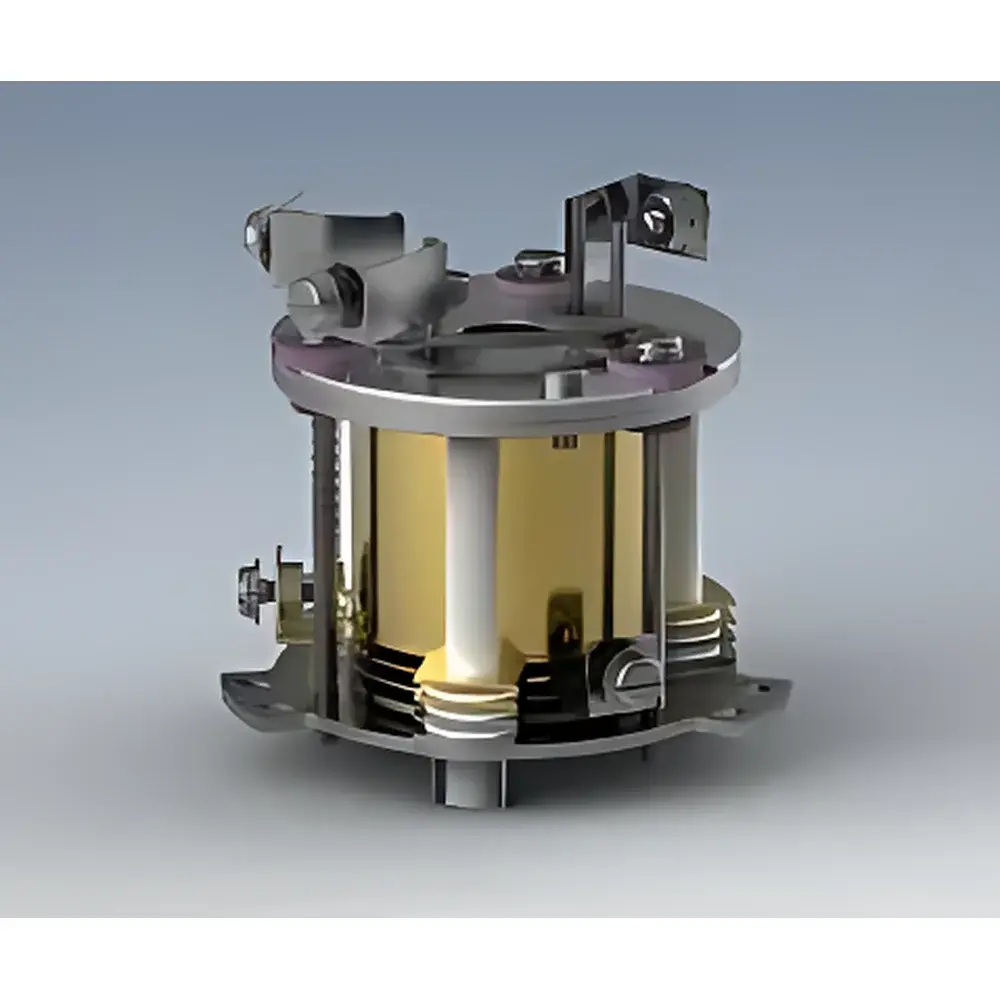
Hiden HAL 201 RC Ultra-High Vacuum Residual Gas Analyzer Quadrupole Mass Spectrometer
| Brand | Hiden |
|---|---|
| Origin | United Kingdom |
| Model | HAL 201 RC |
| Mass Range | 200 / 300 amu |
| Scan Speed | 100 amu/s |
| Minimum Step Size | 0.01 amu |
| Sensitivity | 0.1–1 ppm |
| Long-Term Stability | < ±0.5% peak height over 24 h |
| Minimum Detectable Partial Pressure | 5 × 10⁻¹⁴ mbar |
| Maximum Operating Pressure | 1 × 10⁻⁴ mbar |
| Ion Source | Gold-Plated Dual-Iridium Oxide Filament |
| Detector | Dual Faraday/Channeltron Electron Multiplier |
Overview
The Hiden HAL 201 RC is an ultra-high vacuum (UHV) residual gas analyzer (RGA) based on quadrupole mass spectrometry (QMS) technology, engineered for precise, real-time identification and quantification of trace gaseous species in vacuum environments down to 5 × 10⁻¹⁰ mbar. Designed specifically for UHV system diagnostics—including particle accelerators, fusion research chambers, surface science apparatus, and thin-film deposition systems—the HAL 201 RC operates on the principle of mass-selective ion filtering via a radio-frequency (RF) and direct-current (DC) stabilized quadrupole mass filter. Ions generated in the gold-plated ion source are separated according to their mass-to-charge ratio (m/z), then detected with high signal-to-noise fidelity using a dual-mode detector assembly. Its compact, bakeable stainless-steel construction ensures compatibility with UHV-compatible flanges (CF-63/100), while its low outgassing design minimizes background interference during extended monitoring cycles.
Key Features
- Gold-plated ion source: Reduces surface desorption and memory effects, critical for long-term stability and low-background analysis in UHV conditions.
- Dual-iridium oxide filament emitter: Provides robust thermal electron emission with enhanced oxidation resistance and extended operational lifetime under repeated thermal cycling.
- Dual detection mode: Integrated Faraday cup for high-current, quantitative measurements and Channeltron electron multiplier for sub-picoampere sensitivity—enabling seamless dynamic range coverage from 10⁻¹⁴ to 10⁻⁶ mbar partial pressures.
- High-resolution scanning capability: 0.01 amu minimum step size supports isotopic discrimination (e.g., ¹²C vs. ¹³C, ¹⁶O vs. ¹⁸O) and accurate peak deconvolution in complex gas mixtures.
- Stabilized RF/DC electronics: Ensures < ±0.5% peak height drift over 24 hours, meeting requirements for unattended, multi-shift vacuum health monitoring in regulated R&D and industrial facilities.
- Full EPIC™ software compatibility: Enables direct integration with Hiden’s EPIC ion/molecular analysis platform for advanced spectral library matching, time-resolved trend logging, and automated leak detection protocols.
Sample Compatibility & Compliance
The HAL 201 RC interfaces directly with vacuum chambers via standard ConFlat (CF) flanges and is compatible with inert, reactive, and corrosive gases—including H₂, He, CH₄, CO, CO₂, H₂O, N₂, O₂, Ar, and halogenated compounds—provided appropriate inlet conditioning (e.g., cold traps or pressure-reducing orifices) is applied for species prone to surface adsorption or dissociation. It conforms to ISO 20483:2022 (vacuum metrology — residual gas analyzers) and supports compliance with GLP and GMP documentation requirements through audit-trail-enabled EPIC software. While not intrinsically certified for hazardous area use, its all-metal, non-sparking architecture meets general safety guidelines for installation in controlled laboratory and cleanroom environments (per IEC 61000-6-3 EMC standards).
Software & Data Management
Controlled via Hiden’s EPIC™ software suite (Windows-based, 64-bit), the HAL 201 RC supports full remote operation, script-driven acquisition, and synchronized multi-instrument data logging. EPIC provides real-time spectral display, customizable alarm thresholds (e.g., for H₂O > 1 × 10⁻⁹ mbar indicating vacuum breach), and export to CSV, ASCII, or HDF5 formats for third-party analysis (MATLAB, Python/Pandas, LabVIEW). All acquisition sessions include embedded metadata (timestamp, operator ID, instrument configuration, calibration status), satisfying FDA 21 CFR Part 11 requirements when deployed with validated electronic signatures and access controls. Raw spectral data retains full digitized intensity resolution (16-bit ADC), enabling retrospective reprocessing without loss of quantitative integrity.
Applications
- UHV system commissioning and leak localization in synchrotron beamlines and cryogenic test stands.
- In-situ process gas monitoring during physical vapor deposition (PVD), atomic layer deposition (ALD), and molecular beam epitaxy (MBE).
- Outgassing characterization of spacecraft materials per ECSS-Q-ST-70-02C standards.
- Residual gas profiling in superconducting RF cavity conditioning and helium leak testing.
- Contamination forensics in semiconductor tool maintenance—detecting hydrocarbon fragments, siloxanes, or pump oil backstreaming.
- Time-of-flight correlation with pulsed laser desorption experiments in surface physics laboratories.
FAQ
What vacuum interface options are available for the HAL 201 RC?
Standard configurations include CF-63 and CF-100 flanges; custom KF or ISO-LF variants are available upon request with revised conductance modeling.
Can the HAL 201 RC operate continuously at 1 × 10⁻⁴ mbar?
Yes—its differential pumping design and high-vacuum-rated detector enable stable operation up to this pressure, though optimal sensitivity is achieved below 1 × 10⁻⁷ mbar.
Is calibration traceable to NIST standards?
Hiden provides factory calibration using certified gas mixtures (NIST-traceable); users may perform in-house calibration using optional permeation sources or calibrated leak standards.
How is filament lifetime monitored?
EPIC software logs filament emission current, temperature setpoint, and cumulative operating hours, triggering configurable alerts when degradation exceeds user-defined thresholds.
Does the system support multi-point spatial sampling?
When integrated with Hiden’s QGA series gas sampling manifolds and solenoid valve arrays, the HAL 201 RC can sequentially analyze up to 16 independent vacuum ports under programmable timing control.
Related Products




