
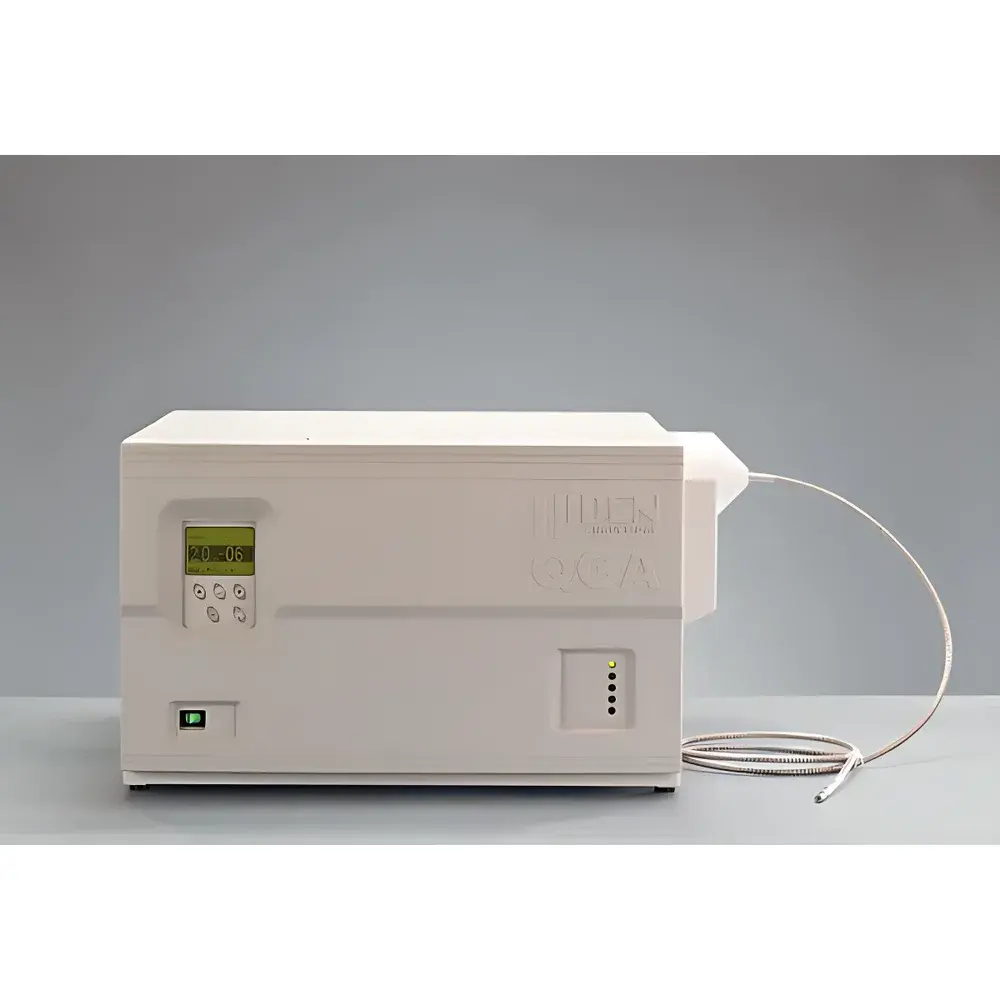
Hiden QGA Quantitative Gas Analysis Mass Spectrometer
| Brand | Hiden |
|---|---|
| Origin | United Kingdom |
| Model | HAPR0128 |
| Operating Pressure Range | Near-ambient (0.1–2 mbar typical for direct inlet |
| Detection Limit | Sub-ppm for most permanent gases and volatiles |
| Mass Range | 1–100 amu (standard), upgradable to 300 amu |
| Scan Speed | Up to 100 mass units per second |
| Data Output Formats | Raw ion current, % composition, ppm/v, nmol/s |
| Multi-stream Capability | Up to 80 gas streams via optional Hiden Multiplexing Valve System (HIDEN MVS-80) |
| Software | QGA Professional Edition with real-time quantification, spectral deconvolution, and external sensor integration |
| Compliance | Designed for GLP/GMP environments |
Overview
The Hiden QGA Quantitative Gas Analysis Mass Spectrometer is a dedicated benchtop process mass spectrometer engineered for continuous, real-time quantitative analysis of gas-phase species at near-atmospheric pressures. Based on quadrupole mass filter technology with electron impact (EI) ionization, the QGA operates with a high-transmission, differentially pumped ion source optimized for stable signal response across dynamic gas mixtures. Unlike laboratory-grade high-vacuum MS systems, the QGA integrates pressure-tolerant sampling interfaces—including heated capillary inlets and optional pressure-reduction stages—enabling direct interfacing with reactors, fermentation vessels, exhaust stacks, and catalytic test benches without extensive gas conditioning. Its core function is precise stoichiometric tracking of up to 16 pre-defined analytes simultaneously, supporting kinetic studies, reaction monitoring, leak detection, and purity verification in chemical, pharmaceutical, energy, and environmental applications.
Key Features
- Real-time quantitative analysis with automatic background subtraction and dynamic baseline correction
- QGA Professional software suite featuring intelligent spectral library scanning, peak shape fidelity preservation, and automated resolution of overlapping fragment ions (e.g., CO+ vs. N2+ at m/z 28)
- Flexible data reporting: simultaneous output in raw ion current (nA), volumetric %, ppm(v), or molar flow rate (nmol/s) when coupled with calibrated mass flow controllers
- Integrated external sensor fusion: accepts analog/digital inputs from third-party analyzers (e.g., non-dispersive IR CO sensors, paramagnetic O2 analyzers) to augment or cross-validate MS-derived concentrations
- Modular multi-stream architecture: supports sequential analysis of up to 80 independent gas sources via the optional HIDEN MVS-80 multiplexing valve system, with programmable dwell times and cycle synchronization
- Ruggedized industrial design: 19-inch rack-mount chassis, CE-marked electronics, and temperature-stabilized detector assembly for long-term operational stability
Sample Compatibility & Compliance
The QGA accommodates a broad spectrum of inorganic and organic volatiles—including H2, O2, N2, CO, CO2, CH4, NH3, H2O, C2H4, SO2, NO, and light hydrocarbons—without derivatization or pre-concentration. Sample introduction is compatible with stainless steel, SilcoNert®-treated, or fused silica transfer lines, minimizing surface adsorption and memory effects. The system complies with IEC 61000-6-2/6-4 for electromagnetic compatibility and meets mechanical safety requirements per EN 61010-1. When configured with role-based access control, electronic signatures, and time-stamped audit logs, the QGA Professional software satisfies data integrity expectations under FDA 21 CFR Part 11, EU Annex 11, and ISO/IEC 17025 for accredited testing laboratories.
Software & Data Management
QGA Professional Edition provides a deterministic, deterministic acquisition engine with sub-second scan repetition and synchronized timestamping across all input channels. All spectra are stored in HDF5 format with embedded metadata (instrument configuration, calibration history, operator ID). Batch processing tools support retrospective quantification using updated calibration curves or alternate internal standards. The software includes built-in validation protocols for linearity (5-point calibration), repeatability (RSD < 2% over 8-hour operation), and limit-of-detection verification per ISO 11843-2. Export modules generate ASTM E1527-compliant reports and CSV/Excel files compatible with LIMS integration via OPC UA or Modbus TCP.
Applications
- Catalytic reaction monitoring: Tracking transient species evolution during TPD, TPR, and pulse chemisorption experiments
- Fermentation off-gas analysis: Real-time quantification of O2 uptake, CO2 evolution, and ethanol/acetate volatilization
- Battery electrolyte decomposition studies: Detection of CO, CO2, C2H4, and HF evolution under thermal or electrochemical stress
- Environmental emission compliance: Continuous stack monitoring for regulated VOCs and greenhouse gases
- High-purity gas certification: Verification of trace impurities (e.g., H2O, O2, hydrocarbons) in semiconductor-grade N2 or Ar
- Plasma process diagnostics: Time-resolved measurement of reactive intermediates (e.g., atomic O, N, F radicals via charge-transfer proxies)
FAQ
What pressure range is the QGA designed for?
The QGA is optimized for sample introduction at pressures between 0.1 and 2 mbar at the ion source entrance. It supports direct coupling to atmospheric-pressure processes via pressure-reducing inlets or integration with secondary vacuum manifolds.
Can the QGA quantify isotopic species such as 13CO2 or D2O?
Yes—the 1 amu mass resolution and high mass accuracy (< ±0.1 amu) enable baseline separation of isotopologues within its standard 1–100 amu range, provided sufficient signal-to-noise ratio and appropriate calibration standards.
Is method transfer possible between different QGA instruments?
Quantitative methods—including calibration coefficients, fragmentation patterns, and dwell-time sequences—are fully portable via encrypted .qgaconfig files, ensuring reproducibility across installations in multi-site manufacturing or research networks.
Does the system support remote operation and cybersecurity protocols?
The QGA Professional software includes TLS 1.2-secured web interface, configurable firewall rules, and Windows-native group policy integration for enterprise-level IT governance and SOC2-aligned infrastructure deployment.




