
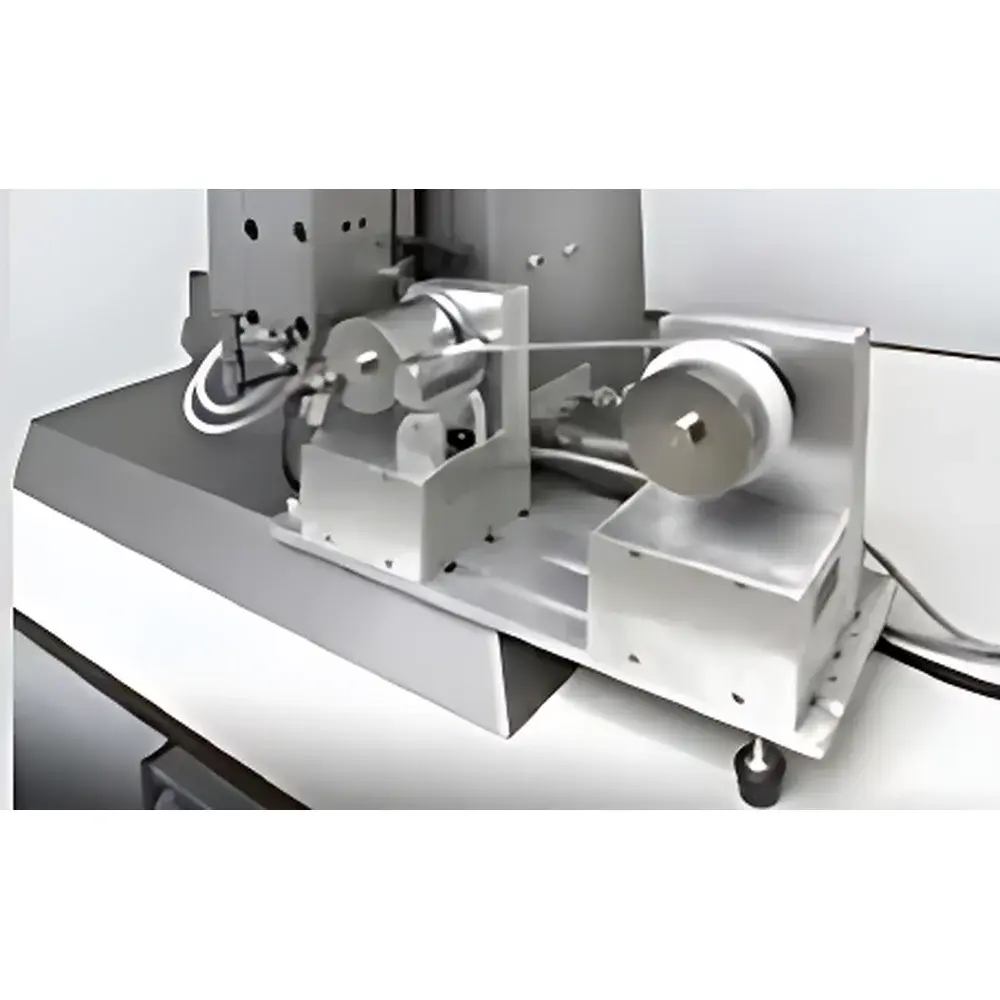
DSM Xplore Micro Film Casting System
| Origin | Netherlands |
|---|---|
| Manufacturer Type | Authorized Distributor |
| Origin Category | Imported |
| Model | Micro Film Casting System |
| Pricing | Available Upon Request |
Overview
The DSM Xplore Micro Film Casting System is a benchtop-scale, precision-engineered film processing platform designed for rapid prototyping and formulation development in polymer science, pharmaceutical film dosage research, and advanced functional materials engineering. Built upon the foundational architecture of DSM Xplore’s patented micro-compounding technology, this system implements a controlled solution-casting and melt-casting hybrid process—enabling solvent-based film formation (e.g., polymer solutions, nanocomposite dispersions) as well as thermoplastic melt extrusion (e.g., TPU, PLA, PE, EVA). Its core principle relies on precise volumetric metering via pressure-regulated die flow control, eliminating the need for gear pumps while maintaining laminar flow stability across sub-gram to multi-gram sample batches. The system operates under ambient or temperature-controlled conditions, supporting both free-standing cast films and substrate-coated layers with thickness uniformity validated by SEM imaging down to 5 µm—free of pinholes or interfacial voids.
Key Features
- Benchtop footprint (43 × 16 × 25 cm) and lightweight design (~10 kg) for integration into fume hoods, gloveboxes, or regulated R&D laboratories.
- Integrated air-knife module enabling uniform film edge control and surface leveling across a 30–35 mm casting width.
- Adjustable die gap (0.1–0.6 mm) with precision-machined stainless-steel tooling for reproducible thickness profiling without mechanical recalibration.
- Continuous feed unit comprising a cooled hopper and geometrically optimized single-screw feeder for stable, pulse-free material delivery—critical for long-length (>1 m), defect-free film production.
- Torque-controlled winding unit with 230 discrete setpoints (1 N/mm increments) and real-time diameter compensation, ensuring constant tension during collection of evolving roll geometry.
- High-resolution traction speed control (100–5000 mm/min in 1 mm/min steps), synchronized with die pressure feedback for closed-loop flow rate modulation.
- Integrated control cabinet featuring an industrial-grade touchscreen HMI with embedded recipe storage, parameter logging, and USB data export capability.
Sample Compatibility & Compliance
The system accommodates thermoplastics (e.g., PP, PET, TPU), biopolymers (PLA, PHA), elastomers (TPE, silicone masterbatches), solvent-cast systems (cellulose acetate, PVP, PVDF/NMP), and nanocomposites (CNT-, graphene-, or API-loaded dispersions). It supports GLP-aligned documentation workflows through timestamped parameter logs and operator ID tagging. While not certified for GMP manufacturing, its design adheres to ISO 17025-relevant traceability principles for method development and comparative studies. Optional accessories—including cryogenic feed hoppers, custom slit dies, and surface-polished tooling—enable compliance with ASTM D882 (tensile properties), ISO 527-3 (film testing), and USP (package integrity assessment) prequalification protocols.
Software & Data Management
The embedded controller firmware provides deterministic real-time control over all motion and thermal subsystems. Parameter sets—including casting speed, winding torque, die pressure, and feed screw RPM—are saved as encrypted .cfg files with version timestamps. Raw operational data (speed, torque, pressure, temperature) is logged at 10 Hz and exportable in CSV format for post-processing in MATLAB, Python (Pandas), or statistical analysis platforms. Audit trails meet FDA 21 CFR Part 11 requirements for electronic records when paired with network-authenticated user accounts and password-protected configuration changes—supporting regulatory submissions for early-phase formulation dossiers.
Applications
- Rapid screening of polymer blend compatibility and plasticizer efficiency in flexible packaging development.
- Preclinical evaluation of transdermal or oral dissolvable film formulations using ≤5 g of active pharmaceutical ingredient (API).
- Structure–property correlation studies of nanofiller dispersion effects on barrier performance (O₂/WVTR) and optical clarity.
- Process mapping of shear-thinning behavior during casting to optimize downstream calendering or lamination parameters.
- Validation of rheological models for low-volume melts using in-die pressure transduction coupled with known geometry.
- Teaching laboratory implementation for polymer processing fundamentals—demonstrating mass balance, draw ratio effects, and thermal history influence on crystallinity.
FAQ
What minimum sample quantity is required to produce a usable film?
Typical operation uses 2–10 g of polymer or masterbatch, depending on target thickness and width. Sub-gram trials are feasible with solvent-based systems.
Can the system produce multilayer films?
Not natively; however, sequential casting with intermediate drying or UV curing enables bilayer structures. Co-extrusion requires optional dual-feed integration.
Is vacuum-assisted degassing supported?
No integrated vacuum chamber is included, but external vacuum desiccators may be used prior to feeding solvent-based solutions.
What power supply configurations are available?
Standard configuration: 220–240 V AC, 50/60 Hz, single-phase. Custom 110 V or three-phase variants are available upon request.
How is calibration maintained across extended use?
Die gap is mechanically fixed and verified via micrometer; speed and torque are factory-calibrated using traceable metrology standards (NIST-traceable encoders and load cells). Annual verification kits are offered.






