
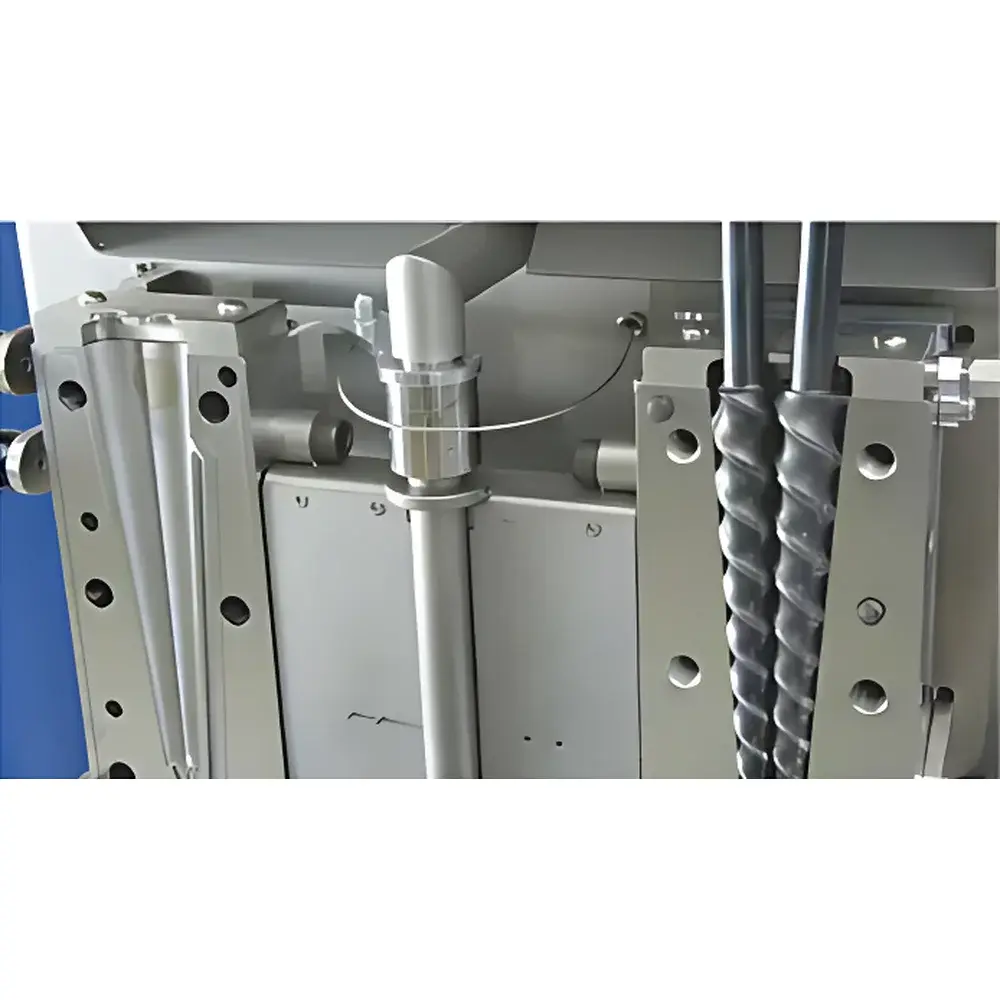
DSM Xplore Micro Twin-Screw Compounding Extruder
| Key | Origin: Netherlands |
|---|---|
| Manufacturer Type | Authorized Distributor |
| Origin Category | Imported |
| Model | Xplore Micro Twin-Screw Compounding Extruder |
| Pricing | Upon Request |
Overview
The DSM Xplore Micro Twin-Screw Compounding Extruder is a precision-engineered laboratory-scale extrusion system designed for rapid, quantitative evaluation of polymer formulations, reactive blends, nanocomposites, and thermosetting systems. Based on co-rotating intermeshing twin-screw architecture, it operates under well-defined shear history, residence time distribution, and thermal profiles—enabling direct correlation between lab-scale process parameters and industrial-scale extrusion behavior. Its core principle leverages controlled melt conveying, distributive and dispersive mixing via adjustable screw geometry, and real-time axial force measurement as a proxy for melt viscosity and flow resistance. With a maximum batch capacity of 15 mL and the patented Vari-Batch™ multi-channel recirculation system (3 mL / 7 mL / 15 mL), it minimizes material consumption while preserving representative rheological and morphological development—critical when handling high-value monomers, catalysts, or scarce bio-based feedstocks.
Key Features
- Modular, split-barrel design with chemically resistant, wear-hardened alloy construction (65 HRC barrel hardness; 2000 Vickers coating; stable geometry up to 450 °C, pH 0–14)
- Tapered, removable twin screws (54 HRC base; 1000 Vickers coating) enabling rapid cleaning with stainless-steel brushes without surface damage
- Six independently controlled heating zones plus nine integrated thermocouples for precise axial temperature profiling and gradient control (standard max: 350 °C; optional upgrade to 450 °C)
- Continuous digital DC main drive (1–250 rpm) with in-line axial force transduction (up to 5000 N standard; 9500 N optional) for real-time melt viscosity inference and pressure-dependent flow analysis
- Vari-Batch™ recirculation architecture allowing discrete batch volumes without hardware change—supporting statistically robust DOE studies across formulation space
- Integrated touchscreen HMI with dedicated Xplore Control & Analysis Software for synchronized parameter logging (torque, temperature, pressure, axial force, RPM), event tagging, and export-compliant data formatting
- Standard air/water cooling circuits and nitrogen purging capability for oxygen-sensitive processing (e.g., peroxide-initiated grafting, metal-catalyzed polymerization)
Sample Compatibility & Compliance
The system accommodates thermoplastics (PP, PE, PA, PC, PEEK), thermosets (epoxies, phenolics), elastomers (EPDM, TPU), filled systems (CaCO₃, glass fiber, nanoclays), and reactive monomers (acrylates, lactides). Its sealed, leak-proof barrel design ensures containment integrity during volatile or hazardous processing—meeting OSHA and EU REACH handling prerequisites. Temperature control accuracy (±1 °C) and axial force repeatability (<±2% full scale) support method validation per ASTM D3835 (extrusion rheometry) and ISO 11443 (melt flow behavior). Data audit trails, user access levels, and electronic signature support align with GLP/GMP documentation requirements and FDA 21 CFR Part 11 readiness when configured with validated software modules.
Software & Data Management
Xplore Control & Analysis Software provides closed-loop PID regulation of all thermal and mechanical parameters, with configurable ramp/soak profiles and automatic safety interlocks (e.g., overtemperature shutdown, torque limit override). Process data—including time-stamped axial force, melt temperature gradients, screw speed, and batch cycle counters—is logged at ≥10 Hz resolution and exported in CSV/Excel-compatible format. Batch metadata (formulation ID, operator, date/time, equipment ID) is embedded automatically. Optional advanced analytics include residence time distribution (RTD) modeling from recirculation cycles, shear rate estimation via screw geometry mapping, and comparative viscosity master curves generated across multiple Vari-Batch™ volumes.
Applications
- Rapid screening of compatibilizers, plasticizers, flame retardants, and conductive fillers in polymer blends
- Processability assessment of biodegradable polymers (PLA, PHA) under low-material conditions
- Reactive extrusion optimization: grafting, crosslinking, and in-situ polymerization with minimal monomer usage
- Morphology development studies for immiscible blends (e.g., PP/PA6) using controlled shear and residence time
- Pre-formulation work for medical-grade compounds requiring ISO 10993-compliant material traceability
- Direct coupling with Xplore micro-injection molding systems for end-to-end lab-scale prototyping (from compounding to part testing)
FAQ
What is the smallest usable batch volume, and how is reproducibility ensured at that scale?
The minimum operational batch is 3 mL using the Vari-Batch™ 3 mL channel. Reproducibility is maintained through fixed screw geometry, calibrated axial force transduction, and thermally stabilized barrel zones—validated by inter-batch CV < 3% for torque and melt temperature under identical setpoints.
Can this system operate in continuous mode, and what modifications are required?
Yes—continuous operation is supported via optional gravimetric feeder, cooled feed throat, and extended torque capacity (9500 N). No structural retrofitting is needed; only firmware configuration and accessory installation.
Is the system compatible with reactive chemistry involving moisture- or oxygen-sensitive reagents?
Yes—integrated nitrogen purge ports, hermetic barrel sealing, and optional glovebox interface enable inert-atmosphere processing down to <10 ppm O₂/H₂O.
How does axial force measurement correlate to material rheology?
Axial force reflects net drag resistance along the screw axis under defined geometry and throughput. When combined with known screw pitch, channel depth, and rotational speed, it enables calculation of apparent viscosity and extensional stress components—particularly valuable for dispersive mixing efficiency assessment.
What regulatory documentation is provided for qualification purposes?
Factory calibration certificates (traceable to NIST), IQ/OQ protocols, and software validation reports (including 21 CFR Part 11 compliance evidence) are available upon request as part of the commissioning package.





