
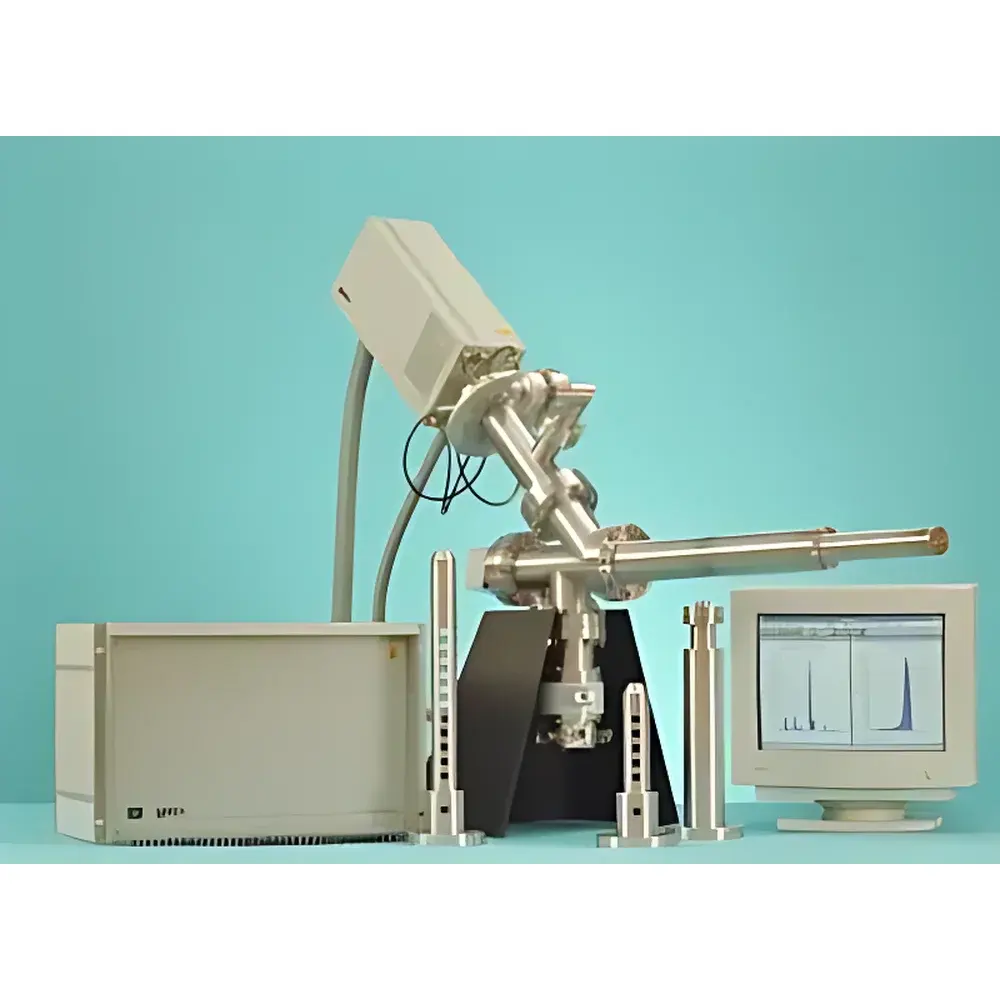
Hiden EQP Mass and Energy Analyser for Plasma Diagnostics
| Brand | Hiden |
|---|---|
| Origin | United Kingdom |
| Model | EQP |
| Mass Range | up to 2500 amu |
| Energy Resolution | 0.05 eV step / 0.25 eV FWHM |
| Ion Detection | Pulse-counting detector with 7-decade dynamic range |
| Signal Gating Resolution | 1 µs |
| Optional Floating Voltage | up to 10 kV |
| Interface | RS232, RS485, or Ethernet LAN |
| Detector Options | Faraday cup (high-density plasmas), electron attachment source (for apparent potential spectroscopy) |
| Vacuum System | Triple-differentially pumped quadrupole with 45° electrostatic sector energy analyser |
| Shielding Options | Mu-metal and radio-metal shielding available |
| Safety | Integrated Penning gauge and interlock system for overpressure protection |
Overview
The Hiden EQP Mass and Energy Analyser is a high-precision, research-grade plasma diagnostic instrument engineered for simultaneous mass spectrometric and energy-resolved analysis of ions, neutrals, and reactive radicals in low-temperature and reactive plasma environments. Unlike conventional quadrupole mass spectrometers, the EQP integrates a 45° electrostatic sector energy analyser upstream of a differentially pumped triple-filter quadrupole mass analyser—enabling true mass/energy correlation across the full operational range. This architecture supports quantitative ion energy distribution function (IEDF) measurements, essential for understanding sheath physics, ion acceleration mechanisms, and surface interaction kinetics in plasma processing systems. Designed specifically for in situ and real-time plasma diagnostics, the EQP operates under dynamic process conditions—including pulsed RF, capacitively coupled (CCP), and inductively coupled (ICP) discharges—while maintaining high signal fidelity and minimal plasma perturbation.
Key Features
- Software-controlled ion extraction optics with variable lens biasing to minimize plasma disturbance during sampling.
- 45° electrostatic sector energy analyser delivering 0.05 eV energy step resolution and 0.25 eV full-width-at-half-maximum (FWHM) energy resolution across the full 0–1000 eV range (optional extension to 10 keV).
- Differentially pumped triple-stage quadrupole mass filter enabling stable operation up to 2500 amu with high mass resolution and reduced background interference.
- Pulse-counting ion detector with 7-decade linear dynamic range and sub-microsecond time-gated acquisition (1 µs gate width), supporting transient plasma characterization and time-resolved IEDF mapping.
- Tunable ion source configuration supporting electron attachment mode for apparent potential spectroscopy of electronegative species (e.g., Cl⁻, F⁻, O⁻) and radical detection via charge-transfer reactions.
- Integrated Penning vacuum gauge and hardware interlock circuitry ensuring automatic shutdown during overpressure events—critical for equipment protection in reactive gas environments.
- Optional Faraday cup detector for high-flux, non-saturating current measurement in high-density plasmas (>10¹² cm⁻³).
- EMI shielding options including mu-metal and radio-metal enclosures to suppress external electromagnetic noise in RF-intensive facilities.
Sample Compatibility & Compliance
The EQP interfaces directly with plasma reactors via standard CF-63 or CF-100 viewports, grounded electrodes, or driven electrode feedthroughs—requiring no physical modification to the process chamber. It supports analysis of cations, anions, metastables, and neutral species (via optional electron impact or photoionization sources). The system complies with CE marking requirements for electromagnetic compatibility (EMC Directive 2014/30/EU) and low-voltage safety (LVD Directive 2014/35/EU). Its vacuum architecture and differential pumping design meet ISO 27893:2015 standards for residual gas analyser performance in industrial plasma tools. Data acquisition protocols are compatible with GLP-compliant audit trails when used with MASsoft v6.0+ and configured for 21 CFR Part 11 electronic signature support.
Software & Data Management
Control and data acquisition are performed using Hiden’s proprietary MASsoft platform, a Windows-based application offering real-time spectral visualization, multi-parameter scripting, and automated calibration routines. MASsoft supports synchronized triggering with external pulse generators, RF power supplies, and optical emission monitors (OEM), enabling correlated plasma diagnostics. All raw and processed datasets are stored in HDF5 format with embedded metadata (timestamp, pressure, bias voltage, gate delay), ensuring traceability and interoperability with MATLAB, Python (h5py), and LabVIEW environments. Batch processing modules allow post-acquisition reconstruction of time-resolved mass-energy histograms, ion flux normalization, and IEDF deconvolution using built-in Boltzmann inversion algorithms.
Applications
- Plasma etching and thin-film deposition process optimization—quantifying ion energy distributions impacting SiO₂/Si selectivity and sidewall profile control.
- Ion implantation dosimetry and beam uniformity assessment in semiconductor fabrication tools.
- Laser ablation plume composition analysis for pulsed laser deposition (PLD) and laser-induced breakdown spectroscopy (LIBS) development.
- Residual gas analysis (RGA) and leak detection in ultra-high vacuum (UHV) plasma chambers and fusion device diagnostics.
- Fundamental studies of electron attachment kinetics, negative ion formation pathways, and radical reaction networks in electronegative plasmas (e.g., SF₆, C₄F₈, O₂).
- Time-resolved plasma chemistry monitoring during RF pulse modulation—resolving ion arrival timing relative to voltage phase in CCP systems.
FAQ
What plasma configurations is the EQP compatible with?
The EQP supports capacitive, inductive, microwave, and pulsed DC plasmas via direct sampling through grounded or biased electrodes, viewport ports, or dedicated plasma probes.
Can the EQP measure neutral species?
Yes—when equipped with optional electron impact (EI) or vacuum ultraviolet (VUV) photoionization sources, it enables selective ionization and detection of ground-state and metastable neutrals.
Is the system suitable for high-pressure plasma environments?
The triple-differential pumping architecture maintains optimal quadrupole vacuum (≤1×10⁻⁶ mbar) even at process pressures up to 100 Pa, making it suitable for atmospheric-pressure plasma jet interfaces with appropriate pressure-reduction stages.
How is calibration performed?
Mass calibration uses known noble gas peaks (He, Ne, Ar); energy calibration employs monoenergetic ion beams from calibrated extraction potentials, traceable to NIST-standard reference materials.
Does MASsoft support automated reporting for quality documentation?
Yes—customizable report templates generate PDF outputs with embedded spectra, acquisition parameters, and operator signatures, fully compliant with ISO/IEC 17025 and internal QA/QC workflows.




