
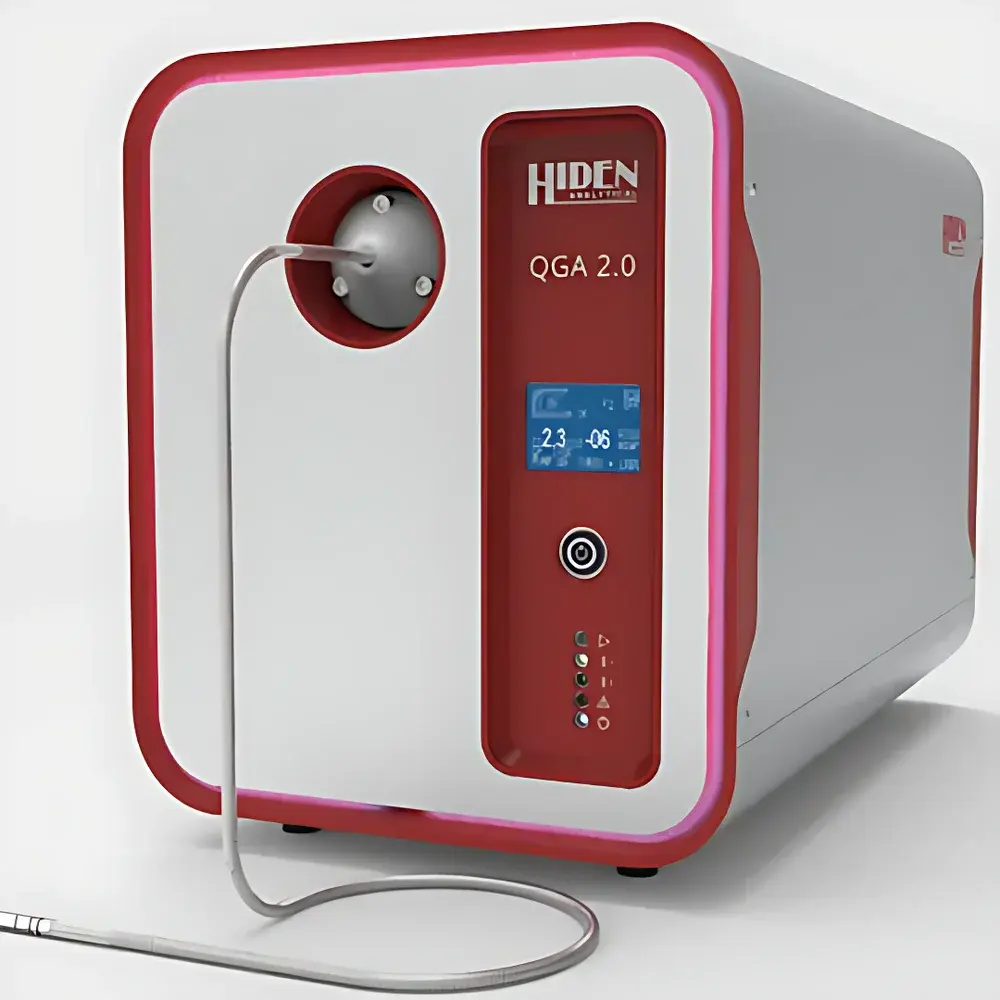
Hiden QGA 2.0 Quantitative Gas Analysis Mass Spectrometer
| Brand | Hiden |
|---|---|
| Origin | United Kingdom |
| Model | QGA 2.0 |
| Detection Range | 100 ppb to 100% |
| Scan Speed | Up to 1000 spectra per second |
| Form Factor | Benchtop, Compact Design |
| Compliance | CE-marked, RoHS-compliant construction |
| Software | QGA 2.0 Quantitative Analysis Suite (Windows-based, FDA 21 CFR Part 11 ready) |
Overview
The Hiden QGA 2.0 Quantitative Gas Analysis Mass Spectrometer is a benchtop quadrupole mass spectrometer engineered for real-time, high-fidelity quantitative analysis of gas-phase species in dynamic process environments. Utilizing electron ionization (EI) at 70 eV and a robust 4–1000 amu mass range, the system operates on the principle of mass-to-charge (m/z) separation via RF/DC quadrupole filtering, enabling precise identification and concentration measurement of permanent gases, vapors, and reactive intermediates. Designed specifically for integration into catalytic reaction monitoring, fermentation off-gas analysis, vacuum chamber residual gas analysis (RGA), and hydrogen purity verification, the QGA 2.0 delivers laboratory-grade accuracy with industrial-grade reliability. Its compact architecture supports deployment in controlled laboratories, pilot-scale reactors, and ISO-classified cleanrooms—without requiring external cooling, high-vacuum pumping infrastructure, or dedicated RF shielding.
Key Features
- High-speed acquisition: Capable of acquiring up to 1000 full-spectrum scans per second, enabling sub-second temporal resolution for transient gas composition changes.
- Extended dynamic range: Quantitative linearity from 100 parts-per-trillion (ppt) to 100% volume fraction across calibrated species, supported by integrated Faraday cup and secondary electron multiplier (SEM) detection.
- Optimized hydrogen analysis: Dedicated filament design, low-outgassing ion source, and differential pumping stage minimize H₂ background noise and enhance signal-to-noise ratio for trace H₂ detection in inert or corrosive matrices.
- Modular inlet compatibility: Supports heated capillary, membrane inlet (e.g., silicone or PTFE), leak-valve-controlled direct sampling, and custom reactor coupling interfaces.
- Reduced footprint and mass: 42% smaller benchtop area and 26% lower unit weight versus prior-generation QGA systems—facilitating integration into space-constrained analytical workstations and mobile lab platforms.
- Eco-conscious manufacturing: Constructed using RoHS-compliant materials and energy-efficient electronics; no hazardous halogenated solvents or lead-based solder used in PCB assembly.
Sample Compatibility & Compliance
The QGA 2.0 accommodates gaseous samples across a broad chemical space—including H₂, O₂, N₂, CO, CO₂, CH₄, NH₃, H₂O vapor, HCl, SO₂, and volatile organic compounds (VOCs)—with minimal sample preparation. Inlet temperature control (up to 200 °C) prevents condensation and ensures representative sampling of thermally labile species. The instrument meets CE marking requirements for electromagnetic compatibility (EMC Directive 2014/30/EU) and low-voltage safety (LVD Directive 2014/35/EU). Its hardware and software architecture support audit-ready operation under GLP and GMP frameworks, including full electronic signature capability, user-access-level permissions, and immutable audit trails compliant with FDA 21 CFR Part 11 when configured with optional validation packages.
Software & Data Management
The QGA 2.0 Quantitative Analysis Software is a native Windows application built on a modular, object-oriented framework. It provides real-time spectral visualization, multi-point calibration curve generation (linear, quadratic, or polynomial), and automated peak deconvolution for overlapping m/z signals (e.g., CO⁺/N₂⁺ at m/z 28). Data export conforms to ASTM E1399-22 (Standard Practice for Exchange of Analytical Data) and supports CSV, HDF5, and vendor-neutral JCAMP-DX formats. Integrated time-series trending tools allow synchronized logging with external process variables (via OPC UA or analog I/O), while batch reporting modules generate PDF/Excel summaries compliant with ISO/IEC 17025 documentation standards.
Applications
- Catalyst characterization: Monitoring reactant consumption and product formation during TPD, TPR, and in situ/operando reaction studies.
- Hydrogen infrastructure QA/QC: Verifying purity grades (ISO 8573-8 Class 1–4) and detecting ppm-level contaminants (O₂, H₂O, CO) in PEM electrolyzer and fuel cell feed streams.
- Fermentation and bioreactor off-gas analysis: Quantifying CO₂ evolution rate (CER), O₂ uptake rate (OUR), and respiratory quotient (RQ) for metabolic flux modeling.
- Plasma process monitoring: Tracking radical species (e.g., atomic O, N, F) and stable byproducts in semiconductor etch and deposition chambers.
- Environmental emissions screening: Continuous stack gas analysis for regulatory reporting under EPA Method 25A and EN 15267-3.
FAQ
What mass range and resolution does the QGA 2.0 provide?
The instrument covers m/z 4–1000 with unit mass resolution (peak width at 10% valley definition) and mass accuracy better than ±0.1 amu after daily calibration.
Is the QGA 2.0 suitable for corrosive gas mixtures such as HCl or Cl₂?
Yes—when equipped with optional corrosion-resistant ion source components (Inconel 600 filaments, gold-plated electrodes) and chemically inert inlet tubing, it maintains stable performance in halogen-rich environments.
Can the system be integrated with existing DCS or SCADA platforms?
Absolutely—the QGA 2.0 supports Modbus TCP, OPC UA, and 4–20 mA analog output interfaces for seamless integration into industrial automation architectures.
Does the software support automated calibration and drift correction?
Yes—built-in calibration routines include multi-point span adjustment, zero-gas baseline stabilization, and time-dependent sensitivity drift compensation using internal reference peaks.
What vacuum requirements are needed for operation?
The system incorporates a dual-stage turbomolecular pump (base pressure <5×10⁻⁸ mbar) and requires no external roughing pump; only standard 230 V AC power and ambient air cooling are necessary.



