
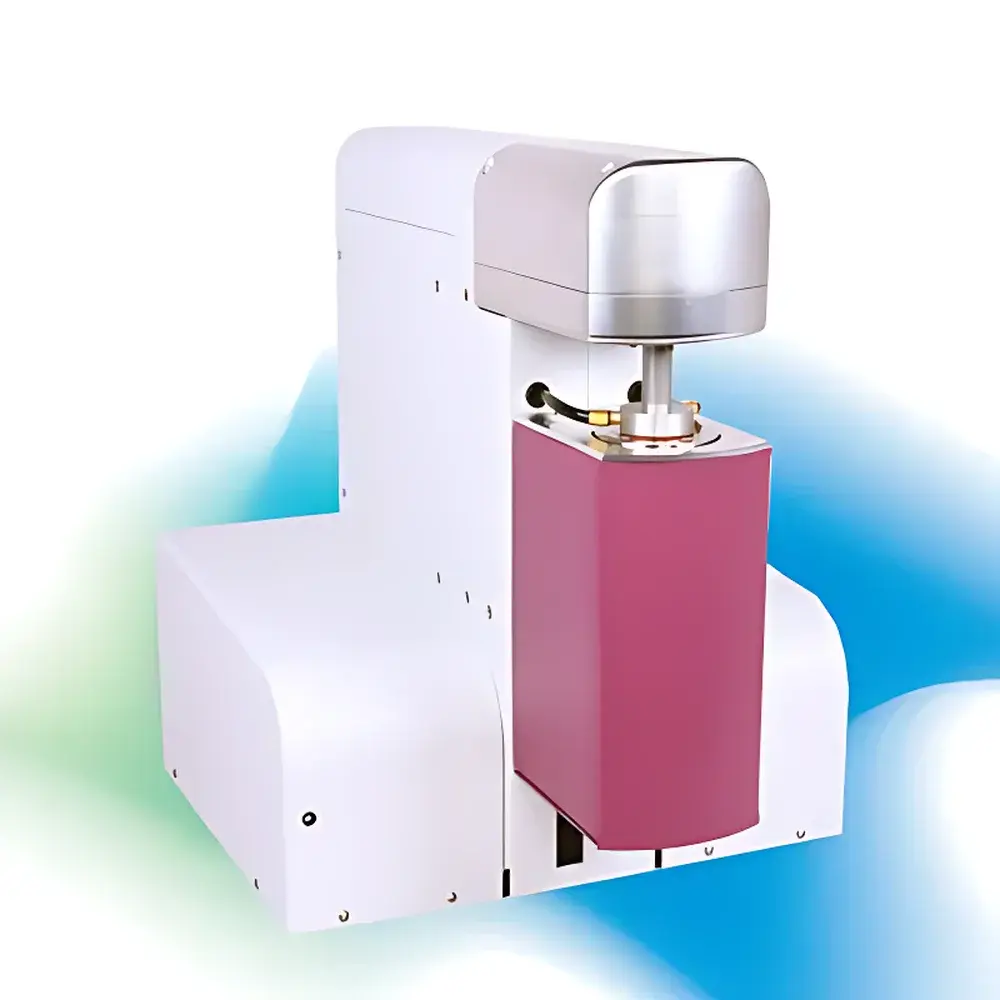
Thermogravimetric Analyzer ISI TGA 1000
| Brand | ISI |
|---|---|
| Origin | USA |
| Model | TGA 1000 |
| Temperature Range | RT–1000°C |
| Balance Sensitivity | 0.1 µg |
| Heating/Cooling Rate | 0.1–300 K/min |
| Maximum Sample Mass | 0.4 g |
| Sample Capacity | Single |
| Environment | High-Temperature/Controlled-Atmosphere |
| Construction | Stainless Steel Gas Pathway |
| Cooling | Water-Cooled Furnace |
| Software Platform | Infinity Pro for Windows |
| Compliance | ASTM E1131, ISO 11358, USP <691>, GLP-Ready |
Overview
The ISI TGA 1000 is a high-precision thermogravimetric analyzer engineered for rigorous quantitative measurement of mass change as a function of temperature or time under controlled atmospheric conditions. Based on the fundamental principle of dynamic thermogravimetry—monitoring sample mass loss or gain during programmed thermal treatment—the instrument delivers reproducible, traceable data essential for decomposition kinetics, compositional analysis, thermal stability assessment, and residual solvent quantification. Its compact micro-furnace design minimizes gas volume within the reaction zone, enabling rapid thermal response and exceptional atmosphere homogeneity. The system operates across a wide temperature range from ambient (RT) to 1000°C with programmable heating and cooling rates spanning 0.1 to 300 K/min—supporting both slow, high-resolution scans and fast screening protocols without compromising baseline stability.
Key Features
- Ultra-sensitive microbalance with 0.1 µg resolution and integrated 24-bit analog-to-digital conversion for high-fidelity mass tracking.
- Dual-purge gas switching system with fully stainless-steel fluidic pathways, eliminating oxygen contamination and ensuring inert or reactive atmosphere integrity.
- Water-cooled furnace housing maintains external surface temperatures below 50°C during high-temperature operation, enhancing operator safety and long-term mechanical stability.
- Electromechanically driven furnace lift mechanism enables precise, repeatable sample positioning and facilitates rapid, tool-free crucible exchange.
- Modular architecture supports optional integration of evolved gas analysis (EGA) modules—including heated transfer lines and quadrupole mass spectrometer (QMS) or FTIR coupling—without hardware modification.
- Real-time auto-stabilization algorithm compensates for thermal drift and buoyancy effects, maintaining baseline flatness across extended runs.
- Corrosion-resistant construction throughout critical gas and thermal zones ensures compatibility with aggressive atmospheres (e.g., HCl, SO₂, Cl₂) and halogenated polymers.
Sample Compatibility & Compliance
The TGA 1000 accommodates a broad spectrum of solid and powdered samples—including polymers, pharmaceuticals, catalysts, ceramics, composites, and inorganic salts—using interchangeable crucibles in alumina, platinum, quartz, and silicon carbide. Crucible geometry and material are selected based on thermal inertia, chemical inertness, and required sensitivity. The system meets key international standards for thermal analysis: ASTM E1131 (standard test method for determining composition by thermogravimetry), ISO 11358 (polymers—thermogravimetry), and USP (thermal analysis in pharmaceutical development). Data acquisition and reporting comply with GLP requirements, including full audit trail logging, electronic signature support, and user-access-level controls—facilitating FDA 21 CFR Part 11 readiness when deployed with validated Infinity Pro software configurations.
Software & Data Management
Controlled entirely via the Infinity Pro for Windows platform, the TGA 1000 provides real-time visualization of mass, temperature, and derivative (DTG) curves during acquisition. The software supports multi-instrument operation—enabling synchronized control of up to eight analyzers from a single workstation—while maintaining independent method storage, calibration history, and raw data archiving per unit. All datasets are saved in vendor-neutral .tdf format, compatible with third-party kinetic modeling tools (e.g., Kinetics Neo, Thermo-Calc). Advanced features include automatic baseline correction, stepwise isothermal holds, multi-ramp sequences, and customizable report templates aligned with internal SOPs or regulatory submission formats. Raw signal timestamps are hardware-synchronized to within ±10 ms, ensuring temporal fidelity for coupled techniques such as TGA-FTIR or TGA-MS.
Applications
- Quantitative determination of moisture, volatile content, filler loading, and ash residue in polymer formulations per ISO 3451 and ASTM D6370.
- Decomposition onset temperature (Td) and activation energy (Ea) calculation for energetic materials and battery cathode precursors.
- Stability profiling of active pharmaceutical ingredients (APIs) and excipients under oxidative and nitrogen atmospheres per ICH Q1A(R2).
- Char yield evaluation in flame-retardant composites and carbonization behavior of biochar precursors.
- Residual catalyst quantification in olefin polymerization residues via high-temperature oxidation protocols.
- Thermal aging studies of encapsulation resins and dielectric films used in power electronics packaging.
FAQ
What is the maximum recommended sample mass for optimal resolution and thermal uniformity?
For best signal-to-noise ratio and minimal temperature lag, we recommend 1–10 mg for most organic materials; up to 100 mg may be used for high-density inorganic samples, provided crucible geometry is optimized.
Can the TGA 1000 operate under reducing atmospheres such as hydrogen or forming gas?
Yes—the dual-purge system supports continuous flow of H₂, CO, NH₃, or mixed gases up to 500 mL/min; all wetted parts are rated for compatibility with reducing environments.
Is calibration traceable to NIST standards?
Temperature calibration uses certified reference materials (e.g., Ni, Cu, Al₂O₃) traceable to NIST SRMs; mass calibration employs Class E2 weights certified to ISO/IEC 17025-accredited laboratories.
How is buoyancy correction handled during high-rate heating?
The instrument applies real-time, model-based buoyancy compensation using furnace geometry, gas density, and sample volume estimates derived from pre-run density input or iterative optimization.
Does the system support automated gas switching during a single run?
Yes—optional AutoGasSwitch module enables programmable, timed transitions between up to four gases (e.g., N₂ → Air → O₂ → Ar) with sub-second response and zero cross-contamination.



