
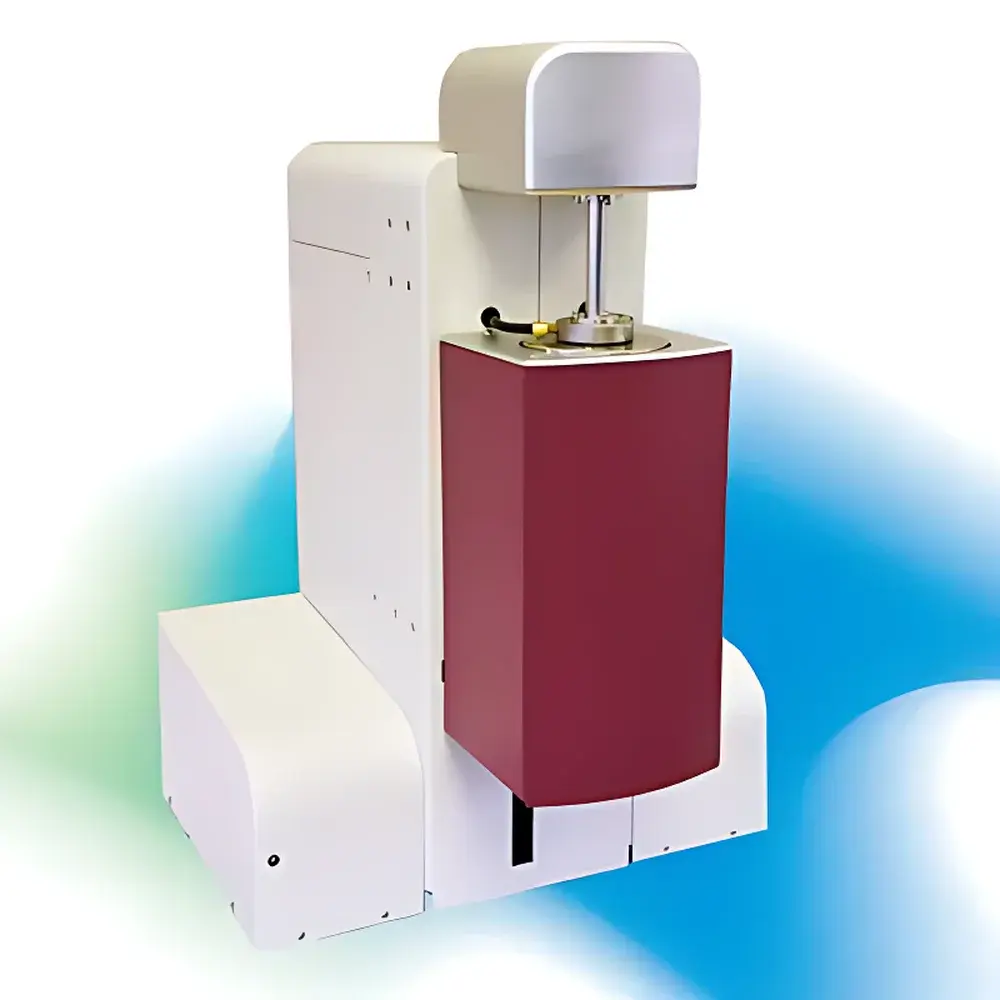
ISI STA 1500 Simultaneous Thermal Analyzer
| Temperature Range | –125 to 1500 °C |
|---|---|
| Heating Rate | 0.1–40 °C/min |
| Max Sample Mass | 0.4 g |
| Balance Resolution | 0.1 µg |
| Furnace Options | 650 °C / 1200 °C / 1500 °C |
| DSC/DTA Mode | Yes |
| Gas Control | Dual- or Quad-channel purge system |
| Software | Infinity Pro Thermal Analysis Suite |
Overview
The ISI STA 1500 Simultaneous Thermal Analyzer is an engineered platform for high-fidelity, concurrent measurement of thermal transitions and mass changes under controlled atmospheric conditions. Based on the principle of simultaneous thermogravimetric analysis (TGA) and differential scanning calorimetry (DSC) — or differential thermal analysis (DTA), depending on sensor configuration — the instrument employs a vertical microbalance architecture coupled with a high-stability heat-flux sensor. This dual-signal acquisition enables precise correlation between endothermic/exothermic events and associated mass loss or gain across a broad temperature domain (–125 °C to 1500 °C). The system’s core design prioritizes mechanical isolation, thermal homogeneity, and signal integrity — critical for detecting subtle thermal events such as polymorphic transitions, dehydration steps, oxidative decomposition, or catalytic reaction onset. Its compatibility with cryogenic (LN2) and high-temperature furnaces ensures applicability from low-T polymer glass transitions to high-T ceramic sintering or metal oxidation kinetics.
Key Features
- Vertical suspension microbalance with 0.1 µg resolution and active drift compensation
- Modular furnace system: interchangeable 650 °C, 1200 °C, and 1500 °C options — all compatible with the same sample carrier geometry
- Dual-mode sensor support: selectable DSC or DTA configurations, optimized for sensitivity vs. baseline stability per application requirement
- Low-volume purge chamber with independently controlled dual-gas inlet (e.g., N2/O2, Ar/CO2); optional quad-gas manifold for complex atmosphere switching or EGA coupling
- Integrated cryogenic cooling option (LN2-based) enabling sub-ambient operation down to –125 °C
- Water-cooled furnace housing for thermal management during extended high-temperature runs
- Real-time synchronization of mass, heat flow, and temperature signals at ≥10 Hz sampling rate
Sample Compatibility & Compliance
The STA 1500 accommodates solid powders, granules, thin films, fibers, and small metallic specimens (≤0.4 g max load) in standard alumina, platinum, or gold crucibles. Its open-sample geometry supports direct coupling to FTIR or mass spectrometry systems for evolved gas analysis (EGA). The instrument meets essential regulatory expectations for laboratory instrumentation: hardware-level data integrity safeguards, audit-trail-enabled software logging (Infinity Pro), and full compliance with GLP/GMP documentation workflows. While not pre-certified to ISO 11357 (plastics — DSC) or ASTM E1131 (TGA), its calibrated performance aligns with the measurement traceability requirements specified in these standards. All calibration routines — temperature, enthalpy, and mass — follow NIST-traceable reference materials (e.g., indium, zinc, calcium oxalate monohydrate).
Software & Data Management
Controlled exclusively by Infinity Pro Thermal Analysis Software (Windows-based), the STA 1500 delivers a deterministic, scriptable environment for method development, real-time monitoring, and post-run analysis. The interface supports multi-step temperature programs with dynamic ramp/hold/cool segments, automatic baseline subtraction, peak deconvolution, derivative thermogravimetry (DTG), and kinetic modeling (e.g., Ozawa-Flynn-Wall, Kissinger). Raw data files are stored in vendor-neutral ASCII format (.txt) alongside proprietary .inf metadata; export modules generate CSV, Excel, and PDF reports compliant with internal QA/QC templates. Audit trails record user actions, parameter changes, and calibration events — satisfying FDA 21 CFR Part 11 requirements when deployed with appropriate IT governance controls.
Applications
- Polymorph screening and thermal stability assessment of pharmaceutical actives (e.g., hydrate/anhydrate transitions)
- Oxidative induction time (OIT) determination in polyolefins per ASTM D3895
- Decomposition kinetics of energetic materials (explosives, propellants)
- Thermal degradation profiling of carbon composites and aerospace-grade resins
- Phase transformation mapping in Ni-based superalloys and shape-memory alloys
- Catalyst deactivation studies via coke burn-off quantification in inert/oxidizing atmospheres
- Hydration/dehydration behavior in cementitious systems and geopolymers
- Thermal characterization of battery electrode materials (e.g., LiCoO2, NMC, silicon anodes)
FAQ
What is the difference between DSC and DTA modes on the STA 1500?
DSC mode measures heat flow difference between sample and reference to quantify enthalpy changes (e.g., ΔH of fusion); DTA records temperature difference and is preferred for high-temperature applications where absolute enthalpy accuracy is secondary to transition onset detection.
Can the STA 1500 be used for quantitative residue analysis after combustion?
Yes — with proper crucible selection (e.g., Pt) and oxygen-rich purge gas, it achieves <±0.1% mass reproducibility for ash/residue yield determination per ASTM D3174.
Is remote operation supported?
Infinity Pro includes secure TCP/IP connectivity for local network access; remote desktop protocols (RDP) are permitted but require institutional firewall and authentication policies.
How often does the system require recalibration?
Temperature and enthalpy calibration are recommended before each critical study series; mass calibration is performed automatically at startup and verified weekly using certified weights.
Does the instrument support purge gas flow rate programming?
Yes — flow rates (0–200 mL/min per channel) can be defined per temperature segment within the method, enabling staged atmosphere control during multi-step reactions.



