
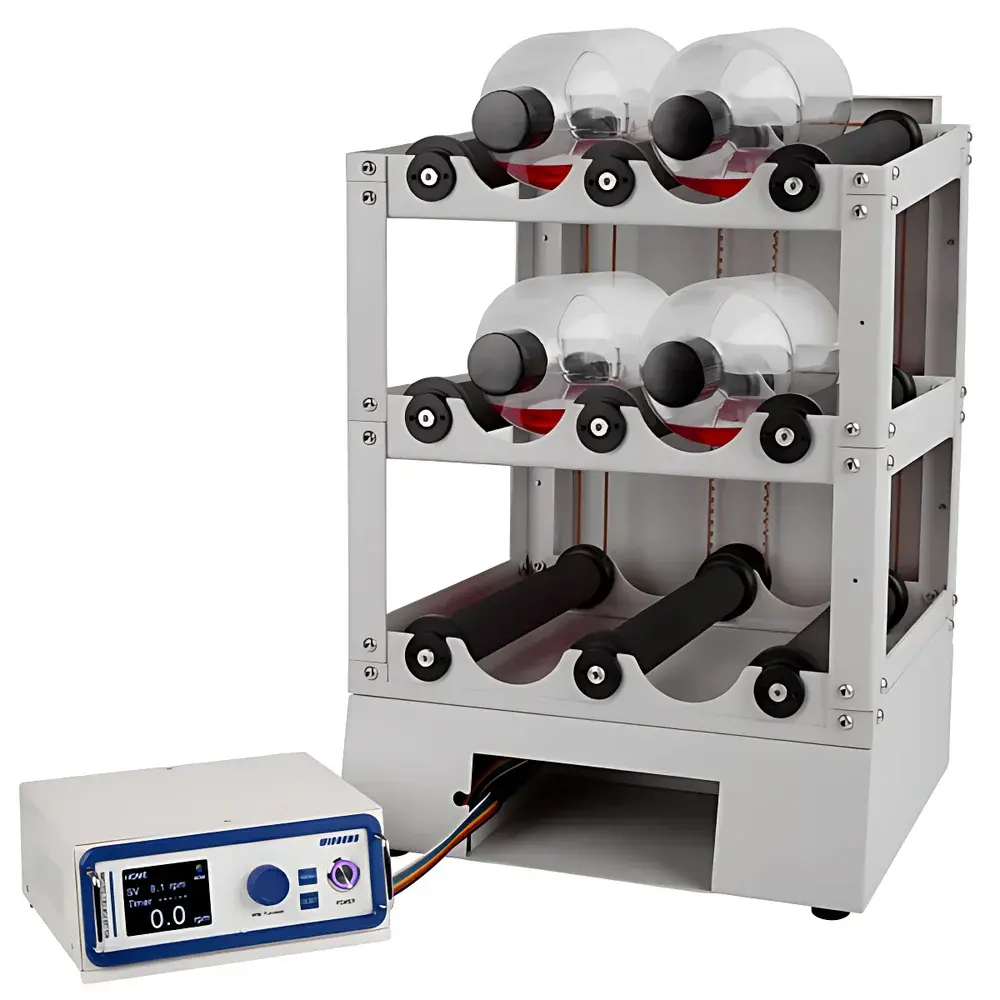
WIGGENS Celrol Mid Benchtop Cell Culture Roller Drum
| Brand | WIGGENS |
|---|---|
| Origin | Germany |
| Model | Celrol Mid |
| Rotation Speed Range | 0.2–8.1 rpm |
| Speed Resolution | 0.1 rpm |
| Speed Accuracy | ±1 rpm |
| Timing Mode | Continuous or up to 99 h 59 min (±1% accuracy) |
| Control System | Digital microprocessor-based PID control |
| Display | LED screen |
| Drive Motor | Maintenance-free brushless DC motor |
| Transmission | Reinforced polyurethane timing belt |
| Sample Capacity | 6 × 2000 mL roller bottles (Ø110–120 mm) |
| Dimensions (unit only) | 362 W × 299 D × 412 H mm |
| Overall Dimensions (with rollers installed) | 375 W × 370 D × 545 H mm |
| Power Supply | AC 100–240 V, 50/60 Hz, 10 W |
| Weight | 13.5 kg |
| Enclosure | Powder-coated aluminum housing |
| Footing | Anti-slip rubber base |
| Compliance | Designed for ISO 13485-aligned lab environments |
Overview
The WIGGENS Celrol Mid Benchtop Cell Culture Roller Drum is an engineered solution for controlled, low-shear, continuous rotation of adherent cell culture vessels in research and process development settings. Based on the fundamental principle of gravity-mediated cell monolayer expansion—where slow, uniform rotation promotes homogeneous nutrient distribution and gas exchange while minimizing mechanical stress—the Celrol Mid delivers precise, repeatable rotational motion essential for scalable suspension-to-adherent transition studies, viral vector production optimization, and primary cell expansion protocols. Its compact footprint and dual-installation capability (benchtop or incubator-integrated) make it especially suitable for laboratories with space constraints or stringent environmental control requirements (e.g., CO2 incubators operating at 37 °C, 5% CO2, >95% RH). Unlike batch-shaking or orbital platforms, roller drums maintain consistent angular velocity across all bottles simultaneously, eliminating edge effects and ensuring inter-bottle reproducibility critical for comparative assays and bioprocess parameter screening.
Key Features
- Maintenance-free brushless DC motor ensures long-term operational stability, zero carbon dust generation, and silent operation—critical for laminar flow hood integration and noise-sensitive core facilities.
- PID-controlled digital microprocessor enables fine-grained speed adjustment down to 0.1 rpm, with factory-calibrated accuracy of ±1 rpm across the full 0.2–8.1 rpm range—sufficient for both slow-diffusion-dependent applications (e.g., neural progenitor differentiation) and faster proliferation phases.
- Flat-profile data cable eliminates the need for wall penetrations when mounting inside incubators, preserving chamber integrity and avoiding thermal leakage points or condensation traps.
- Reinforced polyurethane timing belt provides high-torque transmission with zero slippage, even under load variation caused by uneven bottle fill levels or temperature-induced viscosity shifts in media.
- Powder-coated aluminum chassis offers corrosion resistance, electromagnetic compatibility (EMC), and ease of decontamination via 70% ethanol or validated sporicidal agents—supporting routine aseptic maintenance per ISO 14644-1 Class 5 cleanroom practices.
- Integrated anti-slip rubber base ensures stable positioning on stainless steel benches or incubator shelves without additional anchoring hardware.
Sample Compatibility & Compliance
The Celrol Mid accommodates six standard 2000 mL roller bottles (diameter 110–120 mm), including WIGGENS-certified borosilicate glass vessels compliant with USP Class I and ASTM E438 Type I, A-grade specifications. These bottles withstand repeated autoclaving (121 °C, 20 min) and dry-heat sterilization (180 °C, 2 h), maintaining dimensional stability and surface integrity over ≥50 cycles. The system supports interchangeable cap configurations—including phenolic resin threaded caps with SBR gaskets (GPI38-415), PP screw caps with integrated breathable membranes (Wheaton 45 mm), and PP pour-rings—enabling adaptation to oxygen-permeable or CO2-retentive culture conditions. While the Celrol Mid itself is not certified to GMP Annex 1 or FDA 21 CFR Part 11, its design aligns with foundational GLP documentation principles: LED display logs real-time speed and elapsed time; no internal memory or audit trail is present, but external data loggers (via optional analog output interface) may be deployed for IQ/OQ validation per ASTM E2500-13.
Software & Data Management
The Celrol Mid operates as a stand-alone instrument with embedded firmware—no PC dependency or proprietary software installation required. All operational parameters are set and monitored locally via the front-panel LED display and tactile keypad. For laboratories implementing centralized equipment monitoring, the unit’s low-power consumption (10 W), universal AC input (100–240 V), and minimal electromagnetic emissions facilitate seamless integration into facility-wide power management systems. Although it lacks native network interfaces (e.g., Ethernet, RS-485), its predictable power signature and mechanical simplicity support third-party integration via programmable logic controllers (PLCs) or building management systems (BMS) using discrete I/O triggers. Time-stamped manual records—aligned with SOPs referencing ASTM E2500-13 Annex A3—can be maintained alongside environmental chamber logs for full traceability during regulatory audits.
Applications
- Adherent cell line expansion (e.g., CHO, HEK293, MRC-5) under serum-free or chemically defined media conditions.
- Viral vector production (AAV, lentivirus) where extended rotation duration (>72 h) improves transduction efficiency and reduces shear-induced capsid damage.
- Primary tissue-derived cell isolation and outgrowth, particularly for mesenchymal stromal cells (MSCs) and epithelial organoids requiring prolonged low-shear exposure.
- Bioprocess development studies comparing roller drum vs. static flask vs. bioreactor formats—leveraging its reproducible RPM control for DOE-based parameter sweeps.
- Teaching laboratories conducting hands-on bioreactor fundamentals, given its intuitive interface and mechanical transparency.
FAQ
Can the Celrol Mid be operated inside a CO2 incubator?
Yes. Its flat-profile cable, sealed electronics, and absence of vented cooling fans allow safe operation within standard humidified CO2 incubators (operating range: 10–40 °C, ≤80% RH at 31 °C). Ensure minimum clearance of 50 mm around all sides for passive heat dissipation.
Is speed calibration traceable to national standards?
The unit undergoes factory verification against NIST-traceable tachometric references. End users may perform periodic verification using handheld optical tachometers (e.g., Extech 461923) per ISO/IEC 17025-compliant procedures.
What is the maximum allowable bottle fill volume?
For optimal rolling dynamics and media film formation, fill volume should not exceed 60% of nominal capacity (i.e., ≤1200 mL per 2000 mL bottle). Overfilling increases torque demand and may induce transient speed deviation beyond ±1 rpm tolerance.
Does the system include overload or stall protection?
Yes. The brushless DC motor driver incorporates current-limiting circuitry that automatically reduces output torque upon sustained mechanical resistance—preventing belt slippage, motor overheating, or encoder fault conditions.
Are replacement belts or motor modules available as spare parts?
WIGGENS supplies OEM-certified polyurethane timing belts (P/N W6110201) and field-replaceable motor assemblies (P/N W6110202) with documented MTBF >25,000 hours under continuous operation at 5 rpm.





