
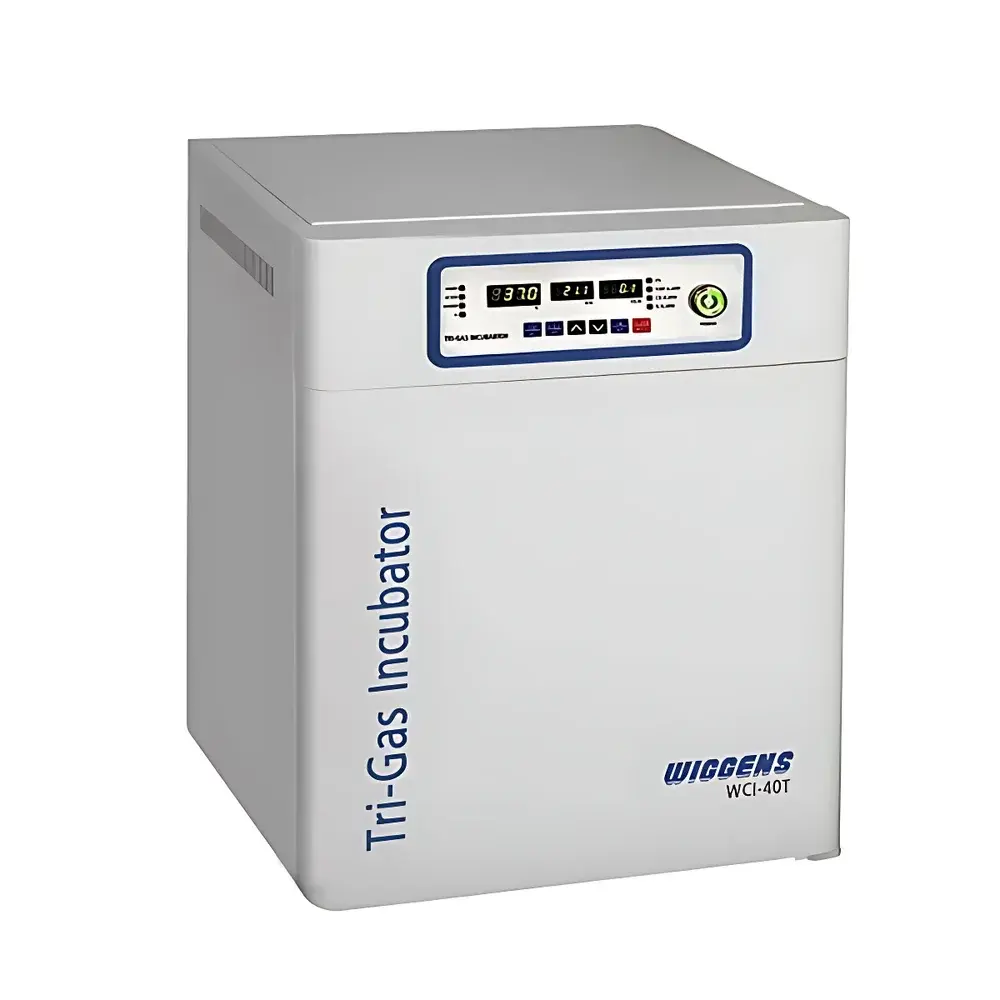
WIGGENS WCI-40T Tri-Gas Incubator
| Brand | WIGGENS |
|---|---|
| Origin | Germany |
| Model | WCI-40T |
| Incubator Type | Air-Jacketed Tri-Gas Incubator |
| Temperature Range | Ambient +5°C to 60°C |
| Temperature Uniformity | ±0.1°C at 37°C |
| CO₂ Control Range & Accuracy | 0–20% vol, ±0.1% at 5% / 37°C |
| O₂ Control Range | 0.6–85% vol |
| Chamber Capacity | 40 L |
| External Dimensions (W×D×H) | 420 × 460 × 570 mm |
| Internal Dimensions (W×D×H) | 320 × 350 × 375 mm |
| Chamber Material | AISI 304 Stainless Steel |
| Heating System | Six-Side Direct Air-Jacketed Heating with Independent PID Zones |
| CO₂ Sensor | Dual-Beam Infrared Sensor |
| O₂ Sensor | Zirconia Electrochemical Sensor |
| Humidification | Passive Water Pan with Bottom Heater and Forced-Air Distribution |
| Door Heating | Integrated Anti-Condensation Heating Element |
| Control System | Microprocessor-Based PID Controller with Dual LED Display |
| Power Cut-Off Safety | Over-Temperature Limit Protection |
Overview
The WIGGENS WCI-40T Tri-Gas Incubator is an air-jacketed, microprocessor-controlled environmental chamber engineered for precise regulation of temperature, CO₂, and O₂ concentrations in life science applications requiring strict physiological gas control. Designed around Couette-type airflow dynamics and six-sided gradient heating architecture, the WCI-40T maintains stable thermal homogeneity across its 40 L stainless steel chamber—critical for sensitive mammalian cell culture, reproductive biology workflows, anaerobic microbiology, and tissue engineering protocols. Its dual-beam infrared CO₂ sensor delivers real-time, humidity- and temperature-compensated measurement without drift, while the zirconia-based O₂ electrode enables accurate hypoxic and hyperoxic modulation from 0.6% to 85% O₂. The unit operates on a validated air-jacket principle: heating elements are embedded between the inner chamber wall and insulation layer, minimizing thermal inertia and enabling rapid recovery (<15 min) after door opening—essential for GLP-compliant routine handling.
Key Features
- Six-side direct air-jacketed heating system with three independently calibrated Pt100 sensors—ensuring ±0.1°C uniformity at 37°C and accelerated temperature stabilization.
- Dual LED display with dedicated dual-channel keypad interface for simultaneous, independent adjustment of CO₂, O₂, and temperature setpoints.
- AISI 304 stainless steel interior with fully rounded corners and seamless welds—designed for autoclavable compatibility and compliance with ISO 14644-1 Class 5 cleanroom maintenance standards.
- Integrated anti-condensation door heating and frame-sealed structural design—eliminating moisture accumulation on observation windows and internal surfaces during high-humidity operation.
- Passive humidification via bottom-heated stainless steel water pan, coupled with axial circulation fan—achieving >95% RH stability without ultrasonic misting or external steam generators.
- Over-temperature cut-off protection: automatic power disconnection if any sensor exceeds user-defined safety threshold—meeting IEC 61010-1 Class II electrical safety requirements.
Sample Compatibility & Compliance
The WCI-40T supports a broad spectrum of biological sample types including primary human fibroblasts, embryonic stem cells, organoids, bacterial anaerobes (e.g., Clostridium difficile, Bacteroides fragilis), and plant meristematic tissues. Its gas control fidelity meets ASTM E2871-22 criteria for CO₂ incubator performance verification and aligns with USP sterility testing environmental controls. Optional dry-heat sterilization mode (order code W6022040) enables in-chamber decontamination at 180°C for 2 hours—validated per EN 554 for depyrogenation and microbial reduction. All firmware logic adheres to FDA 21 CFR Part 11 data integrity principles when paired with optional audit-trail-enabled software modules.
Software & Data Management
While the WCI-40T operates as a standalone instrument with local PID control, it features RS-232/RS-485 serial output for integration into centralized lab monitoring systems (e.g., LabVantage, Thermo Fisher SampleManager). Logged parameters—including real-time CO₂/O₂ partial pressures, chamber temperature, humidity status, and alarm events—are timestamped and exportable as CSV files. Firmware supports configurable alarm thresholds with relay outputs for external notification (e.g., building management systems). Optional Ethernet-enabled gateway modules provide TLS 1.2-secured remote access, supporting ISO/IEC 27001-aligned network security policies.
Applications
- Mammalian cell culture under physiologically relevant O₂ tensions (e.g., 1–5% for stem cell expansion; 10–12% for tumor spheroid models).
- In vitro fertilization (IVF) and assisted reproductive technology (ART) workflows requiring CO₂-stabilized pH control in bicarbonate-buffered media.
- Microaerophilic and obligate anaerobic bacterial cultivation—particularly where H₂ co-supplementation is integrated via auxiliary gas mixing manifolds.
- Plant tissue culture under controlled hypoxia to study adventitious root formation or ethylene signaling pathways.
- Regulatory-compliant stability studies for biologics and cell therapies under ICH Q5D and Q5E environmental stress conditions.
FAQ
What is the recommended calibration frequency for the CO₂ and O₂ sensors?
CO₂ infrared sensors require annual verification against NIST-traceable gas standards; O₂ zirconia electrodes should be zero-calibrated monthly using certified nitrogen and span-checked quarterly with ambient air (20.9% O₂).
Can the WCI-40T operate continuously at 5% CO₂, 5% O₂, and 37°C for extended periods?
Yes—the unit is rated for uninterrupted operation under these conditions, with mean time between failures (MTBF) exceeding 25,000 hours per ASME BPE-2021 Annex G reliability modeling.
Is the stainless steel chamber compatible with hydrogen peroxide vapor (HPV) decontamination?
AISI 304 construction resists HPV exposure up to 1200 ppm for ≤2 hours; however, repeated cycles may accelerate passive layer oxidation—validation per ISO 14937 is advised prior to routine use.
Does the incubator meet electromagnetic compatibility (EMC) requirements for installation in shared laboratory spaces?
Complies with EN 61326-1:2013 Class A emission limits and EN 61000-4-2/3/4/6 immunity standards for laboratory environments.
How does the air-jacket design compare to water-jacketed systems in terms of energy efficiency and contamination risk?
Air-jacketed configuration reduces standby power consumption by ~35% versus water-jacketed equivalents and eliminates risks associated with water leakage, microbial growth in jacket reservoirs, and thermal stratification artifacts.




