
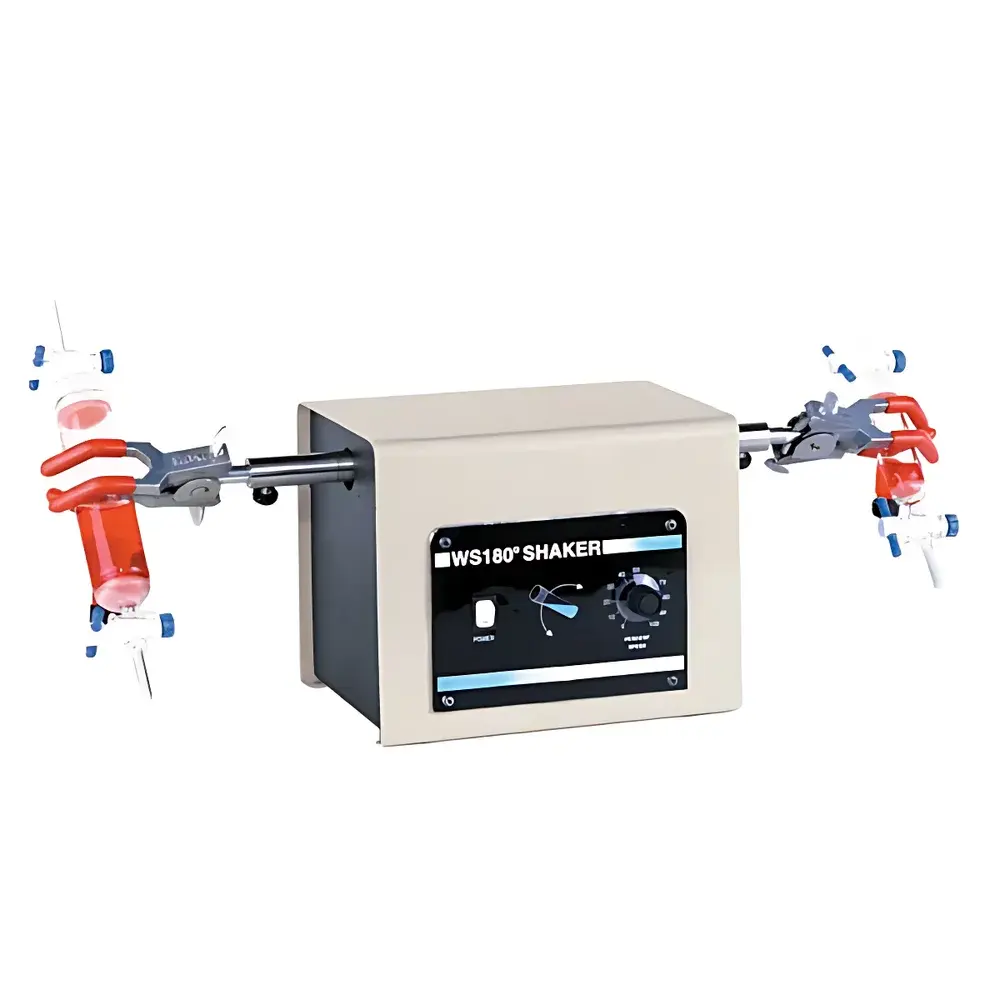
WIGGENS WS18024 180° Rocking Platform Shaker
| Brand | WIGGENS |
|---|---|
| Origin | Germany |
| Model | WS18024 |
| Oscillation Angle | 180° |
| Speed Range | 2–30 rpm |
| Load Capacity | ≤1.4 kg per side |
| Platform Dimensions | 355 mm (W) × 165 mm (D) |
| Height | 177 mm |
| Weight | 5.0 kg |
| Motor Type | DC filtered motor |
| Clamp Compatibility | Two large three-jaw clamps, accommodating vessels up to Ø88.9 mm × 254 mm length |
| Operating Environment | Ambient temperature only (non-temperature-controlled) |
| Power Supply | Standard AC input with internal DC conversion |
Overview
The WIGGENS WS18024 180° Rocking Platform Shaker is an engineered solution for gentle, reproducible horizontal rocking motion in life science and synthetic chemistry laboratories. Unlike orbital or vortex shakers, this device implements a precisely controlled 180° reciprocating rocking motion—mimicking manual agitation—to promote uniform suspension, solvation, and mixing of viscous, particulate, or aggregation-prone samples without shear-induced denaturation or foaming. Its core mechanism relies on a balanced eccentric drive system coupled with a low-inertia rocking platform, ensuring consistent angular displacement and minimal harmonic vibration transmission to adjacent instrumentation. Designed for compatibility with standard peptide synthesis vessels (e.g., 20–100 mL polypropylene or glass reaction tubes), cell culture flasks (T25–T75), and polymer dissolution bottles, the WS18024 supports protocols requiring extended incubation under static ambient conditions—including use inside refrigerated cold rooms (4 °C) or CO₂ incubators (up to 40 °C ambient, non-condensing), provided power cabling is routed externally per IEC 61010-1 safety guidelines.
Key Features
- True 180° rocking motion with adjustable speed (2–30 rpm) via calibrated analog dial—enabling fine-tuned optimization for delicate solid-phase peptide synthesis (SPPS) coupling steps.
- Dual independent three-jaw clamping system: each clamp accommodates cylindrical or conical vessels with diameters up to 88.9 mm and lengths up to 254 mm; compatible with threaded caps, side-arm flasks, and septum-sealed vials.
- Brushless DC motor with integrated filtering circuitry: delivers stable torque across the full speed range, supports uninterrupted operation for >72 hours, and eliminates electromagnetic interference with sensitive detection equipment (e.g., nearby spectrophotometers or microplate readers).
- Reinforced steel base with non-slip silicone feet: prevents lateral displacement during prolonged operation—even on polished stainless-steel lab benches or vibration-dampened optical tables.
- Compact footprint (355 × 165 × 177 mm) and low mass (5.0 kg): facilitates placement within constrained spaces such as reach-in incubators, cold rooms, or biosafety cabinets (subject to local airflow validation).
- No internal heating or cooling elements: operates strictly at ambient laboratory temperature—ideal for applications where thermal stability is critical and external environmental control is managed separately.
Sample Compatibility & Compliance
The WS18024 is routinely deployed in GLP-compliant peptide manufacturing workflows and academic proteomics labs handling resin-bound intermediates. It accommodates common SPPS vessel formats including ChemGlass PEG-PS resins, CEM Liberty Blue reaction vials, and custom borosilicate glass synthesis tubes. Vessel sealing integrity is preserved through mechanical clamping—not magnetic or vacuum-based fixation—ensuring compatibility with pressure-rated closures. The unit conforms to IEC 61010-1:2010 for electrical safety in laboratory equipment and carries CE marking for the European Economic Area. While not intrinsically rated for hazardous locations, its low-voltage DC motor architecture reduces spark risk in solvent-rich environments when used with appropriate ventilation.
Software & Data Management
The WS18024 is a standalone, analog-controlled instrument with no embedded microprocessor, USB interface, or digital logging capability. This design prioritizes operational simplicity, long-term reliability, and electromagnetic compatibility in electromagnetically noisy lab environments (e.g., adjacent to NMR spectrometers or RF-based cell culture systems). Speed settings are manually verified using a calibrated tachometer during IQ/OQ validation. For regulated environments requiring audit trails, users integrate the shaker into broader equipment qualification protocols—documenting speed verification, clamp load testing, and positional repeatability per ASTM E2500-13 and FDA guidance on legacy equipment management.
Applications
- Solid-phase peptide synthesis (SPPS): uniform resin swelling, deprotection washing, and coupling reagent delivery without bead fragmentation.
- Polymer dissolution studies: gradual hydration and dispersion of hydrophobic macromolecules (e.g., PLGA, chitosan) in organic/aqueous co-solvent systems.
- Antibody-antigen binding assays: gentle agitation during overnight incubations to enhance epitope accessibility while minimizing aggregate formation.
- Environmental sample extraction: leaching of trace metals from soil matrices in EPA Method 3050B-compatible vessels.
- Cell detachment support: pre-incubation of adherent monolayers in enzymatic dissociation buffers prior to trypsinization.
FAQ
Can the WS18024 be used inside a CO₂ incubator?
Yes—provided the incubator’s internal humidity remains below 80% RH and the power cord exits through a designated feedthrough port to avoid condensation on electrical components.
Is speed calibration traceable to NIST standards?
Speed verification requires external metrology; users may employ a handheld laser tachometer calibrated per ISO/IEC 17025 to validate rpm output at installation and annually thereafter.
Does the shaker support programmable ramping or timed cycles?
No—this is a fixed-speed analog device. Timed operation must be managed externally via laboratory timers or building automation systems.
What maintenance is required?
Annual inspection of clamp jaw integrity, platform bearing play, and motor housing dust accumulation; no lubrication or firmware updates are specified by the manufacturer.
Can it accommodate Erlenmeyer flasks with ground-glass joints?
Yes—the three-jaw clamps securely grip standard 125–500 mL Erlenmeyer flasks, including those with heavy-walled borosilicate construction and ground-glass necks, provided the flask diameter falls within the 25–88.9 mm range.
Related Products



