
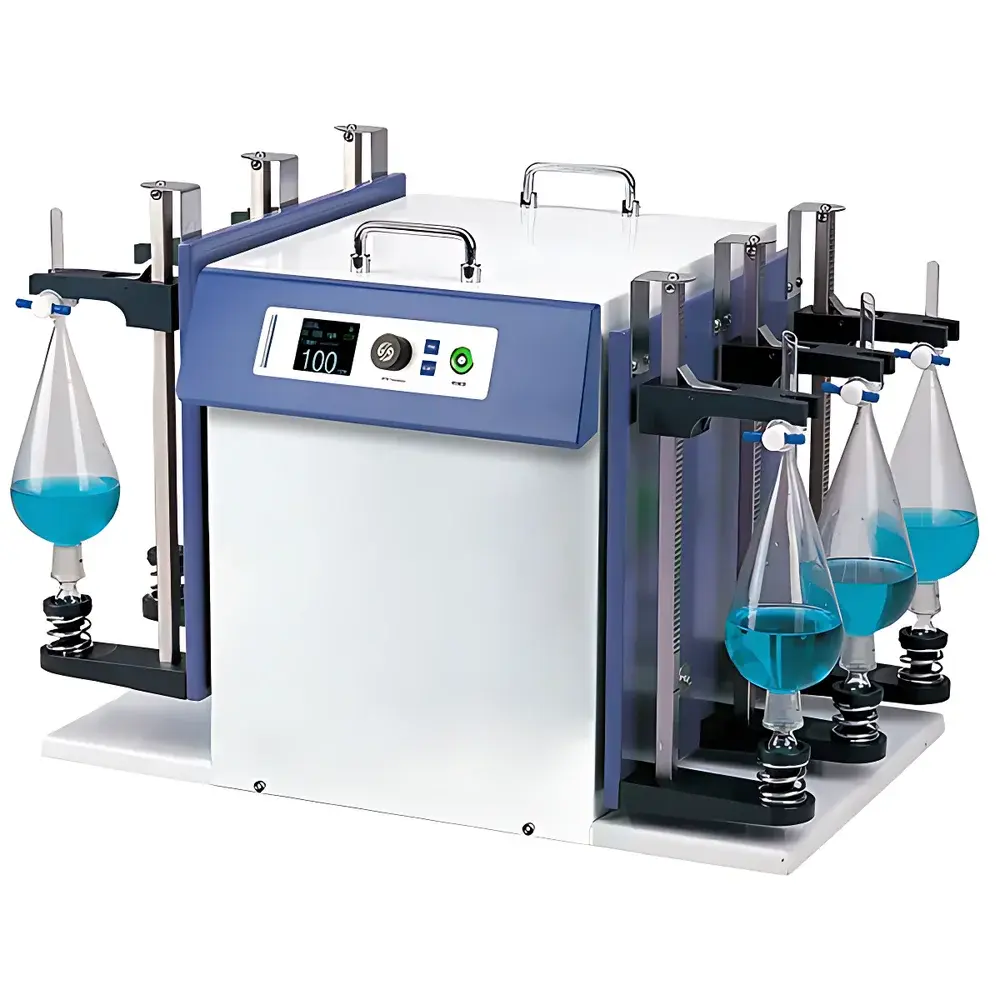
WIGGENS WS-1 Separatory Funnel Shaker
| Brand | WIGGENS |
|---|---|
| Origin | Germany |
| Manufacturer Type | Authorized Distributor |
| Product Category | Imported Instrument |
| Model | WS-1 |
| Instrument Type | Separatory Funnel Oscillating Shaker |
| Timer Range | 0–60 min or Continuous Operation |
| Oscillation Speed | 50–300 rpm |
| Stroke Amplitude | 40 mm |
| Temperature Range | Ambient to 60 °C |
| Number of Shaking Platforms | 6 (3 per side) |
| Load Capacity | ≤3 kg per side |
| Power Consumption | 90 W |
| Dimensions (W×D×H) | 445×730×505 mm |
| Net Weight | 77 kg |
| Voltage | 230 VAC, 50 Hz, 0.4 A |
| Order Code | 32012KA |
Overview
The WIGGENS WS-1 Separatory Funnel Shaker is an engineered laboratory instrument designed specifically for reproducible, high-efficiency solvent extraction workflows in analytical chemistry, pharmaceutical development, environmental testing, and clinical research laboratories. It operates on a vertical reciprocating motion principle—distinct from orbital or rocking mechanisms—delivering consistent linear displacement with fixed 40 mm stroke amplitude. This motion profile ensures vigorous yet controlled agitation of immiscible liquid phases within separatory funnels, promoting rapid interfacial contact and phase separation without excessive emulsification. Unlike general-purpose shakers, the WS-1 integrates structural rigidity, load-balanced dual-side platforms, and precision speed regulation to maintain mechanical stability under asymmetric loading conditions—a critical requirement when processing multiple funnel sizes simultaneously. Its ambient-to-60 °C operational envelope supports temperature-sensitive extractions, including those involving volatile organic solvents or thermolabile analytes.
Key Features
- Vertical reciprocating oscillation mode with ±1 rpm speed accuracy across the full 50–300 rpm range, enabling method transferability between labs and compliance with standardized extraction protocols.
- Dual independent shaking banks—three platforms per side—each rated for up to 3 kg static load, allowing simultaneous processing of up to six 1 L separatory funnels (or mixed configurations of smaller vessels).
- Height-adjustable universal clamping system compatible with conical, pear-shaped, and cylindrical funnels ranging from 50 mL to 1000 mL capacity; clamp geometry accommodates both standard ground-glass joints and threaded necks.
- Acoustic end-of-cycle alert integrated into the control circuitry, providing unambiguous notification without requiring visual monitoring—essential for unattended overnight extractions.
- Robust steel frame construction with vibration-dampening base feet and reinforced platform mounts, eliminating lateral drift or resonance during extended operation at high speeds.
- Compact footprint (445 × 730 mm) optimized for benchtop integration in regulated environments where spatial constraints and workflow efficiency are prioritized.
Sample Compatibility & Compliance
The WS-1 accepts standard laboratory glassware including ASTM E180–22 compliant separatory funnels (e.g., 125 mL, 250 mL, 500 mL, and 1000 mL), as well as custom-designed extraction vessels with compatible neck diameters (14/22, 19/22, 24/29). Its mechanical design conforms to IEC 61010-1:2010 safety standards for electrical equipment used in laboratory settings. While the unit itself does not include active temperature control beyond ambient heating capability, its thermal stability up to 60 °C permits integration into fume hood–based workflows where solvent volatility must be managed. The device supports GLP-compliant documentation through external data loggers interfaced via analog output (0–10 V), and its repeatable motion parameters align with method validation requirements outlined in USP Analytical Instrument Qualification.
Software & Data Management
The WS-1 is a stand-alone electromechanical instrument with no embedded microprocessor or digital interface. All operational parameters—including speed setpoint, timer duration (0–60 min or continuous), and activation/deactivation—are controlled manually via calibrated rotary dials and tactile push-button switches. This analog architecture eliminates firmware dependencies, reduces cybersecurity exposure, and ensures long-term operational continuity in environments where software obsolescence or IT policy restrictions limit connected instrumentation. For traceability, users may pair the shaker with third-party USB data loggers (e.g., HOBO UX120 or Testo 176 T4) to record runtime, elapsed time, and ambient temperature. Calibration certificates for speed and timing accuracy can be generated using NIST-traceable tachometers and stopwatch references per ISO/IEC 17025 guidelines.
Applications
- Solvent extraction of heavy metals (e.g., Pb, Cd, Hg) from aqueous environmental samples per EPA Method 3015A and ISO 11885.
- Organic contaminant isolation (e.g., PAHs, PCBs, pesticides) from soil leachates and wastewater matrices using dichloromethane, ethyl acetate, or hexane-based systems.
- Pharmaceutical active ingredient recovery from fermentation broths or synthetic reaction mixtures prior to HPLC analysis.
- Clinical toxicology sample preparation, including urinary drug metabolite extraction and blood alcohol quantification workflows.
- Standardized partition coefficient (log P) determination in early-stage drug discovery programs following OECD Guideline 107.
FAQ
What types of separatory funnels are supported by the WS-1?
The shaker accommodates standard borosilicate glass funnels with neck diameters of 14/22, 19/22, and 24/29, including both pear-shaped and cylindrical variants up to 1000 mL volume.
Can the WS-1 operate inside a fume hood?
Yes—the unit’s 230 VAC power input, low electromagnetic emissions, and absence of internal cooling fans make it suitable for installation within ventilated enclosures, provided adequate clearance for heat dissipation is maintained.
Is speed calibration traceable to national standards?
Speed accuracy (±1 rpm at 100 rpm) can be verified using a NIST-traceable optical tachometer; WIGGENS provides factory calibration documentation upon request, compliant with ISO/IEC 17025 Annex A.3.
Does the WS-1 meet FDA 21 CFR Part 11 requirements?
As a non-computerized, manually operated device, the WS-1 falls outside the scope of electronic record and signature regulations; however, its mechanical repeatability supports ALCOA+ data integrity principles when paired with paper-based or validated electronic lab notebook (ELN) entries.
How is maintenance performed on the WS-1?
The unit contains no user-serviceable parts beyond periodic cleaning of clamps and platforms; the brushless motor drive requires no lubrication and is rated for >20,000 hours of continuous operation under nominal load conditions.
Related Products





